Kinematics - NEET Physics Questions
Question 21: moderate

A particle moving with a velocity equal to 0.4 m/s is subjected to an uniform acceleration of 0.15 m/s² for 2 sec in a direction at right angles to its initial direction of motion. The resultant

1. 0.7 m/s
2. 0.5 m/s
3. 0.1 m/s
4. None of these
View Answer

To find the resultant velocity using unit vectors:

- Initial velocity: \( \vec{u} = 0.4 \, \hat{i} \, \text{m/s} \)
- Acceleration: \( \vec{a} = 0.15 \, \hat{j} \, \text{m/s}^2 \)
- Time: \( t = 2 \, \text{seconds} \)

Using the equation of motion \( \vec{v} = \vec{u} + \vec{a}t \):

- In the \( x \)-direction: \( v_x = 0.4 \, \text{m/s} \)
- In the \( y \)-direction: \( v_y = 0 + 0.15 \times 2 = 0.3 \, \text{m/s} \)

The resultant velocity is:

\[
|\vec{v}| = \sqrt{v_x^2 + v_y^2} = \sqrt{(0.4)^2 + (0.3)^2} = \sqrt{0.25} = 0.5 \, \text{m/s}
\]

Thus, the resultant velocity is 0.5 m/s
Question 22: moderate

From the top of a tower a ball is thrown vertically upwards. When the ball reaches h below the top of tower, it’s speed is double of what it was at height h above the tower. Find maximum height attained by ball from top of tower?

1. 4h/3
2. 3h/4
3. 5h/3
4. 5h/4
View Answer

Let the initial velocity of the ball be \( u \), and let \( v \) be the velocity of the ball at a distance \( h \) above the tower. Using the equation of motion:

\[
v^2 = u^2 - 2gh
\]

At a distance \( h \) below the tower, the velocity is doubled, so:

\[
(2v)^2 = u^2 + 2gh
\]

Simplifying these:

\[
4v^2 = u^2 + 2gh
\]

Substitute \( v^2 = u^2 - 2gh \) from the first equation:

\[
4(u^2 - 2gh) = u^2 + 2gh
\]

Expanding and solving:

\[
4u^2 - 8gh = u^2 + 2gh
\]

\[
3u^2 = 10gh
\]

\[
u^2 = \frac{10gh}{3}
\]

The maximum height \( H \) from the top of the tower is given by:

\[
H = \frac{u^2}{2g} = \frac{10gh}{6g} = \frac{5h}{3}
\]

Thus, the maximum height attained by the ball from the top of the tower is \( \frac{5h}{3} \).

Question 23: moderate

A stone dropped from the top of a tower travels 5/9th of the height of tower during the last second of fall. Height of the tower is : (Take g = 10 m/s²)

1. 52 m
2. 36 m
3. 45 m
4. 78 m
View Answer

From Galileo's ratio of odd number distances travelled in consecutive seconds are in the order of 1:3:5:7... Here distance travelled in 3rd second is 5/9th of total distance total time of flight is 3 second.

\[ s= \frac{1}{2}gt^{2}= \frac{1}{2}\times 10\times 3^{2}= 45 m \]

Question 24: moderate

An object is dropped from the top of a tower. It travels a distance ‘x’ in the first second of its motion and a distance ‘7x’ in the last second. Height of the tower is :

1. 60 m
2. 70 m
3. 80 m
4. 90 m
View Answer

From Galileo's ratio of odd numbers distances travelled in consecutive seconds are in the order of 1:3:5:7

As distance in last second is is 7x. total distance = x+3x+5x+7x= 16x = 16×5= 80 m 

Question 25: moderate

A stone is dropped from the top of a tower of height h. After 1 s another stone is dropped from the balcony 20 m below the top. Both reach the bottom simultaneously. What is the value of h? Take g = 10 ms–²

1. 3125 m
2. 312.5 m
3. 31.25 m
4. 25.31 m
View Answer

\[ \frac{1}{2}gt^{2} - \frac{1}{2}g(t-1)^{2} = 20 \]

solving we get, t =2.5 sec.

\[ h= \frac{1}{2}g(2.5)^{2}= 31.25 m \]

Question 26: moderate

The x and y co-ordinates of a particle at any time t are given by :
x = 7t + 4t² and y = 5t
where x and y are in m and t in s. The acceleration of the particle at 5 s is :

1. zero
2. 8 m/s²
3. 20 m/s²
4. 40 m/s²
View Answer

To find the acceleration, we need to compute the second derivatives of

xx

and

yy

with respect to

tt

.


  1. x=7t+4t2x = 7t + 4t^2


    • First derivative (velocity in x-direction):
      dxdt=7+8t
       
    • Second derivative (acceleration in x-direction):
      d2xdt2=8m/s2\frac{d^2x}{dt^2} = 8 \, \text{m/s}^2


  2. y=5ty = 5t
     

    • First derivative (velocity in y-direction):
      dydt=5
       
    • Second derivative (acceleration in y-direction):
      d2ydt2=0m/s2
       

Now, the total acceleration is given by:


a=(ax)2+(ay)2=(8)2+(0)2=8m/s2


Thus, the acceleration of the particle at

t=5st = 5 \, \text{s}

is

8m/s28 \, \text{m/s}^2


Question 27: moderate

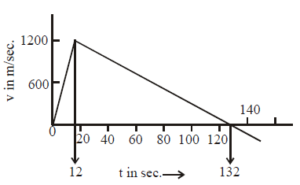
A rocket is fired upwards. Its velocity versus time graph is shown in figure. The maximum height reached by the rocket is :

1. 7.1 km
2. 79.2 km
3. 72 km
4. Infinite
View Answer
Question 28: moderate

The maximum height reached by projectile is 4 m. The horizontal range is 12m. The velocity of projection in ms–¹ is : (g is acceleration due to gravity) :

1. \[5\sqrt{g/2}\]
2. \[3\sqrt{g/2}\]
3. \[1/3\sqrt{g/2}\]
4. \[1/5\sqrt{g/2}\]
View Answer

We Know that,

\[ \frac{R}{H}=\frac{4}{tan\theta}\]

\[ tan \theta = 4/3 \]

\[ H = \frac{u^{2}sin^{2}\theta}{2g} \]

Solving we get

\[ u= 5\sqrt{g/2}\]

Question 29: moderate

The equation of motion of a projectile is \[y=12x-\frac{3}{4}x^{2}\] . What is the range of the projectile?

1. 18 m
2. 16 m
3. 12 m
4. 21.6 m
View Answer

The equation of motion of the projectile is given as:

\[
y = 12x - \frac{3}{4}x^2
\]

At the range, \( y = 0 \). To find the range, set \( y = 0 \) and solve for \( x \):

\[
0 = 12x - \frac{3}{4}x^2
\]

Multiply the entire equation by 4 to eliminate the fraction:

\[
0 = 48x - 3x^2
\]

Factor the equation:

\[
0 = x(48 - 3x)
\]

This gives two solutions:

\[
x = 0 \quad \text{or} \quad 48 - 3x = 0
\]

Solving for \( x \):

\[
x = \frac{48}{3} = 16
\]

Question 30: moderate

A particle is projected at 60° to the horizontal with a kinetic energy K. The kinetic energy at the highest point is :

1. K/2
2. K
3. Zero
4. K/4
View Answer

At the highest point of its trajectory, the vertical component of the velocity becomes zero, while the horizontal component remains unchanged.

Initial kinetic energy \( K \) is given by:

\[
K = \frac{1}{2} m u^2
\]

At the highest point, only the horizontal component of the velocity \( u \cos 60^\circ \) remains. Therefore, the kinetic energy at the highest point is due to this horizontal velocity:

\[
K_{\text{highest}} = \frac{1}{2} m (u \cos 60^\circ)^2
\]

Since \( \cos 60^\circ = \frac{1}{2} \):

\[
K_{\text{highest}} = \frac{1}{2} m \left(\frac{u}{2}\right)^2 = \frac{1}{4} \times \frac{1}{2} m u^2 = \frac{K}{2}
\]

Thus, the kinetic energy at the highest point is \( \frac{K}{2} \).