Relative Motion in One Dimension - NEET Physics Questions
← Back to Kinematics

Relative Motion in One Dimension

Question 1:

A bus begins to move with an acceleration of 1 ms–². A man who is 48 m behind the bus starts running at 10 ms–¹ to catch the bus. The man will be able to catch the bus after

1. 6 s
2. 5 s
3. 8 s
4. 7 s
View Answer

Using relative speed, let’s re-calculate with the correct setup:

1. Acceleration of the bus: \( a = 1 \, \text{m/s}^2 \)

2. Initial distance behind the bus: \( d = 48 \, \text{m} \)

3. Speed of the man: \( v_m = 10 \, \text{m/s} \)

4. The equation of motion for the bus after \( t \) seconds:
\[
d_b = \frac{1}{2} a t^2 = \frac{1}{2} \cdot 1 \cdot t^2 = \frac{1}{2} t^2
\]

5. Distance traveled by the man:
\[
d_m = v_m \cdot t = 10t
\]

6. Setting the distances equal considering the man starts 48 m behind:
\[
10t = \frac{1}{2} t^2 + 48
\]
\[
\frac{1}{2} t^2 - 10t + 48 = 0
\]

7. Multiplying by 2:
\[
t^2 - 20t + 96 = 0
\]

8. Using the quadratic formula:
\[
t = \frac{20 \pm \sqrt{20^2 - 4 \cdot 96}}{2}
\]
\[
t = \frac{20 \pm \sqrt{400 - 384}}{2}
\]
\[
t = \frac{20 \pm 4}{2}
\]
\[
t = 12 \, \text{s} \quad \text{or} \quad t = 8 \, \text{s}
\]

 the man will catch the bus is 8 seconds. 
Question 2:

A 100 m long train at 15 m/s overtakes a man running on the platform in the same direction in 10s. How long the train will take to cross the man if he was running in the opposite direction ?

1. 7 s
2. 5 s
3. 3 s
4. 1 s
View Answer

1. Relative Speed (Same Direction):
\[
\text{Speed of Train} = 15 \, \text{m/s}
\]
\[
\text{Time to Overtake} = 10 \, \text{s}
\]
\[
\text{Distance} = \text{Length of Train} = 100 \, \text{m}
\]
\[
\text{Relative Speed} = \frac{\text{Distance}}{\text{Time}} = \frac{100}{10} = 10 \, \text{m/s}
\]
\[
\text{Speed of Man} = 15 - 10 = 5 \, \text{m/s}
\]

2. Relative Speed (Opposite Direction):
\[
\text{Relative Speed} = 15 + 5 = 20 \, \text{m/s}
\]

3. Time to Cross Man (Opposite Direction):
\[
\text{Time} = \frac{\text{Distance}}{\text{Relative Speed}} = \frac{100}{20} = 5 \, \text{s}
\]

Thus, the train will take 5 seconds to cross the man if he is running in the opposite direction.

Question 3:

Two cars are moving along a straight line in opposite direction with the same speed 10 m/s. The relative velocity of two cars w.r.t. each other is:

1. 20 m/s
2. 30 m/s
3. zero
4. none of these
View Answer

When objects move in opposite directions relative velocity= v1+ v2= 20 m/s

Question 4:

Two objects A and B are moving with speeds 10 m/s  and 20 m/s respectively in the same direction. The relative velocity of A w.r.t. B is

1. 30 m/s
2. 10 m/s
3. - 10 m/s
4. 50 m/s
View Answer

When moving in same direction relative velocity = V 1 -V 2= 10-20 = -10 m/s

Question 5:

Two objects A and B are moving with speeds 10 m/s and 20 m/s respectively in the same direction. The relative velocity of B w.r.t. A is

1. 30 m/s
2. 10 m/s
3. - 10 m/s
4. 50 m/s
View Answer

Velocity of A w.r.t B = V A - V B
Velocity of B w.r.t A = V B - V A

Question 6:

The relative velocity of two objects A and B is 10 m/s. If the velocity of object A is 40 m/s then the velocity with which B is moving is (assume both objects are moving in same direction)

1. 10 m/s
2. 20 m/s
3. 30 m/s
4. 40 m/s
View Answer

Relative Velocity = V A - V B
10= 40 - V B
V B = 30 m/s

* Is 50 m/s a possible answer ?

Question 7:

Two trains A and B are moving in a straight line in the same direction with speeds of 54 km/h and 15 m/s respectively. The relative velocity of one train w.r.t. other is

1. 69 km/hr
2. 69 m/s
3. 39 m/s
4. Zero
View Answer

As, 54 km/hr = 15 m/s both have same velocity in same direction their relative speed/velocity is zero

Question 8:

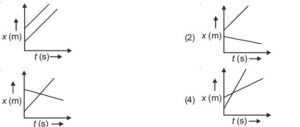
Two objects A and B are moving in same direction with same speed of 20 m/s each then, which of the following position-time graphs correctly represents two moving objects A and B

neet question in 1-d motion

1. 1
2. 2
3. 3
4. 4
View Answer

As both A and B have same velocity their relative speed is zero. so both have same slope in position time graph.

Question 9:

A boat takes two hours to travel 4 km down and 4 km up the river when the water is still. How much time will the boat take to make the same trip when the river starts flowing at 2 kmph?

1. 2 hour
2. 2 hour 40 minute
3. 3 hour
4. 3 hour 40 minute
View Answer

Let the boat's speed in still water be x kmph. Given

8x=2\frac{8}{x} = 2

, we get x = 4 kmph.

With a 2 kmph current:

  • Downstream speed = 6 kmph, time =
    46=23\frac{4}{6} = \frac{2}{3}
     

    hours

  • Upstream speed = 2 kmph, time =
    42=2\frac{4}{2} = 2
     

    hours

Total time =

2232 \frac{2}{3}

hours or 2 hours 40 minutes.

Question 10:

A taxi leaves the station X for station Y every 10 minutes. Simultaneously, a taxi leaves the station Y also for station X every 10 minutes. The taxis move at the same constant speed and go from X to Y or vice-versa in 2 hours. How many taxis coming from the other side will each taxi meet enroute from Y to X ?

1. 10
2. 11
3. 12
4. 23
View Answer

Each taxi takes 2 hours, and taxis leave every 10 minutes.

  • Taxis already on the route from X to Y:

    12010

  • Taxis that start after from X to Y:

    12010

  • Exclude the simultaneously departing taxi:

    12+11= 23 

Final Answer: 23 taxis.