Kinematics - NEET Physics Questions
Question 41: moderate

An object is dropped from the top of a tower. It travels a distance ‘x’ in the first second of its motion and a distance ‘7x’ in the last second. Height of the tower is :

1. 60 m
2. 70 m
3. 80 m
4. 90 m
View Answer

From Galileo's ratio of odd numbers distances travelled in consecutive seconds are in the order of 1:3:5:7

As distance in last second is is 7x. total distance = x+3x+5x+7x= 16x = 16×5= 80 m 
Question 42: moderate

A stone is dropped from the top of a tower of height h. After 1 s another stone is dropped from the balcony 20 m below the top. Both reach the bottom simultaneously. What is the value of h? Take g = 10 ms–²

1. 3125 m
2. 312.5 m
3. 31.25 m
4. 25.31 m
View Answer

\[ \frac{1}{2}gt^{2} - \frac{1}{2}g(t-1)^{2} = 20 \]

solving we get, t =2.5 sec.

\[ h= \frac{1}{2}g(2.5)^{2}= 31.25 m \]

Question 43: difficult

A particle is thrown upwards from ground. It experience a constant air resistance force which can produce a retardation of 2 m/s². The ratio of time of ascent to the time of descent is : [g = 10 m/s²]

1. 1 : 1
2. \[\sqrt{\frac{2}{3}}\]
3. 2/3
4. \[\sqrt{\frac{3}{2}}\]
View Answer

Effective accelerations:
- Ascent: \( a_{\text{eff}} = g + a = 10 + 2 = 12 \, \text{m/s}^2 \)
- Descent: \( a'_{\text{eff}} = g - a = 10 - 2 = 8 \, \text{m/s}^2 \)

Ratio of times:
\[
\frac{t_a}{t_d} = \sqrt{\frac{a'_{\text{eff}}}{a_{\text{eff}}}} = \sqrt{\frac{8}{12}} = \sqrt{\frac{2}{3}}
\]

The ratio of time of ascent to time of descent is √(2/3).

Question 44: moderate

The x and y co-ordinates of a particle at any time t are given by :
x = 7t + 4t² and y = 5t
where x and y are in m and t in s. The acceleration of the particle at 5 s is :

1. zero
2. 8 m/s²
3. 20 m/s²
4. 40 m/s²
View Answer

To find the acceleration, we need to compute the second derivatives of

xx

and

yy

with respect to

tt

.


  1. x=7t+4t2x = 7t + 4t^2


    • First derivative (velocity in x-direction):
      dxdt=7+8t
       
    • Second derivative (acceleration in x-direction):
      d2xdt2=8m/s2\frac{d^2x}{dt^2} = 8 \, \text{m/s}^2


  2. y=5ty = 5t
     

    • First derivative (velocity in y-direction):
      dydt=5
       
    • Second derivative (acceleration in y-direction):
      d2ydt2=0m/s2
       

Now, the total acceleration is given by:


a=(ax)2+(ay)2=(8)2+(0)2=8m/s2


Thus, the acceleration of the particle at

t=5st = 5 \, \text{s}

is

8m/s28 \, \text{m/s}^2


Question 45: easy

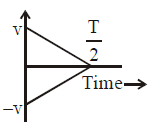
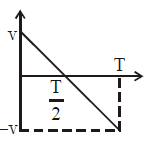
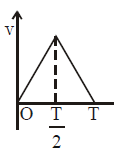
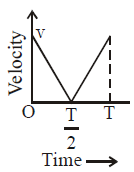
A particle is thrown vertically upwards with a velocity ν. It returns to the ground in time T. Which of the following graphs correctly represents the motion?

1.
2.
3.
4.
View Answer

Graph of velocity time graph represents acceleration. During the entire journey acceleration is -g. so slope is negative.

Question 46: moderate

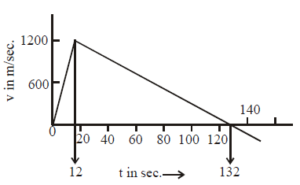
A rocket is fired upwards. Its velocity versus time graph is shown in figure. The maximum height reached by the rocket is :

1. 7.1 km
2. 79.2 km
3. 72 km
4. Infinite
View Answer
Question 47: difficult

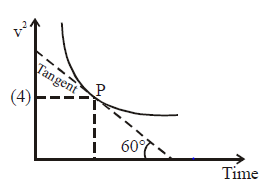
Particle moving along x-axis with variable velocity its (v²) vs. time graph is as shown in the following figure, then the acceleration of particle at point P is :

1. √3 m/s²
2. √3/4 m/s²
3. √3/2 m/s²
4. 1/√3 m/s²
View Answer
Question 48: moderate

The maximum height reached by projectile is 4 m. The horizontal range is 12m. The velocity of projection in ms–¹ is : (g is acceleration due to gravity) :

1. \[5\sqrt{g/2}\]
2. \[3\sqrt{g/2}\]
3. \[1/3\sqrt{g/2}\]
4. \[1/5\sqrt{g/2}\]
View Answer

We Know that,

\[ \frac{R}{H}=\frac{4}{tan\theta}\]

\[ tan \theta = 4/3 \]

\[ H = \frac{u^{2}sin^{2}\theta}{2g} \]

Solving we get

\[ u= 5\sqrt{g/2}\]

Question 49: moderate

The equation of motion of a projectile is \[y=12x-\frac{3}{4}x^{2}\] . What is the range of the projectile?

1. 18 m
2. 16 m
3. 12 m
4. 21.6 m
View Answer

The equation of motion of the projectile is given as:

\[
y = 12x - \frac{3}{4}x^2
\]

At the range, \( y = 0 \). To find the range, set \( y = 0 \) and solve for \( x \):

\[
0 = 12x - \frac{3}{4}x^2
\]

Multiply the entire equation by 4 to eliminate the fraction:

\[
0 = 48x - 3x^2
\]

Factor the equation:

\[
0 = x(48 - 3x)
\]

This gives two solutions:

\[
x = 0 \quad \text{or} \quad 48 - 3x = 0
\]

Solving for \( x \):

\[
x = \frac{48}{3} = 16
\]

Question 50: moderate

A particle is projected at 60° to the horizontal with a kinetic energy K. The kinetic energy at the highest point is :

1. K/2
2. K
3. Zero
4. K/4
View Answer

At the highest point of its trajectory, the vertical component of the velocity becomes zero, while the horizontal component remains unchanged.

Initial kinetic energy \( K \) is given by:

\[
K = \frac{1}{2} m u^2
\]

At the highest point, only the horizontal component of the velocity \( u \cos 60^\circ \) remains. Therefore, the kinetic energy at the highest point is due to this horizontal velocity:

\[
K_{\text{highest}} = \frac{1}{2} m (u \cos 60^\circ)^2
\]

Since \( \cos 60^\circ = \frac{1}{2} \):

\[
K_{\text{highest}} = \frac{1}{2} m \left(\frac{u}{2}\right)^2 = \frac{1}{4} \times \frac{1}{2} m u^2 = \frac{K}{2}
\]

Thus, the kinetic energy at the highest point is \( \frac{K}{2} \).