Kinematics - NEET Physics Questions
Question 21: difficult

A particle has an initial velocity \[3\hat{i}+4\hat{j}\] and an acceleration of \[0.4\hat{i}+0.3\hat{j}\] . Its speed after 10 s is

1. 10 unit
2. 7 unit
3. 7√2 unit
4. 8.5 unit
View Answer

Given:

- Initial velocity: \(\mathbf{u} = 3\hat{i} + 4\hat{j}\)
- Acceleration: \(\mathbf{a} = 0.4\hat{i} + 0.3\hat{j}\)

Calculate final velocity after 10 s:

\[
\mathbf{v} = \mathbf{u} + \mathbf{a}t = (3\hat{i} + 4\hat{j}) + (0.4\hat{i} + 0.3\hat{j}) \cdot 10
\]

\[
\mathbf{v} = 3\hat{i} + 4\hat{j} + (4\hat{i} + 3\hat{j}) = (3 + 4)\hat{i} + (4 + 3)\hat{j} = 7\hat{i} + 7\hat{j}
\]

Calculate speed:

\[
\text{Speed} = |\mathbf{v}| = \sqrt{(7)^2 + (7)^2} = \sqrt{49 + 49} = \sqrt{98} = 7\sqrt{2} \, \text{m/s}
\]
Question 22: moderate

The position of a particle x (in meters) at a time t second is given by the relation \[r=\left( 3t\hat{i}-t^{2}\hat{j}+4\hat{k} \right)\] . Calculate the magnitude of velocity of the particular after 5 s.

1. 3.55 m/s
2. 5.03 m/s
3. 8.75 m/s
4. 10.44 m/s
View Answer

Given the position vector:

\[
\mathbf{r} = (3t)\hat{i} - (t^2)\hat{j} + 4\hat{k}
\]

To find the velocity, differentiate the position vector with respect to time \(t\):

\[
\mathbf{v} = \frac{d\mathbf{r}}{dt} = \left( \frac{d}{dt}(3t) \hat{i} + \frac{d}{dt}(-t^2) \hat{j} + \frac{d}{dt}(4) \hat{k} \right)
\]

Calculating the derivatives:

\[
\mathbf{v} = (3)\hat{i} - (2t)\hat{j} + (0)\hat{k} = 3\hat{i} - 2t\hat{j}
\]

Now, substitute \(t = 5\) s:

\[
\mathbf{v}(5) = 3\hat{i} - 2(5)\hat{j} = 3\hat{i} - 10\hat{j}
\]

Calculate the magnitude of the velocity:

\[
|\mathbf{v}| = \sqrt{(3)^2 + (-10)^2} = \sqrt{9 + 100} = \sqrt{109}
\]

Thus, the magnitude of velocity after 5 seconds is: 10.44 m/s


Question 23: difficult

A point initially at rest moves along x-axis. Its acceleration varies with time as a = (6t + 5) ms–². If it starts from origin, the distance covered in 2 s is

1. 20 m
2. 18 m
3. 16 m
4. 25 m
View Answer

Given the acceleration:

\[
a = 6t + 5 \, \text{m/s}^2
\]

1. Integrate acceleration to find velocity \(v\):

\[
v = \int a \, dt = \int (6t + 5) \, dt = 3t^2 + 5t + C
\]

Since it starts from rest, \(C = 0\):

\[
v = 3t^2 + 5t
\]

2. Integrate velocity to find displacement \(x\):

\[
x = \int v \, dt = \int (3t^2 + 5t) \, dt = t^3 + \frac{5}{2}t^2 + D
\]

Starting from the origin gives \(D = 0\):

\[
x = t^3 + \frac{5}{2}t^2
\]

3. Calculate displacement at \(t = 2\) s:

\[
x(2) = (2)^3 + \frac{5}{2}(2)^2 = 8 + \frac{5}{2} \cdot 4 = 8 + 10 = 18 \, \text{m}
\]

Thus, the distance covered in 2 seconds is: 18 m

Question 24: moderate

The velocity of particle is \[v=v_{0}+gt+ft^{2}\]. If its position is x = 0 at t = 0, then its displacement after unit time (t = 1) is

1. \[v_{0}+2g+3f\]
2. \[v_{0}+g/2+f/3\]
3. \[v_{0}+g+f\]
4. \[v_{0}+g/2+f\]
View Answer

Given the velocity function:

\[
v = v_0 + gt + ft^2
\]

We can find displacement by integrating the velocity function with respect to time. The displacement \(x(t)\) is the integral of velocity:

\[
x(t) = \int (v_0 + gt + ft^2) \, dt
\]

Integrating:

\[
x(t) = v_0 t + \frac{gt^2}{2} + \frac{ft^3}{3} + C
\]

Since \(x = 0\) at \(t = 0\), we know \(C = 0\). Therefore, the position function is:

\[
x(t) = v_0 t + \frac{gt^2}{2} + \frac{ft^3}{3}
\]

Now, for \(t = 1\):

\[
x(1) = v_0(1) + \frac{g(1)^2}{2} + \frac{f(1)^3}{3}
\]

Simplifying:

\[
x(1) = v_0 + \frac{g}{2} + \frac{f}{3}
\]

Thus, the displacement after unit time \(t = 1\) is:

\[
x(1) = v_0 + \frac{g}{2} + \frac{f}{3}
\]

Question 25: moderate

A particle located at x = 0 at time t = 0, starts moving along the positive x-direction with a velocity v that varies as v = α√x . The displacement of the particle varies with time as

1.
2. t
3. \[t^{1/2}\]
4.
View Answer

Given that the velocity \(v = \alpha \sqrt{x}\), we need to find the displacement \(x\) as a function of time \(t\).

1. \( v = \frac{dx}{dt} = \alpha \sqrt{x} \)

2. Rearranging and separating variables:
\[
\frac{dx}{\sqrt{x}} = \alpha \, dt
\]

3. Integrate both sides:
\[
2\sqrt{x} = \alpha t
\]

4. Solving for (x):
\[ x = \frac{\alpha^2 t^2}{4} \]

Thus, the displacement of the particle varies with time as \(x = \frac{\alpha^2 t^2}{4}\).

Question 26: difficult

If the velocity of a particle is given by \[v=(180-16x)^{1/2} ms^{-1}\], then its acceleration will be

1. zero
2. \[16 ms^{-2}\]
3. \[-8 ms^{-2}\]
4. \[4 ms^{-2}\]
View Answer

Given the velocity:


v=18016xm/s


To find the acceleration, use the chain rule:


a=dvdt=dvdxdxdt=dvdxv


Differentiate

vv

with respect to

xx

:


dvdx=818016x\frac{dv}{dx} = \frac{-8}{\sqrt{180 - 16x}}

Now, substitute

v=18016xv = \sqrt{180 - 16x}


a=8m/s2


Thus, the acceleration is

a=8m/s2a = -8 \, \text{m/s}^2


Question 27: easy

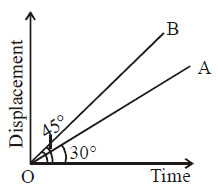
The displacement-time graph of two moving particles A and B respectively make angles of 30° and 45° with the x-axis respectively. The ratio of their velocities is

1. 1 : √3
2. 1 : 2
3. 1 : 1
4. √3 : 2
View Answer

Slope of displacement time graph represents velocity.

VA= tan 30 0
VB= tan 45 0

So, VA/VB=tan 30 0/tan 45 0= 1/√3

Question 28: easy

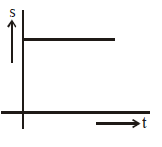
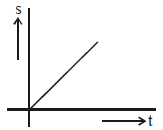
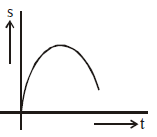
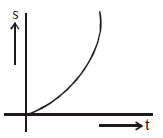
A body is travelling in a straight line with a uniformly increasing speed. Which one of the plot represents the change in distance (s) travelled with time (t)?

1.
2.
3.
4.
View Answer

\[ s= \frac{1}{2}at^{2}\]

As s is proportional to square of t. s-t graph is a parabola.

Question 29: easy

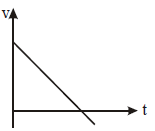
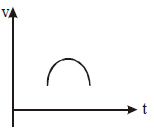
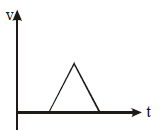
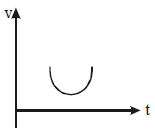
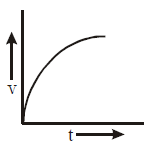
A particle is thrown upwards, then correct v-t graph will be

1.
2.
3.
4.
View Answer

Slope of v-t graph represent acceleration. when object is thrown upward its acceleration is -g for the entire journey. So, slope is -g.

Question 30: easy

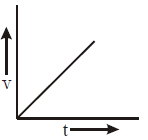
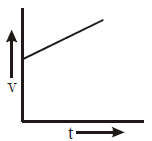
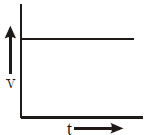
A body starts from rest and moves with uniform acceleration. Which of the following graphs represents it motion?

1.
2.
3.
4.
View Answer

\[ v = u + at ; as, u = 0 ; v = at\]

As, v is proportional to t ; graph of v-t is a straight line.