Question 31:
easy
If the figure below represents a parabola, identify the physical quantities representing Y and X for constant acceleration
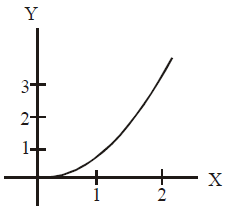
If the figure below represents a parabola, identify the physical quantities representing Y and X for constant acceleration
The v-t graph for a particle is as shown. The distance travelled in the first four second is
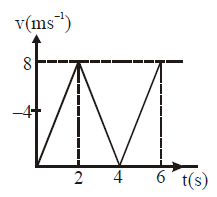
Area bounded by v-t graph represents displacement. Here.
Area = (1/2)×4×8= 16
So, Distance travelled is 16 m.
A particle starts form rest. Its acceleration (a) versus time (t) is as shown in the figure. The maximum speed of the particle will be
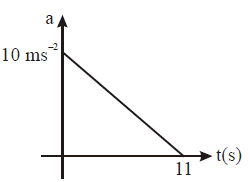
Area of acceleration time graph represents change in velocity. As acceleration is always positive speed is always increasing.
Area = (1/2)× 10× 11 = 55
So, max. speed of 55 m/s
A bus begins to move with an acceleration of 1 ms–². A man who is 48 m behind the bus starts running at 10 ms–¹ to catch the bus. The man will be able to catch the bus after
Using relative speed, let’s re-calculate with the correct setup:
1. Acceleration of the bus: \( a = 1 \, \text{m/s}^2 \)
2. Initial distance behind the bus: \( d = 48 \, \text{m} \)
3. Speed of the man: \( v_m = 10 \, \text{m/s} \)
4. The equation of motion for the bus after \( t \) seconds:
\[
d_b = \frac{1}{2} a t^2 = \frac{1}{2} \cdot 1 \cdot t^2 = \frac{1}{2} t^2
\]
5. Distance traveled by the man:
\[
d_m = v_m \cdot t = 10t
\]
6. Setting the distances equal considering the man starts 48 m behind:
\[
10t = \frac{1}{2} t^2 + 48
\]
\[
\frac{1}{2} t^2 - 10t + 48 = 0
\]
7. Multiplying by 2:
\[
t^2 - 20t + 96 = 0
\]
8. Using the quadratic formula:
\[
t = \frac{20 \pm \sqrt{20^2 - 4 \cdot 96}}{2}
\]
\[
t = \frac{20 \pm \sqrt{400 - 384}}{2}
\]
\[
t = \frac{20 \pm 4}{2}
\]
\[
t = 12 \, \text{s} \quad \text{or} \quad t = 8 \, \text{s}
\]
the man will catch the bus is 8 seconds.
A car is moving along a straight road with a uniform acceleration. It passes through two points P and Q separated by a distance with velocity 30 km/hr and 40 km/hr respectively. The velocity of the car midway between P and Q is :
Speed at mid point is given by
\[ V_{mid}=\sqrt{\frac{V_{1}^{2}+V_{2}^{2}}{2}} \]
Between two stations, a train accelerates from rest uniformly at first, then moves with constant velocity, and finally retards uniformly to come to rest. If the ratio of the time taken is 1 : 8 : 1 and the maximum speed attained be 60 km h–¹, then what is the average speed over the whole journey?
. So, if the total time is
, the train spends
accelerating,
at constant velocity, and
decelerating.
Key points:
.
For the constant velocity portion:
Thus, the average speed is 54 km/h.
A particle moving with a velocity equal to 0.4 m/s is subjected to an uniform acceleration of 0.15 m/s² for 2 sec in a direction at right angles to its initial direction of motion. The resultant
To find the resultant velocity using unit vectors:
- Initial velocity: \( \vec{u} = 0.4 \, \hat{i} \, \text{m/s} \)
- Acceleration: \( \vec{a} = 0.15 \, \hat{j} \, \text{m/s}^2 \)
- Time: \( t = 2 \, \text{seconds} \)
Using the equation of motion \( \vec{v} = \vec{u} + \vec{a}t \):
- In the \( x \)-direction: \( v_x = 0.4 \, \text{m/s} \)
- In the \( y \)-direction: \( v_y = 0 + 0.15 \times 2 = 0.3 \, \text{m/s} \)
The resultant velocity is:
\[
|\vec{v}| = \sqrt{v_x^2 + v_y^2} = \sqrt{(0.4)^2 + (0.3)^2} = \sqrt{0.25} = 0.5 \, \text{m/s}
\]
Thus, the resultant velocity is 0.5 m/s
Two bodies of different masses \[m_{a} and m_{b}\] are dropped from two different heights, viz, a and b. The ratio of time taken by the two to drop through these distances is :
The time taken by an object to fall from a height is given by the equation:
\[
t = \sqrt{\frac{2h}{g}}
\]
For mass \( m_a \) dropped from height \( a \), the time taken is:
\[
t_a = \sqrt{\frac{2a}{g}}
\]
For mass \( m_b \) dropped from height \( b \), the time taken is:
\[
t_b = \sqrt{\frac{2b}{g}}
\]
The ratio of time taken by the two bodies is:
\[
\frac{t_a}{t_b} = \frac{\sqrt{\frac{2a}{g}}}{\sqrt{\frac{2b}{g}}} = \sqrt{\frac{a}{b}}
\]
So, the ratio of the time taken is:
\[
\frac{t_a}{t_b} = \sqrt{\frac{a}{b}}
\]
From the top of a tower a ball is thrown vertically upwards. When the ball reaches h below the top of tower, it’s speed is double of what it was at height h above the tower. Find maximum height attained by ball from top of tower?
Let the initial velocity of the ball be \( u \), and let \( v \) be the velocity of the ball at a distance \( h \) above the tower. Using the equation of motion:
\[
v^2 = u^2 - 2gh
\]
At a distance \( h \) below the tower, the velocity is doubled, so:
\[
(2v)^2 = u^2 + 2gh
\]
Simplifying these:
\[
4v^2 = u^2 + 2gh
\]
Substitute \( v^2 = u^2 - 2gh \) from the first equation:
\[
4(u^2 - 2gh) = u^2 + 2gh
\]
Expanding and solving:
\[
4u^2 - 8gh = u^2 + 2gh
\]
\[
3u^2 = 10gh
\]
\[
u^2 = \frac{10gh}{3}
\]
The maximum height \( H \) from the top of the tower is given by:
\[
H = \frac{u^2}{2g} = \frac{10gh}{6g} = \frac{5h}{3}
\]
Thus, the maximum height attained by the ball from the top of the tower is \( \frac{5h}{3} \).
A stone dropped from the top of a tower travels 5/9th of the height of tower during the last second of fall. Height of the tower is : (Take g = 10 m/s²)
From Galileo's ratio of odd number distances travelled in consecutive seconds are in the order of 1:3:5:7... Here distance travelled in 3rd second is 5/9th of total distance total time of flight is 3 second.
\[ s= \frac{1}{2}gt^{2}= \frac{1}{2}\times 10\times 3^{2}= 45 m \]