Kinematics - NEET Physics Questions
Question 61: moderate

A car moving along a straight road with speed of 144 km h–¹ is brought to a stop within a distance of 200 m. How long does it take for the car to stop :

1. 5 s
2. 10 s
3. 15 s
4. 20 s
View Answer

To solve this, we'll use the equation of motion:

\[
v^2 = u^2 + 2as
\]

Where:
- \( v = 0 \) (final velocity, since the car comes to rest)
- \( u = 144 \, \text{km/h} = 40 \, \text{m/s} \) (initial velocity)
- \( s = 200 \, \text{m} \) (distance)
- \( a \) is the acceleration (which we'll solve for)

Rearranging the equation:

\[
0 = (40)^2 + 2 \cdot a \cdot 200
\]
\[
0 = 1600 + 400a
\]
\[
a = - \frac{1600}{400} = -4 \, \text{m/s}^2
\]

Now, to find the time (\( t \)):

\[
v = u + at
\]
\[
0 = 40 + (-4)t
\]
\[
t = \frac{40}{4} = 10 \, \text{seconds}
\]

Thus, it takes 10 seconds for the car to stop.
Question 62: easy

A player throws a ball upwards with an initial speed of 30 ms–¹. How long does the ball take to return to the player’s hands? (Take g = 10 ms–²)

1. 3 s
2. 6 s
3. 9 s
4. 12 s
View Answer

\[ t =\frac{2u}{g}=\frac{2\times 30}{10}= 6 sec\]

Question 63: easy

A car moving with a speed of 50 km h–¹ can be stopped by brakes after atleast 6m. If the same car is moving at a speed of 100 km h–¹ the minimum stopping distance is :

1. 6 m
2. 12 m
3. 18 m
4. 24 m
View Answer

The stopping distance is proportional to the square of the speed:
\[
\frac{s_2}{s_1} = \left( \frac{v_2}{v_1} \right)^2
\]

Substituting the values:
\[
\frac{s_2}{6} = \left( \frac{100}{50} \right)^2 = 2^2 = 4
\]
\[
s_2 = 6 \times 4 = 24 \, \text{m}
\]

Thus, the minimum stopping distance at 100 km/h is 24 meters.

Question 64: difficult

If velocity of a particle is given by V = (t + 3) m/s, then average velocity in interval

0 ≤ t ≤ 1s is :

1. 7/2 m/s
2. 9/2 m/s
3. 5 m/s
4. 4 m/s
View Answer

\[ V_{av}=\frac{\int_{0}^{1}v.dt}{\int_{0}^{1}dt}= \frac{\int_{0}^{1}(t + 3).dt}{\int_{0}^{1}dt}=\frac{7}{2} m/s \]

Question 65: easy

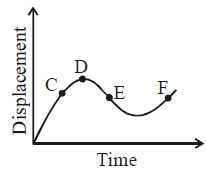
The displacement-time graph of a moving particle is as shown in the figure. The instantaneous velocity of the particle is negative at the point :

1. C
2. D
3. E
4. F
View Answer

Slope of x-t graph represents velocity. Slope is negative at point E so, velocity is negative for E.

Question 66: easy

A body covered a distance of 5 m along a semicircular path. The ratio of distance to displacement is :

1. 11 : 7
2. 12 : 5
3. 8 : 3
4. 7 : 5
View Answer

1. Distance covered: \(d = 5 \, \text{m}\) (along the semicircular path).

2. Displacement: The displacement is the straight-line distance from the starting point to the endpoint. For a semicircle with a radius \(r\):

\[
\text{Diameter} = 2r
\]
Since the distance covered is the semicircle's arc length:
\[
\text{Arc length} = \frac{1}{2}(2\pi r) = \pi r
\]

Therefore, if \(d = 5\):
\[
r = \frac{5}{\pi}
\]
So, the displacement (which is the diameter) is:
\[
\text{Displacement} = 2r = 2 \cdot \frac{5}{\pi} = \frac{10}{\pi} \, \text{m}
\]

3. Ratio of distance to displacement:
\[
\text{Ratio} = \frac{d}{\text{Displacement}} = \frac{5}{\frac{10}{\pi}} = \frac{5 \pi}{10} = \frac{\pi}{2}
\]

Question 67: moderate

A scooter is going towards east at 10 ms–¹ turns right through an angle of 90°. If the speed of the scooter remains unchanged in taking this turn, the change in the velocity of the scooter is :

1. 20.0 ms–¹ in south–western direction
2. zero
3. 10.0 ms–¹ in southern direction
4. 14.14 ms–¹ in south–western direction
View Answer

Change in a vector when it is rotated by an angle θ is

\[ \Delta V = 2V sin \left( \frac{\theta}{2} \right) \]

\[ \Delta V = 2\times 10 sin \left( \frac{90^{0}}{2} \right)= 20/\sqrt{2}= 10\sqrt{2}= 14.4 m/s \]

Question 68: moderate

Two balls are dropped to the ground from different heights. One ball is dropped 2 s after the other but they both strike the ground at the same time. If the first ball takes 5 s to reach the ground, then the difference in initial heights is: (Take g = 10 ms–²)

1. 20 m
2. 80 m
3. 170 m
4. 40 m
View Answer

1. Time taken by each ball:
- First ball: \( t_1 = 5 \, \text{s} \)
- Second ball: \( t_2 = 3 \, \text{s} \) (dropped 2 s later)

2. Heights:
- Height of the first ball:
\[
h_1 = \frac{1}{2} g t_1^2 = \frac{1}{2} \cdot 10 \cdot (5)^2 = 125 \, \text{m}
\]
- Height of the second ball:
\[
h_2 = \frac{1}{2} g t_2^2 = \frac{1}{2} \cdot 10 \cdot (3)^2 = 45 \, \text{m}
\]

3. Difference in heights:
\[
\Delta h = h_1 - h_2 = 125 - 45 = 80 \, \text{m}
\]

 The difference in initial heights is 80 meters.

Question 69: moderate

A river flows from east to west with a speed of 5 m/min. A man on south bank of river, capable of swimming at the rate of 10 m/min in still water, wants to swim across the river in shortest time; he should swim :

1. due north
2. due north-east
3. due north-east with double the speed of river
4. none of these
View Answer

To cross the river in the shortest time, the man should swim directly perpendicular to the riverbank, regardless of the river's flow. This way, his entire swimming speed is used to cross the river.

 Given:
- Speed of the river (east to west) = 5 m/min
- Speed of the swimmer in still water = 10 m/min

The swimmer should aim **directly north** to minimize the crossing time. The river's current will cause him to drift downstream, but this direction ensures the shortest crossing time.

Thus, the man should swim:

\[
{\text{directly north}}
\]

Question 70: easy

A river is flowing at the rate of 6 km/h. A swimmer swims across the river with a velocity of 9 km/h w.r.t. water. The resultant velocity of the man will be in (km/h) :

1. √117
2. √340
3. √17
4. 3√40
View Answer

The resultant velocity of the swimmer is the vector sum of the river's velocity and the swimmer's velocity relative to the water.

Given:
- River velocity = 6 km/h
- Swimmer's velocity relative to water = 9 km/h

Using the Pythagorean theorem:

\[
v_{\text{resultant}} = \sqrt{(9^2 + 6^2)} = \sqrt{81 + 36} = \sqrt{117}
\]

Thus, the resultant velocity of the swimmer is:

\[
{\sqrt{117} \text{km/h}}
\]