Kinematics - NEET Physics Questions
Question 11: moderate

A body of mass m moving along a straight line covers half the distance with a speed of 2 ms–¹. The remaining half of distance is covered in two equal time intervals with a speed of 3 ms–¹ and 5 ms–¹ respectively. The average speed of the particle for the entire journey is

1. 3/8 m-¹
2. 8/3 m-¹
3. 4/3 m-¹
4. 16/3 m-¹
View Answer

For Second Half of Journey

\[ V_{av}=\frac{3+5}{2}= 4 m/s \]

\[ V_{av}= \frac{2\times 2 \times 4}{2+4}= \frac{8}{6}= \frac{4}{3} \]
Question 12: difficult

A particle is moving with a constant speed v on a circle of radius R, then find average acceleration of particle during half cycle is :

1. \[\frac{2\sqrt{2}v^{2}}{\pi R}\]
2. \[\frac{2v^{2}}{\pi R}\]
3. \[\frac{2v^{2}}{R}\]
4. Zero
View Answer

Change in velocity = 2V

Time taken = πR/V so,

Average acceleration = 2V/(πR/V)

Question 13: moderate

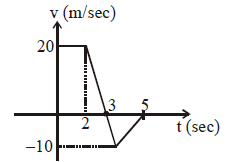
Velocity-time graph of a particle is given as :


then average speed of particle from t = 0 to t = 5 sec is :

1. 5 m/sec
2. 8 m/sec
3. 10 m/sec
4. 12 m/sec
View Answer

Area bounded with Velocity time graph represents displacement. Magnitude of Area bounded  by Velocity time graph represents distance.

Total Area = 60 so, distance = 60 m and time = 5 sec.

Average speed = 12 m/s

Question 14: easy

A car moves from X to Y with a uniform speed \[v_{u}\] and returns to X with a uniform speed \[v_{d}\]. The average speed for this round trip is

1. \[\frac{2v_{d}v_{u}}{v_{d}+v_{u}}\]
2. \[\sqrt{v_{d}v_{u}}\]
3. \[\frac{v_{d}v_{u}}{v_{d}+v_{u}}\]
4. \[\frac{v_{u}+v_{d}}{2}\]
View Answer


\[ \frac{2}{V_{av}}= \frac{1}{V_{1}}+\frac{1}{V_{2}} \]

Question 15: easy

The velocity of a body of mass 20 kg decreases from 20 ms–¹ to 5 ms–¹ in a distance of 100 m. Force on the body is

1. –27.5 N
2. –47.5 N
3. –37.5 N
4. –67.5 N
View Answer

We can use the work-energy principle to find the force.

Given:
- Initial velocity, \( u = 20 \, \text{m/s} \)
- Final velocity, \( v = 5 \, \text{m/s} \)
- Distance, \( s = 100 \, \text{m} \)
- Mass, \( m = 20 \, \text{kg} \)

Using the equation of motion:
\[
v^2 = u^2 + 2as
\]
\[
(5)^2 = (20)^2 + 2a(100)
\]
\[
25 = 400 + 200a
\]
\[
200a = -375 ;a = -\frac{375}{200} = -1.875 \, \text{m/s}^2
\]

Now, force \( F = ma \):
\[
F = 20 \times (-1.875) = -37.5 \, \text{N}
\]

Thus, the force on the body is -37.5 N (opposite to the direction of motion).

Question 16: moderate

A body moving with a uniform acceleration crosses a distance of 65 m in the 5th second and 105 m in 9th second. How far will it go in first 20 s?

1. 2040 m
2. 240 m
3. 2400 m
4. 2004 m
View Answer

We will use the formula for the distance covered in the \(n\)-th second:

\[
s_n = u + \frac{a}{2}(2n - 1)
\]

Given:
- Distance in the 5th second: \( s_5 = 65 \, \text{m} \)
- Distance in the 9th second: \( s_9 = 105 \, \text{m} \)

Using the formula for both:
1. \( s_5 = u + \frac{a}{2}(9) = 65 \)
\[
u + \frac{9a}{2} = 65 \tag{1}
\]

2. \( s_9 = u + \frac{a}{2}(17) = 105 \)
\[
u + \frac{17a}{2} = 105 \tag{2}
\]

Now, subtract equation (1) from equation (2):
\[
\left( u + \frac{17a}{2} \right) - \left( u + \frac{9a}{2} \right) = 105 - 65
\]
\[
\frac{8a}{2} = 40 \implies 4a = 40 \implies a = 10 \, \text{m/s}^2
\]

Substitute \( a = 10 \) into equation (1):
\[
u + \frac{9 \times 10}{2} = 65 \implies u + 45 = 65 \implies u = 20 \, \text{m/s}
\]

Now, to find the total distance covered in 20 seconds:
\[
S = ut + \frac{1}{2} a t^2 = 20 \times 20 + \frac{1}{2} \times 10 \times 20^2
\]
\[
S = 400 + 0.5 \times 10 \times 400 = 400 + 2000 = 2400 \, \text{m}
\]

Thus, the body will cover 2400 meters in 20 seconds.

Question 17: moderate

A body starting from rest moves with constant acceleration. The ratio of distance covered by the body during the 5th second to that covered in 5 s in

1. 9/25
2. 3/5
3. 25/5
4. 1/25
View Answer

For a body starting from rest with constant acceleration:

- Distance covered in the 5th second: \( s_5 = u + \frac{a}{2}(2n - 1) \), where \( u = 0 \) and \( n = 5 \):
\[
s_5 = \frac{a}{2} (9) = \frac{9a}{2}
\]

- Distance covered in 5 seconds: \( S = \frac{1}{2} a t^2 \), where \( t = 5 \):
\[
S = \frac{1}{2} a (5)^2 = \frac{25a}{2}
\]

Ratio of distances:
\[
\frac{s_5}{S} = \frac{\frac{9a}{2}}{\frac{25a}{2}} = \frac{9}{25}
\]

Thus, the ratio is 9:25.

Question 18: moderate

A car is travelling at 72 kmh–¹ and is 20 m from a barrier when the driver puts on the brakes. The car hits the barrier 2s later. What is the magnitude of the constant deceleration?

1. \[7.2 ms^{-2}\]
2. \[10 ms^{-2}\]
3. \[36 ms^{-2}\]
4. \[15 ms^{-2}\]
View Answer

Given:
- Initial velocity: \( u = 20 \, \text{m/s} \)
- Time: \( t = 2 \, \text{seconds} \)
- Distance to the barrier: \( s = 20 \, \text{m} \)

Using the equation of motion:
\[
s = ut + \frac{1}{2} a t^2
\]
\[
20 = 20 \times 2 + \frac{1}{2} a \times 2^2
\]
\[
20 = 40 + 2a
\]
\[
2a = -20
\]
\[
a = -10 \, \text{m/s}^2
\]

Thus, the magnitude of the deceleration is 10 m/s².

Question 19: difficult

Displacement (x) of a particle is related to time (t) as x = at + bt² – ct³, where a, b and c are constants of the motion. The velocity of the particle when its acceleration is zero is given by

1. \[a+\frac{b^{2}}{c}\]
2. \[a+\frac{b^{2}}{2c}\]
3. \[a+\frac{b^{2}}{3c}\]
4. \[a+\frac{b^{2}}{4c}\]
View Answer

Given:

\[
x = at + bt^2 - ct^3
\]

1. Velocity:

\[
v = \frac{dx}{dt} = a + 2bt - 3ct^2
\]

2.Acceleration:

\[
a = \frac{dv}{dt} = 2b - 6ct
\]

3. Set acceleration to zero:

\[
2b - 6ct = 0 ; t = \frac{b}{3c}
\]

4. Velocity at \(t = \frac{b}{3c}\)

\[
v = a + 2b\left(\frac{b}{3c}\right) - 3c\left(\frac{b}{3c}\right)^2
\]

\[
= a + \frac{2b^2}{3c} - \frac{b^2}{3c} = a + \frac{b^2}{3c}
\]

Question 20: moderate

The acceleration a of a particle starting from rest varies with time according to relation a = αt + β. The velocity of the particle after a time t will be

1. \[\frac{\alpha t^{2}}{2}+\beta\]
2. \[\frac{\alpha t^{2}}{2}+\beta t\]
3. \[\alpha t^{2}+\frac{1}{2}+\beta t\]
4. \[\frac{\left( \alpha t^{2}+\beta \right)}{2}\]
View Answer

Given acceleration:

\[
a = \alpha t + \beta
\]

The velocity after time \(t\) is:

\[
v(t) = \frac{\alpha t^2}{2} + \beta t
\]