Question 11:
easy
At what angle to the horizontal should an object be projected so that the maximum height reached is equal to the horizontal range?
At what angle to the horizontal should an object be projected so that the maximum height reached is equal to the horizontal range?
The numerical ratio of distance to magnitude of displacement is :
The numerical ratio of distance to the magnitude of displacement depends on the type of motion:
1. For straight-line motion in one direction, the distance and displacement are the same, so the ratio is:
\[
\frac{\text{Distance}}{\text{Displacement}} = 1
\]
2. For any other type of motion (like a curved path or circular motion), the distance is generally greater than or equal to the displacement, making the ratio:
\[
\frac{\text{Distance}}{\text{Displacement}} \geq 1
\]
The ratio is greater than 1 because distance is the total path travelled, while displacement is the shortest straight line between the start and end points.
A cyclist moving on a circular track of radius 40 m completes half a revolution in 40 s. Its average velocity is :
A player throws a ball upwards with an initial speed of 30 ms–¹. How long does the ball take to return to the player’s hands? (Take g = 10 ms–²)
\[ t =\frac{2u}{g}=\frac{2\times 30}{10}= 6 sec\]
A car moving with a speed of 50 km h–¹ can be stopped by brakes after atleast 6m. If the same car is moving at a speed of 100 km h–¹ the minimum stopping distance is :
The stopping distance is proportional to the square of the speed:
\[
\frac{s_2}{s_1} = \left( \frac{v_2}{v_1} \right)^2
\]
Substituting the values:
\[
\frac{s_2}{6} = \left( \frac{100}{50} \right)^2 = 2^2 = 4
\]
\[
s_2 = 6 \times 4 = 24 \, \text{m}
\]
Thus, the minimum stopping distance at 100 km/h is 24 meters.
The displacement-time graph of a moving particle is as shown in the figure. The instantaneous velocity of the particle is negative at the point :
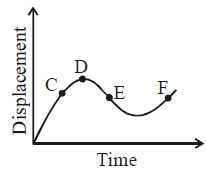
Slope of x-t graph represents velocity. Slope is negative at point E so, velocity is negative for E.
A body covered a distance of 5 m along a semicircular path. The ratio of distance to displacement is :
1. Distance covered: \(d = 5 \, \text{m}\) (along the semicircular path).
2. Displacement: The displacement is the straight-line distance from the starting point to the endpoint. For a semicircle with a radius \(r\):
\[
\text{Diameter} = 2r
\]
Since the distance covered is the semicircle's arc length:
\[
\text{Arc length} = \frac{1}{2}(2\pi r) = \pi r
\]
Therefore, if \(d = 5\):
\[
r = \frac{5}{\pi}
\]
So, the displacement (which is the diameter) is:
\[
\text{Displacement} = 2r = 2 \cdot \frac{5}{\pi} = \frac{10}{\pi} \, \text{m}
\]
3. Ratio of distance to displacement:
\[
\text{Ratio} = \frac{d}{\text{Displacement}} = \frac{5}{\frac{10}{\pi}} = \frac{5 \pi}{10} = \frac{\pi}{2}
\]
A river is flowing at the rate of 6 km/h. A swimmer swims across the river with a velocity of 9 km/h w.r.t. water. The resultant velocity of the man will be in (km/h) :
The resultant velocity of the swimmer is the vector sum of the river's velocity and the swimmer's velocity relative to the water.
Given:
- River velocity = 6 km/h
- Swimmer's velocity relative to water = 9 km/h
Using the Pythagorean theorem:
\[
v_{\text{resultant}} = \sqrt{(9^2 + 6^2)} = \sqrt{81 + 36} = \sqrt{117}
\]
Thus, the resultant velocity of the swimmer is:
\[
{\sqrt{117} \text{km/h}}
\]
A train moves in north direction with a speed of 54 km/h A monkey is running on the roof of the train, against its motion with a velocity of 18 km/h. with respect to train. The velocity of monkey as observed by a man standing on the ground is :
To find the velocity of the monkey as observed by a man standing on the ground, we need to add the velocity of the monkey relative to the train to the velocity of the train.
Given:
- Velocity of the train (north direction) = 54 km/h
- Velocity of the monkey relative to the train (opposite to train's motion) = 18 km/h
Monkey's velocity relative to the ground:
Since the monkey is running against the train’s motion, the monkey's velocity relative to the ground will be:
\[
\vec{v}_{\text{monkey}} = \vec{v}_{\text{train}} - \vec{v}_{\text{monkey relative to train}}
\]
\[
v_{\text{monkey}} = 54 \, \text{km/h} - 18 \, \text{km/h} = 36 \, \text{km/h}
\]
Thus, the velocity of the monkey as observed by a man on the ground is:
\[
{36 \, \text{km/h} \text{ north} or 10 m/s \text{ north}}
\]
A boat is sailing with a velocity \[\left( 3\hat{i}+4\hat{j} \right)\] with respect to ground and water in river is flowing with a velocity
\[\left( -3\hat{i}-4\hat{j} \right)\] . Relative velocity of the boat with respect to water is :
The relative velocity of the boat with respect to the water is given by subtracting the velocity of the water from the velocity of the boat.
\[
\vec{v}_{\text{bw}} = \vec{v}_{\text{boat}} - \vec{v}_{\text{water}}
\]
Given:
\[
\vec{v}_{\text{boat}} = 3\hat{i} + 4\hat{j}, \quad \vec{v}_{\text{water}} = -3\hat{i} - 4\hat{j}
\]
Now, subtract:
\[
\vec{v}_{\text{bw}} = (3\hat{i} + 4\hat{j}) - (-3\hat{i} - 4\hat{j})
\]
\[
\vec{v}_{\text{bw}} = 3\hat{i} + 4\hat{j} + 3\hat{i} + 4\hat{j}
\]
\[
\vec{v}_{\text{bw}} = 6\hat{i} + 8\hat{j}
\]
Thus, the relative velocity of the boat with respect to the water is:
\[ {6\hat{i} + 8\hat{j}} \]