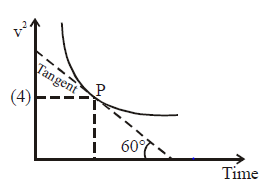
Particle moving along x-axis with variable velocity its (v²) vs. time graph is as shown in the following figure, then the acceleration of particle at point P is :

Particle moving along x-axis with variable velocity its (v²) vs. time graph is as shown in the following figure, then the acceleration of particle at point P is :

If velocity of a particle is given by V = (t + 3) m/s, then average velocity in interval
0 ≤ t ≤ 1s is :
\[ V_{av}=\frac{\int_{0}^{1}v.dt}{\int_{0}^{1}dt}= \frac{\int_{0}^{1}(t + 3).dt}{\int_{0}^{1}dt}=\frac{7}{2} m/s \]
A boat-man can row a boat to make it move with a speed of 10 km/h in still water. River flows steadily at the rate of 5 km/h. and the width of the river is 2 km. If the boat man cross the river along the minimum distance of approach then time elapsed in rowing the boat will be :
To cross the river along the minimum distance (i.e., directly perpendicular to the riverbank), the boatman must row with a velocity component equal and opposite to the river flow to cancel the drift.
Given:
- Speed of the boat in still water = 10 km/h
- Speed of the river flow = 5 km/h
- Width of the river = 2 km
The boat's velocity perpendicular to the riverbank is:
\[
v_{\text{perpendicular}} = \sqrt{(10^2 - 5^2)} = \sqrt{100 - 25} = \sqrt{75} = 5\sqrt{3} \, \text{km/h}
\]
Time to cross the river:
\[
\text{Time} = \frac{\text{Distance}}{\text{Speed perpendicular}} = \frac{2}{5\sqrt{3}} \, \text{hours}
\]
Simplifying:
\[{\frac{2}{5\sqrt{3}} \, \text{hours}}
\]
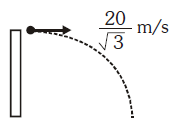
A particle is projected horizontally with a speed of 20/√3 m/s, from some height at t = 0. At what time will its velocity make 60° angle with the initial velocity

\[ tan \alpha = \frac{-gt}{u} \]
\[ tan (-60^{\circ })= \frac{-10t}{20/\sqrt{3}} \]
Solving t =2 sec
Four persons P, Q, R and S of same mass travel with same speed u along a square of side ‘d’ such that each one always faces the other. After what time will they meet each other ?
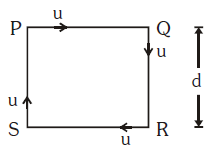
To determine when the four persons \( P, Q, R, \) and \( S \) will meet, consider the following:
Relative Velocity:
- Each person moves with speed \( u \) towards the center of the square.
Configuration:
- As they face each other and move towards the center, their paths converge.
Effective Speed Towards Each Other:
- The effective speed of each person towards the center is \( u \cos 45^\circ = \frac{u}{\sqrt{2}} \) because they move diagonally.
Distance to Center:
- The distance from each person to the center of the square is \( \frac{d}{\sqrt{2}} \).
Time to Meet:
\[
t = \frac{\text{Distance}}{\text{Effective Speed}} = \frac{\frac{d}{\sqrt{2}}}{\frac{u}{\sqrt{2}}} = \frac{d}{u}
\]
Thus, the time after which they will all meet is \( \frac{d}{u} \).
At what angle to the horizontal should a ball be thrown so that its range R is related to the time of flight T as R = 5T² ? Take g = 10 ms–² :
Given the relationship \( R = 5T^2 \), and using the formulas for range \( R \) and time of flight \( T \):
1. **Range formula:**
R = u cos(θ) · T
2. **Time of flight formula:**
T = (2u sin(θ)) / g
Substituting T into the range equation:
R = u cos(θ) · (2u sin(θ) / g)
This gives:
R = (2u² sin(θ) cos(θ)) / g
Setting this equal to \( 5T^2 \):
(2u² sin(θ) cos(θ)) / g = 5((2u sin(θ)) / g)²
Simplifying:
(2u² sin(θ) cos(θ)) / g = (20u² sin²(θ)) / g²
Cancelling \( u² / g \):
2 cos(θ) = 20 sin(θ) / g
Given g = 10 m/s²:
2 cos(θ) = 2 sin(θ)
Thus:
cos(θ) = sin(θ)
This implies:
tan(θ) = 1 → θ = 45°
The angle to the horizontal should be 45°
A body dropped from the top of a tower clears 7/16th of the total height of the tower in its last second of flight. The time taken by the body to reach the ground is :
According to Galileo's Ratio of Odd Number distances travelled is consecution interval of 1 sec is in the ratio of 1:3:5:7 so in 4th second distance travelled is 7/16th of total journey.
so, total time = 4 sec.
Two bullets are fired horizontally and simultaneously towards each other from roof tops of two buildings 100 m apart and of same height of 200 m, with the same velocity of 25 m/s. When and where will the two bullets collide? (g = 10 m/s²)
m/s. Time to meet:
Answer: (2) After 2 s at a height of 180 m.
Two bodies are moving such that their (x)-coordinates are changing according to the law, \( X_1 = -3 + 2t + t^2 \) and \( X_2 = 7 – 8t + t^2 \). The relative speed (V) of bodies at the time of their meeting will be :
For meeting, equate positions: \(X_1 = X_2 -3 + 2t + t^2 = 7 - 8t + t^2; 10t = 10; t = 1 \text{ s} \). Differentiating positions gives velocities: \(v_1 = 2+2t = 4\text{ m/s}\) and \(v_2 = -8+2t = -6\text{ m/s}\) at \(t=1\text{ s}\). Relative speed \(V = |v_1 - v_2| = 10 \text {m/s}\).
If the velocity of a particle is given by \(v = (180 – 16x)^{1/2}\text{ ms}^{-1}\), then its acceleration will be
We have \(v^2 = 180 - 16x\). Comparing with \(v^2 = u^2 + 2ax\), we get \(2a = -16 ⇒ a = -8\text{ ms}^{-2}\).