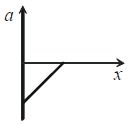
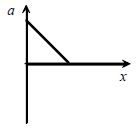
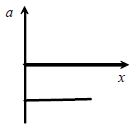
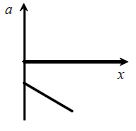
The given graph shows the variation of velocity with which one of the graph given below correctly represents the variation of acceleration with displacement :
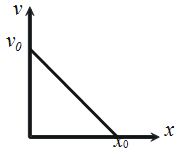
\[ a= v \frac{dv}{ds} \]
The given graph shows the variation of velocity with which one of the graph given below correctly represents the variation of acceleration with displacement :

\[ a= v \frac{dv}{ds} \]
A particle is moving with a constant speed v on a circle of radius R, then find average acceleration of particle during half cycle is :
Change in velocity = 2V
Time taken = πR/V so,
Average acceleration = 2V/(πR/V)
Displacement (x) of a particle is related to time (t) as x = at + bt² – ct³, where a, b and c are constants of the motion. The velocity of the particle when its acceleration is zero is given by
Given:
\[
x = at + bt^2 - ct^3
\]
1. Velocity:
\[
v = \frac{dx}{dt} = a + 2bt - 3ct^2
\]
2.Acceleration:
\[
a = \frac{dv}{dt} = 2b - 6ct
\]
3. Set acceleration to zero:
\[
2b - 6ct = 0 ; t = \frac{b}{3c}
\]
4. Velocity at \(t = \frac{b}{3c}\)
\[
v = a + 2b\left(\frac{b}{3c}\right) - 3c\left(\frac{b}{3c}\right)^2
\]
\[
= a + \frac{2b^2}{3c} - \frac{b^2}{3c} = a + \frac{b^2}{3c}
\]
A particle has an initial velocity \[3\hat{i}+4\hat{j}\] and an acceleration of \[0.4\hat{i}+0.3\hat{j}\] . Its speed after 10 s is
Given:
- Initial velocity: \(\mathbf{u} = 3\hat{i} + 4\hat{j}\)
- Acceleration: \(\mathbf{a} = 0.4\hat{i} + 0.3\hat{j}\)
Calculate final velocity after 10 s:
\[
\mathbf{v} = \mathbf{u} + \mathbf{a}t = (3\hat{i} + 4\hat{j}) + (0.4\hat{i} + 0.3\hat{j}) \cdot 10
\]
\[
\mathbf{v} = 3\hat{i} + 4\hat{j} + (4\hat{i} + 3\hat{j}) = (3 + 4)\hat{i} + (4 + 3)\hat{j} = 7\hat{i} + 7\hat{j}
\]
Calculate speed:
\[
\text{Speed} = |\mathbf{v}| = \sqrt{(7)^2 + (7)^2} = \sqrt{49 + 49} = \sqrt{98} = 7\sqrt{2} \, \text{m/s}
\]
A point initially at rest moves along x-axis. Its acceleration varies with time as a = (6t + 5) ms–². If it starts from origin, the distance covered in 2 s is
Given the acceleration:
\[
a = 6t + 5 \, \text{m/s}^2
\]
1. Integrate acceleration to find velocity \(v\):
\[
v = \int a \, dt = \int (6t + 5) \, dt = 3t^2 + 5t + C
\]
Since it starts from rest, \(C = 0\):
\[
v = 3t^2 + 5t
\]
2. Integrate velocity to find displacement \(x\):
\[
x = \int v \, dt = \int (3t^2 + 5t) \, dt = t^3 + \frac{5}{2}t^2 + D
\]
Starting from the origin gives \(D = 0\):
\[
x = t^3 + \frac{5}{2}t^2
\]
3. Calculate displacement at \(t = 2\) s:
\[
x(2) = (2)^3 + \frac{5}{2}(2)^2 = 8 + \frac{5}{2} \cdot 4 = 8 + 10 = 18 \, \text{m}
\]
Thus, the distance covered in 2 seconds is: 18 m
If the velocity of a particle is given by \[v=(180-16x)^{1/2} ms^{-1}\], then its acceleration will be
Given the velocity:
To find the acceleration, use the chain rule:
Differentiate
with respect to
:
Now, substitute
Thus, the acceleration is
A bus begins to move with an acceleration of 1 ms–². A man who is 48 m behind the bus starts running at 10 ms–¹ to catch the bus. The man will be able to catch the bus after
Using relative speed, let’s re-calculate with the correct setup:
1. Acceleration of the bus: \( a = 1 \, \text{m/s}^2 \)
2. Initial distance behind the bus: \( d = 48 \, \text{m} \)
3. Speed of the man: \( v_m = 10 \, \text{m/s} \)
4. The equation of motion for the bus after \( t \) seconds:
\[
d_b = \frac{1}{2} a t^2 = \frac{1}{2} \cdot 1 \cdot t^2 = \frac{1}{2} t^2
\]
5. Distance traveled by the man:
\[
d_m = v_m \cdot t = 10t
\]
6. Setting the distances equal considering the man starts 48 m behind:
\[
10t = \frac{1}{2} t^2 + 48
\]
\[
\frac{1}{2} t^2 - 10t + 48 = 0
\]
7. Multiplying by 2:
\[
t^2 - 20t + 96 = 0
\]
8. Using the quadratic formula:
\[
t = \frac{20 \pm \sqrt{20^2 - 4 \cdot 96}}{2}
\]
\[
t = \frac{20 \pm \sqrt{400 - 384}}{2}
\]
\[
t = \frac{20 \pm 4}{2}
\]
\[
t = 12 \, \text{s} \quad \text{or} \quad t = 8 \, \text{s}
\]
the man will catch the bus is 8 seconds.
A car is moving along a straight road with a uniform acceleration. It passes through two points P and Q separated by a distance with velocity 30 km/hr and 40 km/hr respectively. The velocity of the car midway between P and Q is :
Speed at mid point is given by
\[ V_{mid}=\sqrt{\frac{V_{1}^{2}+V_{2}^{2}}{2}} \]
Between two stations, a train accelerates from rest uniformly at first, then moves with constant velocity, and finally retards uniformly to come to rest. If the ratio of the time taken is 1 : 8 : 1 and the maximum speed attained be 60 km h–¹, then what is the average speed over the whole journey?
. So, if the total time is
, the train spends
accelerating,
at constant velocity, and
decelerating.
Key points:
.
For the constant velocity portion:
Thus, the average speed is 54 km/h.
A particle is thrown upwards from ground. It experience a constant air resistance force which can produce a retardation of 2 m/s². The ratio of time of ascent to the time of descent is : [g = 10 m/s²]
Effective accelerations:
- Ascent: \( a_{\text{eff}} = g + a = 10 + 2 = 12 \, \text{m/s}^2 \)
- Descent: \( a'_{\text{eff}} = g - a = 10 - 2 = 8 \, \text{m/s}^2 \)
Ratio of times:
\[
\frac{t_a}{t_d} = \sqrt{\frac{a'_{\text{eff}}}{a_{\text{eff}}}} = \sqrt{\frac{8}{12}} = \sqrt{\frac{2}{3}}
\]
The ratio of time of ascent to time of descent is √(2/3).