Electric Potential - NEET Physics Questions
Question 11: moderate

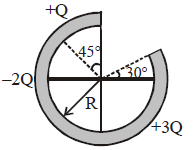
Figure shows three circular arcs, each of radius R and total charge as indicated. The net electric potential at the centre of curvature is :
 

1. \[\frac{Q}{2\pi \varepsilon_{0}R}\]
2. \[\frac{Q}{4\pi \varepsilon_{0}R}\]
3. \[\frac{2Q}{\pi \varepsilon_{0}R}\]
4. \[\frac{Q}{\pi \varepsilon_{0}R}\]
View Answer

As potential is a scaler quantity distribution of charges will not have any effect.

Total charge = 3Q-2Q+Q= 2Q

Electric Potential V = \( \frac{2KQ}{R}= \frac{Q}{2\pi \varepsilon_{0}R}\)
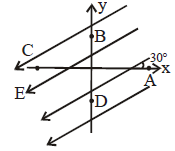
Question 12: moderate

There exists a uniform electric field in the space as shown. Four points A, B, C and D are marked which are equidistant from the origin. If \(V_{A} ,ย  V_{B} , V_{C} and V_{D}\) are their potentials, respectively :


1. \[V_{B}\gt V_{B}\gt V_{C}\gt V_{D} \]
2. \[V_{A}\gt V_{B}\gt V_{D}\gt V_{C} \]
3. \[V_{A}= V_{B}\gt V_{C}= V_{D} \]
4. \[V_{B}\gt V_{C}\gt V_{A}\gt V_{D} \]
View Answer

In a uniform electric field, the electric potential decreases in the direction of the field. From the diagram:

1. Direction of the electric field: The field points downward and to the left (parallel to lines \(C \to D\)).

2. Potential relation:
- Points further along the direction of the field have lower potential.
- Points opposite to the field direction have higher potential.

3. Comparison of potentials:
- \(A\): Least aligned with the field direction (highest potential).
- \(B\): Slightly more aligned with the field direction than \(A\).
- \(D\): More aligned with the field direction than \(B\).
- \(C\): Most aligned with the field direction (lowest potential).

Thus, the potential order is:
\[
V_A > V_B > V_D > V_C
\]

Question 13: moderate

A cube of side b has equal point charge q at seven vertices. The electric potential due to this charge distribution at the centre of this cube will be :

1. \[\frac{14kq}{b}\]
2. \[\frac{7kq}{\sqrt{3}b}\]
3. \[\frac{14kq}{\sqrt{2}b}\]
4. \[\frac{14kq}{\sqrt{3}b}\]
View Answer

The electric potential \( V \) at the center of the cube due to a point charge \( q \) is:
\[
V = \frac{kq}{r},
\]
where \( r \) is the distance of the charge from the center.

1. Distance from center:
For a cube of side \( b \), the distance of any vertex from the center is:
\[
r = \frac{\sqrt{3}b}{2}.
\]

2. Potential due to 7 charges:
Since potential is scalar, the total potential is the sum of potentials due to all charges:
\[
V_{\text{total}} = 7 \cdot \frac{kq}{r}.
\]

Substitute \( r = \frac{\sqrt{3}b}{2} \):
\[
V_{\text{total}} = 7 \cdot \frac{kq}{\frac{\sqrt{3}b}{2}} = 7 \cdot \frac{2kq}{\sqrt{3}b} = \frac{14kq}{\sqrt{3}b}.
\]

Thus, the potential at the center is \(\frac{14kq}{\sqrt{3}b}\).

Question 14: moderate

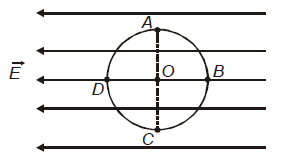
A,B,C and D are four points on an imaginary circle in region containing uniform electric field as shown in figure. Select the incorrect option


1. \[V_{B}>V_{A}\]
2. \[V_{B}>V_{C}\]
3. \[V_{B} < V_{D}\]
4. \[V_{A}>V_{D}\]
View Answer

Electric potential decreases in the direction of electric field. so ,ย  \[V_{B} < V_{D}\] is wrong.

Question 15: moderate

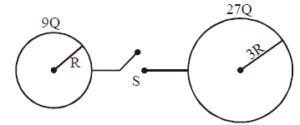
Find final charge on smaller sphere after closing switch :


1. 18 Q
2. 27 Q
3. 9 Q
4. Zero
View Answer

After closing the switch:

1. Potential equality: \(\frac{Q_1}{R} = \frac{Q_2}{3R} \Rightarrow Q_2 = 3Q_1\).

2. Charge conservation: \(Q_1 + Q_2 = 36Q \Rightarrow Q_1 + 3Q_1 = 36Q \Rightarrow Q_1 = 9Q\).

Final charge on the smaller sphere = 9Q.

Question 16: moderate

There are two concentric conducting shells. The potential of outer shell is 10 V and that of inner shell is 15 V. If the outer shell is grounded, the potential of inner shell becomes/remains

1. 25 V
2. 15 V
3. 10 V
4. 5 V
View Answer

When the outer shell is grounded, its potential becomes 0. The potential difference between the shells remains the same as before grounding (since grounding doesn't change the relative configuration of charges).

Initial potential difference:
Inner shell - Outer shell = \( 15 \, \text{V} - 10 \, \text{V} = 5 \, \text{V} \).

After grounding, the inner shellโ€™s potential relative to the grounded outer shell becomes \( 0 + 5 \, \text{V} = 5 \, \text{V} \).

Thus, the inner shellโ€™s potential is 5 V.

Question 17: moderate

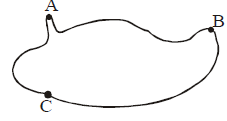
Figure shows a charged conductor of irregular shape. If \ ( \sigma_{A},\sigma_{B} and \sigma_{C}\) are the surface charge densities at A, B and C respectively, then :

1. \[\sigma_{A}=\sigma_{B} = \sigma_{C}\]
2. \[\sigma_{A}<\sigma_{B} < \sigma_{C}\]
3. \[\sigma_{A}>\sigma_{B} > \sigma_{C}\]
4. \[\sigma_{A}=\sigma_{B} < \sigma_{C}\]
View Answer

Pointed ends have more surface charge density so,

\[\sigma_{A}>\sigma_{B} > \sigma_{C}\]