Electric Potential - NEET Physics Questions
Question 11: moderate

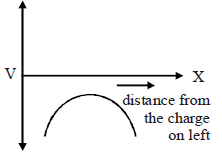
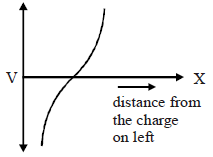
Which graph show the correct variation of potential between two negative point charges along x-axis separated by finite distance
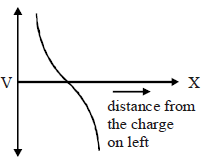
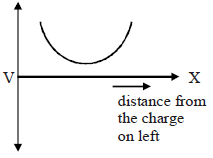
1.
2.
3.
4.
View Answer

The graph shown correctly represents the variation of electric potential along the x-axis between two negative charges.

Explanation:
1. Electric Potential Due to a Point Charge:
- For a single negative charge, the potential is negative and becomes less negative (closer to zero) as the distance from the charge increases.

2. Superposition of Potentials:
- The net potential at any point is the sum of potentials due to both charges.
- Near each charge, the potential is dominated by that charge and highly negative.
- At a point midway between the two charges, the potentials due to both charges add up (both are negative), giving the minimum (most negative) potential.

3. Shape of the Graph:
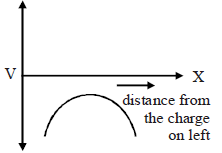

- The potential decreases sharply near each charge.
- Between the charges, the potential reaches a minimum (most negative value) due to the additive contributions of both charges.

The graph accurately shows this behavior with a dip between the two charges.
Question 12: difficult

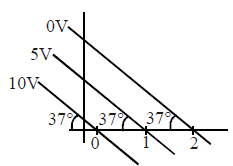
In a particular region, equipotential surfaces are spaced as shown. The electric field is :

1. \[ 5\hat{i}+5\hat{j}\]
2. \[ 5\hat{i}+\frac{20}{3}\hat{j}\]
3. \[ \frac{15}{4}\hat{i}+5\hat{j}\]
4. \[ \frac{-15}{4}\hat{i}+\frac{20}{3}\hat{j}\]
View Answer


To determine the electric field \(\vec{E}\) from the equipotential surfaces:

1. Electric Field Magnitude: The electric field is the negative gradient of the potential:
\[
|\vec{E}| = -\frac{\Delta V}{\Delta s}
\]
where \(\Delta V\) is the potential difference and \(\Delta s\) is the perpendicular spacing between equipotential surfaces.

2. Horizontal Component (\(E_x\)):
- The horizontal spacing between 0V and 10V surfaces is \(2 \, \text{units}\).
- \(E_x = -\frac{\Delta V_x}{\Delta x} = -\frac{10}{2} = -5 \, \text{V/unit}\).

3. Vertical Component (\(E_y\)):
- The vertical spacing between equipotential surfaces (tilted at \(37^\circ\)) corresponds to \(\tan 37^\circ = \frac{3}{4}\). Hence, the vertical spacing between 0V and 10V is \(2 \cdot \frac{3}{4} = 1.5 \, \text{units}\).
- \(E_y = -\frac{\Delta V_y}{\Delta y} = -\frac{10}{1.5} = -\frac{20}{3} \, \text{V/unit}\).

4. Resultant Electric Field:
\[
\vec{E} = -E_x \hat{i} - E_y \hat{j} = 5\hat{i} + \frac{20}{3}\hat{j}.
\]

Question 13: difficult

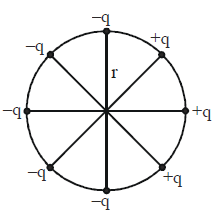
Three positive charges and five negative charges of same magnitude are arrangement as shown in the figure. The magnitude of the electric field and the electric potential at the centre of the circuit (radius r) are given by


1. \[ E=\frac{2kq}{r^{2}}(1+2\sqrt{2}),V=0\]
2. \[ E=\frac{2kq}{r^{2}}(1+\sqrt{2}),V=\frac{-2qk}{r}\]
3. \[ E=\frac{2kq}{r^{2}}(1+2\sqrt{2}),V=\frac{-2qk}{r}\]
4. None of these
View Answer

Electric Potential (\( V \)):

1. Potential at the center due to a charge \( q \) at a distance \( r \) is:
\[
V = \frac{kq}{r}.
\]

2. Total potential is the algebraic sum since potential is scalar. For 3 positive charges and 5 negative charges:
\[
V_{\text{total}} = 3 \cdot \frac{kq}{r} - 5 \cdot \frac{kq}{r} = \frac{-2kq}{r}.
\]

---

Electric Field (\( E \)):

1. Symmetry of arrangement: The charges along the diagonals cancel their horizontal components, leaving only vertical components.

2. Field due to charges along diagonals (\( -q, -q, +q, +q \)):
- Each diagonal pair creates a net field of magnitude:
\[
E_{\text{pair}} = \frac{\sqrt{2}kq}{r^2}.
\]
- Two such pairs contribute:
\[
E_{\text{diagonals}} = 2 \cdot \frac{\sqrt{2}kq}{r^2} = \frac{2\sqrt{2}kq}{r^2}.
\]

3. Field due to the remaining vertical pair (\( -q, -q \)):
- Net field:
\[
E_{\text{vertical}} = \frac{2kq}{r^2}.
\]

4. Total electric field:
\[
E_{\text{total}} = E_{\text{diagonals}} + E_{\text{vertical}} = \frac{2kq}{r^2}(1 + \sqrt{2}).
\]

---

Final Answer:
\[
E = \frac{2kq}{r^2}(1 + \sqrt{2}), \quad V = \frac{-2kq}{r}.
\]

Question 14: moderate

Electric field due to a uniformly charged ring of radius √5 m at a certain point on its axis is 1 V/m and electric potential at the same point is 6V. If the distance of this point from centre of the ring is x (in m), find the smallest value of x.

1. 5
2. 8
3. 40
4. 1
View Answer

For a uniformly charged ring:

1. Electric potential on the axis:
\[
V = \frac{kQ}{\sqrt{R^2 + x^2}},
\]
where \( R = \sqrt{5} \) and \( x \) is the distance from the center.

2. Electric field on the axis:
\[
E = \frac{kQx}{(R^2 + x^2)^{3/2}}.
\]

3. Given:
\( V = 6 \, \text{V} \), \( E = 1 \, \text{V/m} \).

4. Divide \( E \) by \( V \)Β to eliminate \( kQ \):
\[
\frac{E}{V} = \frac{x}{R^2 + x^2} \quad \Rightarrow \quad \frac{1}{6} = \frac{x}{5 + x^2}.
\]

5. Simplify:
\[
5 + x^2 = 6x \quad \Rightarrow \quad x^2 - 6x + 5 = 0.
\]

6. Solve quadratic:
\[
(x - 5)(x - 1) = 0 \quad \Rightarrow \quad x = 5 \, \text{or} \, x = 1.
\]

The smallest value of \( x \) is 1 m.

Question 15: moderate

The potential V is varying with x as V=\( \frac{1}{2}\left( y^{2}-4x \right)\) volt. The field at x = 1m, y = 1m, is:

1. \[ \left( 2\hat{i}+\hat{j} \right)V/m\]
2. \[ \left(- 2\hat{i}+\hat{j} \right)V/m\]
3. \[ \left( 2\hat{i}-\hat{j} \right)V/m\]
4. \[ \left(- 2\hat{i}+2\hat{j} \right)V/m\]
View Answer

The electric field is given by:
\[
\vec{E} = -\nabla V = -\left( \frac{\partial V}{\partial x} \hat{i} + \frac{\partial V}{\partial y} \hat{j} \right).
\]

Given \( V = \frac{1}{2}(y^2 - 4x) \):

1. Partial derivatives:
- \(\frac{\partial V}{\partial x} = -2\)
- \(\frac{\partial V}{\partial y} = y\).

2. At \( x = 1, y = 1 \):
- \( E_x = -\frac{\partial V}{\partial x} = -(-2) = 2 \),
- \( E_y = -\frac{\partial V}{\partial y} = -(1) = -1 \).

3. Electric field:
\[
\vec{E} = 2\hat{i} - \hat{j} \, \text{V/m}.
\]

Question 16: moderate

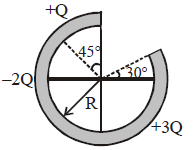
Figure shows three circular arcs, each of radius R and total charge as indicated. The net electric potential at the centre of curvature is :


1. \[\frac{Q}{2\pi \varepsilon_{0}R}\]
2. \[\frac{Q}{4\pi \varepsilon_{0}R}\]
3. \[\frac{2Q}{\pi \varepsilon_{0}R}\]
4. \[\frac{Q}{\pi \varepsilon_{0}R}\]
View Answer

As potential is a scaler quantity distribution of charges will not have any effect.

Total charge = 3Q-2Q+Q= 2Q

Electric Potential V = \( \frac{2KQ}{R}= \frac{Q}{2\pi \varepsilon_{0}R}\)

Question 17: moderate

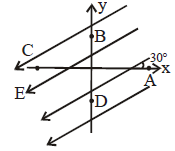
There exists a uniform electric field in the space as shown. Four points A, B, C and D are marked which are equidistant from the origin. If \(V_{A} ,Β  V_{B} , V_{C} and V_{D}\) are their potentials, respectively :


1. \[V_{B}\gt V_{B}\gt V_{C}\gt V_{D} \]
2. \[V_{A}\gt V_{B}\gt V_{D}\gt V_{C} \]
3. \[V_{A}= V_{B}\gt V_{C}= V_{D} \]
4. \[V_{B}\gt V_{C}\gt V_{A}\gt V_{D} \]
View Answer

In a uniform electric field, the electric potential decreases in the direction of the field. From the diagram:

1. Direction of the electric field: The field points downward and to the left (parallel to lines \(C \to D\)).

2. Potential relation:
- Points further along the direction of the field have lower potential.
- Points opposite to the field direction have higher potential.

3. Comparison of potentials:
- \(A\): Least aligned with the field direction (highest potential).
- \(B\): Slightly more aligned with the field direction than \(A\).
- \(D\): More aligned with the field direction than \(B\).
- \(C\): Most aligned with the field direction (lowest potential).

Thus, the potential order is:
\[
V_A > V_B > V_D > V_C
\]

Question 18: easy

At the centre of a uniformaly charged ring :

1. E = 0, V = 0
2. E = maximum, V = 0
3. E = maximum, V = maximum
4. E = 0, V = maximum
View Answer

At the centre of a uniformly charge ring electric field becomes zero because being a vector quantity it will cancel out each.

Electric potential is a scaler quantity so will be present at the centre of ring.

E = 0, V = maximum

Question 19: moderate

A cube of side b has equal point charge q at seven vertices. The electric potential due to this charge distribution at the centre of this cube will be :

1. \[\frac{14kq}{b}\]
2. \[\frac{7kq}{\sqrt{3}b}\]
3. \[\frac{14kq}{\sqrt{2}b}\]
4. \[\frac{14kq}{\sqrt{3}b}\]
View Answer

The electric potential \( V \) at the center of the cube due to a point charge \( q \) is:
\[
V = \frac{kq}{r},
\]
where \( r \) is the distance of the charge from the center.

1. Distance from center:
For a cube of side \( b \), the distance of any vertex from the center is:
\[
r = \frac{\sqrt{3}b}{2}.
\]

2. Potential due to 7 charges:
Since potential is scalar, the total potential is the sum of potentials due to all charges:
\[
V_{\text{total}} = 7 \cdot \frac{kq}{r}.
\]

Substitute \( r = \frac{\sqrt{3}b}{2} \):
\[
V_{\text{total}} = 7 \cdot \frac{kq}{\frac{\sqrt{3}b}{2}} = 7 \cdot \frac{2kq}{\sqrt{3}b} = \frac{14kq}{\sqrt{3}b}.
\]

Thus, the potential at the center is \(\frac{14kq}{\sqrt{3}b}\).

Question 20: difficult

In a certain region of space, the potential is given by : V = k[2xΒ² + yΒ² – 2z]. The electric field at the point (1, 0, 1) has magnitude equal toΒ 

1. k√5
2. 2k√5
3. 2k√3
4. 4k√3
View Answer

The electric field \(\vec{E}\) is related to the potential \(V\) by:
\[
\vec{E} = -\nabla V = -\left(\frac{\partial V}{\partial x} \hat{i} + \frac{\partial V}{\partial y} \hat{j} + \frac{\partial V}{\partial z} \hat{k}\right).
\]

Given \(V = k[2x^2 + y^2 - 2z]\):

1. Partial derivatives:
- \(\frac{\partial V}{\partial x} = 4kx\),
- \(\frac{\partial V}{\partial y} = 2ky\),
- \(\frac{\partial V}{\partial z} = -2k\).

2. Electric field components at \((1, 0, 1)\):
- \(E_x = -\frac{\partial V}{\partial x} = -4k(1) = -4k\),
- \(E_y = -\frac{\partial V}{\partial y} = -2k(0) = 0\),
- \(E_z = -\frac{\partial V}{\partial z} = -(-2k) = 2k\).

3. Magnitude of \(\vec{E}\):
\[
|\vec{E}| = \sqrt{E_x^2 + E_y^2 + E_z^2} = \sqrt{(-4k)^2 + (0)^2 + (2k)^2} = \sqrt{16k^2 + 4k^2} = \sqrt{20k^2} = 2k\sqrt{5}.
\]

Thus, the magnitude of the electric field is \(2k\sqrt{5}\).