A,B,C and D are four points on an imaginary circle in region containing uniform electric field as shown in figure. Select the incorrect option
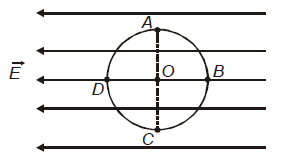
Electric potential decreases in the direction of electric field. so ,Β \[V_{B} < V_{D}\] is wrong.
A,B,C and D are four points on an imaginary circle in region containing uniform electric field as shown in figure. Select the incorrect option

Electric potential decreases in the direction of electric field. so ,Β \[V_{B} < V_{D}\] is wrong.
An electric charge 10βΒ³ ΞΌC is placed at the origin (0, 0) of XβY co-ordinate system. Two points A and B are situated at ( β2, β2) and (2, 0) respectively. Find the potential difference between the points A and B.
The potential \( V \) due to a point charge \( q \) at a distance \( r \) is given by:
\[
V = \frac{kq}{r}
\]
1. Distance from the charge at the origin:
- Point \( A(\sqrt{2}, \sqrt{2}) \): Distance \( r_A = \sqrt{(\sqrt{2})^2 + (\sqrt{2})^2} = \sqrt{4} = 2 \).
- Point \( B(2, 0) \): Distance \( r_B = \sqrt{(2)^2 + 0^2} = 2 \).
2. Potentials at \( A \) and \( B \):
\[
V_A = \frac{kq}{r_A} = \frac{kq}{2}, \quad V_B = \frac{kq}{r_B} = \frac{kq}{2}.
\]
3. Potential difference:
\[
V_A - V_B = \frac{kq}{2} - \frac{kq}{2} = 0.
\]
Thus, \( V_A - V_B = 0 \).
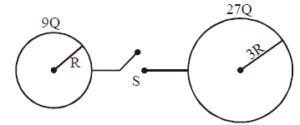
Find final charge on smaller sphere after closing switch :

After closing the switch:
1. Potential equality: \(\frac{Q_1}{R} = \frac{Q_2}{3R} \Rightarrow Q_2 = 3Q_1\).
2. Charge conservation: \(Q_1 + Q_2 = 36Q \Rightarrow Q_1 + 3Q_1 = 36Q \Rightarrow Q_1 = 9Q\).
Final charge on the smaller sphere = 9Q.
There are two concentric conducting shells. The potential of outer shell is 10 V and that of inner shell is 15 V. If the outer shell is grounded, the potential of inner shell becomes/remains
When the outer shell is grounded, its potential becomes 0. The potential difference between the shells remains the same as before grounding (since grounding doesn't change the relative configuration of charges).
Initial potential difference:
Inner shell - Outer shell = \( 15 \, \text{V} - 10 \, \text{V} = 5 \, \text{V} \).
After grounding, the inner shellβs potential relative to the grounded outer shell becomes \( 0 + 5 \, \text{V} = 5 \, \text{V} \).
Thus, the inner shellβs potential is 5 V.
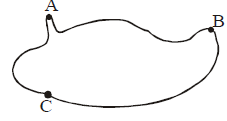
Figure shows a charged conductor of irregular shape. If \ ( \sigma_{A},\sigma_{B} and \sigma_{C}\) are the surface charge densities at A, B and C respectively, then :

Pointed ends have more surface charge density so,
\[\sigma_{A}>\sigma_{B} > \sigma_{C}\]
Two small spheres each carrying a charge q are placed r meter apart. If one of the sphere is taken around the other one in a circular path of radius r, the work done will be equal to:
The electrostatic force is conservative and directed radially. When moving in a circular path, the displacement is always perpendicular to the force, resulting in zero work done.
Assertion: No work is done in moving a test charge from one point to another over an equipotential surface.
Reason: Electric field is always normal to the equipotential surface at every point.
Since potential is constant on an equipotential surface, the work done in moving a charge is zero \(W = q \Delta V = 0\). This is because the electric field is always perpendicular to the displacement along the surface \(\vec{E} \cdot d\vec{r} = 0\).
Assertion: The distribution of charge given to a metallic sphere does not depend on whether it is hollow or solid.
Reason: The charge resides only at the surface of conductor.
Since charges repel, they reside entirely on the outer surface of metallic conductors. Thus, the charge distribution is identical for hollow and solid metallic spheres of the same radius.
A hollow metal sphere of radius 5 cm is charged so that the potential on its surface is 10 V. The potential at the centre of the sphere is :
Inside a hollow metal sphere, the electric field is zero. This implies the electric potential is constant throughout the interior and equal to the surface potential of 10 V.
A large sphere \( P \) of radius \( R \) is charged positively. It is momentarily connected to a small sphere \( Q \) of radius \( r \). The two spheres now have same
When two conductors are connected by a conducting path (like a wire), charge flows between them until they reach electrostatic equilibrium, which means they acquire the same electrical potential.