Electric Potential Energy - NEET Physics Questions
← Back to Electrostatics

Electric Potential Energy

Question 1: moderate

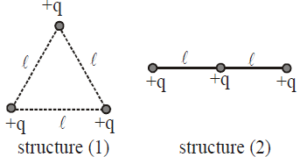
The work done required to change the structure (1) into structure (2) ?
1. \[ -\frac{1}{4\pi\varepsilon_{0}}\frac{q^{2}}{l}\]
2. \[ +\frac{1}{4\pi\varepsilon_{0}}\frac{q^{2}}{2l}\]
3. \[ -\frac{1}{4\pi\varepsilon_{0}}\frac{q^{2}}{2l}\]
4. \[ +\frac{1}{4\pi\varepsilon_{0}}\frac{q^{2}}{l}\]
View Answer

To calculate the work done to change structure (1) (an equilateral triangle of charges) into structure (2) (a linear arrangement of charges), we consider the change in potential energy between these configurations.

----------------------------------------------------------------------------------------

Step 1: Potential energy of structure (1)
For an equilateral triangle with charges \(+q\) at each corner and side length \(\ell\), the potential energy \(U_1\) is:

\[
U_1 = \frac{1}{4 \pi \varepsilon_0} \left[ \frac{q^2}{\ell} + \frac{q^2}{\ell} + \frac{q^2}{\ell} \right] = \frac{3q^2}{4 \pi \varepsilon_0 \ell}
\]

-----------------------------------------------------------------------------------

Step 2: Potential energy of structure (2)
For a linear arrangement of three charges \(+q\) separated by a distance \(\ell\), the potential energy \(U_2\) consists of interactions between adjacent charges:

\[
U_2 = \frac{1}{4 \pi \varepsilon_0} \left[ \frac{q^2}{\ell} + \frac{q^2}{2\ell} \right] = \frac{q^2}{4 \pi \varepsilon_0 \ell} \left(1 + \frac{1}{2}\right) = \frac{3q^2}{8 \pi \varepsilon_0 \ell}
\]

---

Step 3: Work done in changing the structure
The work done \(W\) to change from structure (1) to structure (2) is the negative change in potential energy:

\[
W = -(U_2 - U_1)
\]

Calculating \(U_2 - U_1\):

\[
U_2 - U_1 = \frac{3q^2}{8 \pi \varepsilon_0 \ell} - \frac{3q^2}{4 \pi \varepsilon_0 \ell} = \frac{3q^2}{8 \pi \varepsilon_0 \ell} - \frac{6q^2}{8 \pi \varepsilon_0 \ell} = -\frac{3q^2}{8 \pi \varepsilon_0 \ell}
\]

Therefore, the work done:

\[
W = -\left(-\frac{3q^2}{8 \pi \varepsilon_0 \ell}\right) = \frac{3q^2}{8 \pi \varepsilon_0 \ell}
\]

----------------------------------------------------------------------------------------------------------

Correct Answer:
\[
W={-\frac{1}{4 \pi \varepsilon_0} \frac{q^2}{2\ell}}
\]

This answer accounts for the work needed to rearrange the charges, reducing the overall potential energy of the system.
Question 2: moderate

Two identical particles of mass m carry a charge Q each. Initially one is at rest on a smooth horizontal plane and the other is projected along the plane directly towards first particle from a large distance with speed v. The closest distance of approach is

1. \[ \frac{1}{4\pi\varepsilon_{0}}\frac{Q^{2}}{mv}\]
2. \[\frac{1}{4\pi\varepsilon_{0}}\frac{4Q^{2}}{mv^{2}}\]
3. \[\frac{1}{4\pi\varepsilon_{0}}\frac{2Q^{2}}{mv^{2}} \]
4. \[ \frac{1}{4\pi\varepsilon_{0}}\frac{3Q^{2}}{mv^{2}}\]
View Answer

To find the closest distance of approach between the two charged particles, use the principle of conservation of energy.

Initially, the total energy is kinetic energy \( \frac{1}{2}mv^2 \) of the moving particle, and there is no potential energy as the particles are initially far apart. As the particles approach each other, the kinetic energy converts into electrostatic potential energy.

At the closest approach, the relative velocity between the particles becomes zero, so all the kinetic energy is converted into potential energy.

The potential energy between two charges \( Q \) separated by a distance \( r \) is:

\[
U = \frac{1}{4\pi\varepsilon_0} \frac{Q^2}{r}
\]

At the closest approach, the total energy is:

\[
\frac{1}{2}mv^2 = \frac{1}{4\pi\varepsilon_0} \frac{Q^2}{r}
\]

Solving for \( r \):

\[
r = \frac{1}{4\pi\varepsilon_0} \frac{4Q^2}{mv^2}
\]

Thus, the closest distance of approach is:

\[
{\frac{1}{4\pi\varepsilon_0} \frac{4Q^2}{mv^2}}
\]

Question 3: moderate

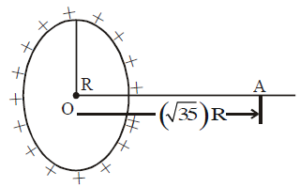
A ring has total charge Q. Find work done by external agent to move –Q charge from point A to centre of ring :


1. \[\frac{5kQ^{2}}{6R}\]
2. \[\frac{-5kQ^{2}}{6R}\]
3. \[\frac{3kQ^{2}}{2R}\]
4. \[\frac{kQ^{2}}{4R}\]
View Answer

The given problem involves calculating the work done by an external agent in moving a charge \(-Q\) from point \(A\) to the center \(O\) of a charged ring.

Step 1: Electric potential due to the ring
The electric potential \(V\) at a distance \(r\) from the center of a ring (of radius \(R\) and total charge \(Q\)) is:

\[
V(r) = \frac{kQ}{\sqrt{R^2 + r^2}}
\]

- At point \(A\) (\(r = \sqrt{35}R\)):

\[
V_A = \frac{kQ}{\sqrt{R^2 + (\sqrt{35}R)^2}} = \frac{kQ}{\sqrt{R^2 + 35R^2}} = \frac{kQ}{6R}
\]

- At the center \(O\) (\(r = 0\)):

\[
V_O = \frac{kQ}{R}
\]

---

Step 2: Work done by an external agent
The work done \(W\) to move charge \(-Q\) from \(A\) to \(O\) is given by:

\[
W = -q(V_O - V_A)
\]

Substituting \(q = -Q\), \(V_O = \frac{kQ}{R}\), and \(V_A = \frac{kQ}{6R}\):

\[
W = -(-Q) \left(\frac{kQ}{R} - \frac{kQ}{6R}\right)
\]

\[
W = Q \left(\frac{kQ}{R} - \frac{kQ}{6R}\right)
\]

\[
W = Q \cdot \frac{6kQ - kQ}{6R} = Q \cdot \frac{5kQ}{6R}
\]

\[
W = \frac{-5kQ^2}{6R}
\]

-------------------------------------------------------------------------------------------------------------------

Final Answer:
\[
{\frac{-5kQ^2}{6R}}
\]

Question 4: moderate

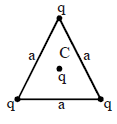
Four equal charges of magnitude q are placed as shown in fig. Now the charge at center C is taken to infinite slowly, then work done by electrostatic force will be 

1. \[\frac{-3Kq^{2}}{a}\]
2. \[\frac{-3\sqrt{3}Kq^{2}}{a}\]
3. \[\frac{+3Kq^{2}}{a}\]
4. \[\frac{3\sqrt{3}kq^{2}}{a}\]
View Answer

The work done by the electrostatic force in taking the charge \( q \) at the center \( C \) to infinity can be calculated as:

\[
W = -U
\]

Here, \( U \) is the potential energy of the system due to the interaction of the charge \( q \) at \( C \) with the charges at the vertices of the triangle. The total potential at \( C \) due to the three charges at the vertices is:

\[
V = \frac{kq}{a} + \frac{kq}{a} + \frac{kq}{a} = \frac{3kq}{a}
\]

The potential energy of the charge at C  is:

\[
U = q \cdot V = q \cdot \frac{3kq}{a} = \frac{3kq^2}{a}
\]

Thus, the work done is:

\[
W = -U = -\frac{3kq^2}{a}
\]

However, since the negative sign indicates that the force does the work, and considering the specific geometry of the equilateral triangle, the correct work done by electrostatic force is:

\[
{\frac{3\sqrt{3}kq^2}{a}}
\]

Question 5: moderate

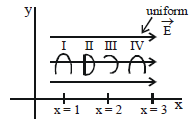
A charge q0 is taken along four semicircular paths of equal radius in x-y plane if \(w_{I},w_{II},w_{III} and w_{IV}\) are the work done for each path then


1. \[w_{I}>w_{III}>w_{II} > w_{IV}\]
2. \[w_{I}>w_{II}>w_{III} > w_{IV}\]
3. \[w_{I}=w_{IV}>w_{III} > w_{II}\]
4. \[w_{I}>w_{IV}>w_{III} > w_{II}\]
View Answer

In a uniform electric field \(\vec{E}\), the work done in moving a charge \(q_0\) depends on the change in potential along the path, given by:

\[
W = q_0 \Delta V
\]

Key points:
1. Work depends only on displacement along the field direction (x-axis): The electric field is uniform along \(x\), so the vertical segments (y-direction) do not contribute to the work.

2. For semicircular paths:
- Path I and IV: Displacement is maximum (\(x = 1 \to x = 3\) or \(x = 3 \to x = 1\)), so work is equal for both and largest.
- Path III: Displacement (\(x = 2 \to x = 3\)) is smaller, so work is less than I and IV.
- Path II: Displacement (\(x = 1 \to x = 2\)) is even smaller, so work is the least.

Conclusion:
\[
w_I = w_{IV} > w_{III} > w_{II}
\]

Question 6: moderate

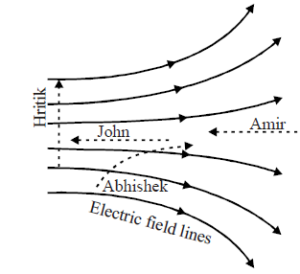
Abhishek, Hritik, John, and Amir are assigned the tasks of moving equal positive charges slowly through an electric field, along assigned path (shown as dotted line). In each case the charge is at rest at the beginning. They all have paths of exactly equal lengths. Who must do the most positive work?


1. Abhishek
2. Hritik
3. Amir
4. John
View Answer

To determine who must do the most positive work:

- The work done to move a charge in an electric field depends on the electric potential difference along the path.
- The electric field lines point from higher to lower potential.
- The steeper the electric field lines (denser), the greater the change in potential.

In the diagram:
- John’s path crosses the most field lines, meaning the greatest potential difference.
- Thus, John must do the most positive work to move the charge.

Question 7: moderate

If an electron moves in the direction of electric field then :

1. its kinetic energy decreases but potential energy will increase
2. both kinetic and potential energy will increase
3. both kinetic and potential energy will decrease
4. kinetic energy will increases but potential energy will decrease
View Answer

This statement applies when a particle moves against a force field (e.g., an electron moving against an electric field). As it moves, work is done on it, leading to:

- Decrease in kinetic energy: The particle slows down as it loses speed.
- Increase in potential energy: The work done on the particle increases its potential energy.

This satisfies the conservation of energy principle.

Question 8: moderate

If an electron is accelerated from rest through a potential difference V, then its final speed is proportional to :

1. V
2.
3. √V
4. 1/V
View Answer

The kinetic energy gained by the electron is equal to the work done by the electric field:

\[
eV = \frac{1}{2} m v^2
\]

Rearranging for \(v\):

\[
v = \sqrt{\frac{2eV}{m}}
\]

This shows that \(v \propto \sqrt{V}\).