Electric Potential Energy - NEET Physics Questions
← Back to Electrostatics

Electric Potential Energy

Question 1: easy

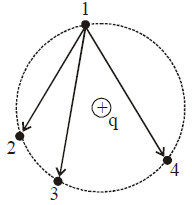
In the electrostatic field of a point charge q from point 1(Figure) we moved one and the same charge to points 2, 3, 4. Find work done on the charge during the movement in each case and compare them.
 

1. W2 < W3 > W4
2. W2 < W3 < W4
3. W2 = W3 = W4
4. W2 = W4 < W3
View Answer

Explanation and Solution

The work done by an electrostatic field in moving a charge from one point to another depends only on the electric potential difference between the two points, since the electrostatic force is conservative.

---

Given:
- We have a point charge \(q\) at the center of a circle.
- Points 1, 2, 3, and 4 lie on the same circle around the charge \(q\).

Step 1: Understand the electric potential
The electric potential \(V\) at any point on a circle centered around the charge \(q\) is the same because:

\[
V = \frac{kq}{r}
\]

where \(r\) is the radius of the circle. Since points 1, 2, 3, and 4 are equidistant from \(q\), the potential at all these points is identical.

---

Step 2: Work done in moving a charge
The work done \(W\) in moving a charge \(Q\) from one point to another in an electrostatic field is given by:

\[
W = Q (V_{\text{final}} - V_{\text{initial}})
\]

Since the potential \(V\) is the same at points 2, 3, and 4, the potential difference for each movement is zero:

\[
V_{\text{final}} = V_{\text{initial}}
\]

Thus, for movements from point 1 to points 2, 3, and 4, the work done:

\[
W_2 = W_3 = W_4 = 0
\]

---

Final Comparison:
The work done \(W_2\), \(W_3\), and \(W_4\) are all equal. Hence:

\[
{W_2 = W_3 = W_4 = 0}
\]

This result arises because the electric field is conservative and the movement is along an equipotential surface.

Question 2: easy

When a positive charge is released and moves in electric field, it moves towards a position of

1. lower electric potential and lower potential energy
2. lower electric potential and higher potential energy
3. higher electric potential and lower potential energy
4. higher electric potential and higher potential energy
View Answer

A positive charge, when released in an electric field:

- Moves along the direction of the electric field.
- Electric field lines point from higher potential to lower potential.
- As the charge moves to a lower electric potential, its potential energyΒ also decreases because:

\[
U = qV
\]

For a positive charge (\(q > 0\)), both \(V\) and \(U\) decrease. Hence, the charge moves toward lower electric potential and lower potential energy.

Question 3: easy

An elementary particle of mass m and charge +e is projected with velocity v at a much more massive fixed particle of charge Ze, where Z > 0. What is the closest possible approach of the incident particle?

1. \( \frac{Ze^2}{2\pi\varepsilon_0 m v^2} \)
2. \( \frac{Ze}{4\pi\varepsilon_0 m v^2} \)
3. \( \frac{Ze^2}{8\pi\varepsilon_0 m v^2} \)
4. \( \frac{Ze}{8\pi\varepsilon_0 m v^2} \)
View Answer

At the distance of closest approach \( r_0 \), the kinetic energy is completely converted into electrostatic potential energy: \( \frac{1}{2} m v^2 = \frac{1}{4 \pi \varepsilon_0} \frac{Ze^2}{r_0} \). Rearranging gives \( r_0 = \frac{Ze^2}{2\pi\varepsilon_0 m v^2} \).