Electric Flux - NEET Physics Questions
Question 1: easy

How much electric flux will come out through a surface of area vector \(\overrightarrow{S}=10\hat{j}\) kept in an electrostatic field \(E=2\hat{j}+4\hat{j}+3\hat{k} \)?

1. 20 units
2. 40 units
3. 30 units
4. 90 units
View Answer

The electric flux is given by:

\[
\Phi = \overrightarrow{E} \cdot \overrightarrow{S}
\]

Here, \(\overrightarrow{E} = 2\hat{i} + 4\hat{j} + 3\hat{k}\) and \(\overrightarrow{S} = 10\hat{j}\).

\[
\Phi = (2\hat{i} + 4\hat{j} + 3\hat{k}) \cdot (10\hat{j}) = 0 + 4 \cdot 10 + 0 = 40 \, \text{units}.
\]

Question 2: easy

A point charge + Q is positioned at the center of the base of a square pyramid as shown. The flux through one of the four identical upper faces of the pyramid is


1. \[ \frac{Q}{16\varepsilon_{0}}\]
2. \[ \frac{Q}{4\varepsilon_{0}}\]
3. \[ \frac{Q}{8\varepsilon_{0}}\]
4. None of these
View Answer

Step-by-Step Explanation:

1. Flux through the Entire Pyramid:
The total charge enclosed by the pyramid is \(+Q\), and the total flux through the entire closed surface of the pyramid is given by Gauss's law:
\[
\Phi_{\text{total}} = \frac{Q}{\varepsilon_0}.
\]

2. Flux Distribution:
The pyramid has a square base and four triangular faces. However, **the charge \(+Q\) is located at the center of the base, not at the geometric center of the pyramid.** This means the flux through the base is not zero and contributes to the total flux.

3. Flux Through the Base:
Due to symmetry, half of the total flux passes through the square base:
\[
\Phi_{\text{base}} = \frac{\Phi_{\text{total}}}{2} = \frac{Q}{2\varepsilon_0}.
\]

4. Flux Through the Four Triangular Faces:
The remaining half of the total flux passes through the four triangular faces combined:
\[
\Phi_{\text{triangular (total)}} = \frac{\Phi_{\text{total}}}{2} = \frac{Q}{2\varepsilon_0}.
\]

5. Flux Through One Triangular Face:
Since the four triangular faces are identical, the flux is equally distributed among them:
\[
\Phi_{\text{face}} = \frac{\Phi_{\text{triangular (total)}}}{4} = \frac{\frac{Q}{2\varepsilon_0}}{4} = \frac{Q}{8\varepsilon_0}.
\]

Final Answer:
The flux through one triangular face is:
\[
{\frac{Q}{8\varepsilon_0}}.
\]

Question 3: easy

A cylinder of radius R and length L is placed in a uniform electric field E parallel to the cylinder axis. The total flux from the surface of the cylinder is:

1. \[2\pi R^{2}E\]
2. \[\pi R^{2}E\]
3. \[\left( \pi R^{2}+\pi R^{2} \right)/E\]
4. zero
View Answer

Since the electric field \( E \) is parallel to the cylinder's axis, the field lines enter and exit symmetrically through the two flat circular ends. The curved surface has no perpendicular component of the field, so no flux passes through it.

By Gauss's law, the net flux through the entire surface is:
\[
\Phi = \text{Charge enclosed} / \varepsilon_0
\]

As no charge is enclosed, \( \Phi = 0 \).

Question 4: easy

The electric flux Φ through a hemisphere surface of radius R, placed in a uniform electric field of intensity E parallel to the axis of its circular plane is:

1. \[2\pi RE\]
2. \[2\pi R^{2}E\]
3. \[\pi R^{2}E\]
4. \[\left( 4/3 \right)\pi R^{3}E\]
View Answer

The electric flux through the hemisphere is due to the uniform electric field passing perpendicularly through the circular plane of radius \( R \).

Flux through the circular plane:
\[
\Phi = E \cdot \text{Area of circular plane} = E \cdot \pi R^2
\]

Since no flux passes through the curved surface (field is parallel to it), the total flux is:
\[
\Phi = \pi R^2 E
\]

Question 5: easy

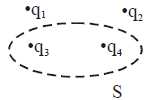
Figure shows four charges q1, q2, q3 and q4 fixed in space. Then the total flux of electric field through a closed surface S, due to all charges q1, q2, q3, and q4 is :

1. not equal to the total flux through S due to charges q3 and q4.
2. equal to the total flux through S due to charges q3 and q4.
3. zero if q1 + q2 = q3 + q4
4. twice the total flux through S due to charges q3 and q4 if q1 + q2 = q3 + q4
View Answer

Gauss's law states that the total electric flux passing through a closed surface is equal to the charge enclosed within the surface divided by the permittivity of the medium.

In short: The net electric field around a closed surface depends on the charge inside it.