Electric Flux - NEET Physics Questions
Question 1: difficult

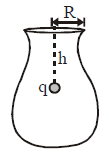
Consider the situation shown in figure. A point charge q is placed at a depth h= √3R exactly below the centre of mouth of a vessel whose open end is circular having a radius R. Calculate the electric flux through the lateral surface of this vessel.
1. \[ \frac{q}{2\epsilon_{0}}\left( 1-\frac{\sqrt{3}}{2} \right)\]
2. \[ \frac{q}{2\epsilon_{0}}\left( 1+\frac{\sqrt{3}}{2} \right)\]
3. \[ \frac{q}{\epsilon_{0}}\]
4. \[ \frac{q}{2\epsilon_{0}}\left(\frac{\sqrt{3}}{2} \right)\]
View Answer

To calculate the electric flux through the lateral surface of the vessel, we apply Gauss's lawΒ and consider the symmetry of the system.

---=====================================

Step-by-Step Solution:

1. Total Flux from the Charge \(q\):
The total flux emitted by the point charge \(q\) in all directions is:
\[
\Phi_{\text{total}} = \frac{q}{\varepsilon_0}.
\]

2. Flux Through the Circular Mouth:
Using the geometry of the vessel, the charge \(q\) is placed at a depth \(h = \sqrt{3}R\). The flux through the circular mouth of radius \(R\) can be calculated as:
\[
\Phi_{\text{mouth}} = \frac{q}{2\varepsilon_0}.
\]

3. Flux Through the Lateral Surface
By symmetry, the flux through the lateral surface is the remaining flux from the total flux after subtracting the flux through the mouth:
\[
\Phi_{\text{lateral}} = \Phi_{\text{total}} - \Phi_{\text{mouth}}.
\]

4. Simplify:
Substitute the values:
\[
\Phi_{\text{lateral}} = \frac{q}{\varepsilon_0} - \frac{q}{2\varepsilon_0}.
\]
\[
\Phi_{\text{lateral}} = \frac{q}{2\varepsilon_0} \left(1 + \frac{\sqrt{3}}{2}\right).
\]

----------------------------------------------------------------------------------------

Final Answer:
The electric flux through the lateral surface of the vessel is:
\[
{\frac{q}{2\varepsilon_0} \left( 1 + \frac{\sqrt{3}}{2} \right)}.
\]
Question 2: difficult

It is required to hold equal charges q in equilibrium at the corners of a square. What charge when placed at the centre of the square will do this ?

1. \[ -\frac{q}{2}\left( 1+2\sqrt{2} \right)\]
2. \[ \frac{q}{2}\left( 1+2\sqrt{2} \right)\]
3. \[ \frac{q}{4}\left( 1+2\sqrt{2} \right)\]
4. \[ -\frac{q}{4}\left( 1+2\sqrt{2} \right)\]
View Answer

To hold equal charges \(q\) in equilibrium at the corners of a square, we need to place a charge \(Q\) at the center of the square such that the net force on each corner charge due to other charges is balanced.

1. Force due to corner charges:
Each charge \(q\) at the corners experiences repulsive forces due to the other three corner charges. The net force from these three charges is:
\[
F_{\text{corners}} = q \cdot \frac{1}{4\pi\varepsilon_0} \left( \frac{2}{a^2} + \frac{\sqrt{2}}{a^2} \right) = \frac{q^2}{4\pi\varepsilon_0 a^2} \left( 2 + \sqrt{2} \right),
\]
where \(a\) is the side of the square.

2. Force due to center charge \(Q\):
The attractive force due to the central charge \(Q\) on each corner charge is:
\[
F_{\text{center}} = \frac{1}{4\pi\varepsilon_0} \cdot \frac{qQ}{r^2},
\]
where \(r = \frac{a}{\sqrt{2}}\) is the distance from the center to a corner. Substituting \(r\):
\[
F_{\text{center}} = \frac{qQ}{4\pi\varepsilon_0 \cdot \frac{a^2}{2}} = \frac{2qQ}{4\pi\varepsilon_0 a^2}.
\]

3. Equilibrium condition:
For equilibrium, \(F_{\text{corners}} = F_{\text{center}}\):
\[
\frac{q^2}{4\pi\varepsilon_0 a^2} \left( 2 + \sqrt{2} \right) = \frac{2qQ}{4\pi\varepsilon_0 a^2}.
\]

4. Solve for \(Q\):
\[
Q = \frac{q}{2} \left( 2 + \sqrt{2} \right).
\]
Since \(Q\) is opposite in sign to \(q\), the final charge is:
\[
Q = -\frac{q}{4} \left( 1 + 2\sqrt{2} \right).
\]

Thus, the required charge at the center is:

\[
Q = -\frac{q}{4} \left( 1 + 2\sqrt{2} \right).
\]

Question 3: difficult

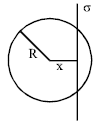
An infinite, uniformly charged sheet with surface charge density Οƒ cuts through a spherical Gaussian surface of radius R at a distance x from its center, as shown in the figure. The electric flux Ξ¦ through the Gaussian surface is :

1. \[ \frac{\pi R^{2}\sigma}{\varepsilon_{0}}\]
2. \[ \frac{2\pi \left( R^{2}-x^{2} \right)\sigma}{\varepsilon_{0}}\]
3. \[ \frac{\pi \left( R-x \right)^{2}\sigma}{\varepsilon_{0}}\]
4. \[ \frac{\pi \left( R^{2}-x^{2} \right)\sigma}{\varepsilon_{0}}\]
View Answer

The electric flux \(\Phi\) through the Gaussian surface can be found using Gauss's law:

\[
\Phi = \frac{q_{\text{enc}}}{\epsilon_0}
\]

Here, \(q_{\text{enc}}\) is the charge enclosed by the spherical Gaussian surface.

Since the infinite sheet has a uniform surface charge density \(\sigma\), the charge enclosed is the product of \(\sigma\) and the area of the sheet that lies inside the sphere. The area of the sheet within the sphere is the area of the circle formed by the intersection, which has a radius \(r\) determined by the geometry of the sphere and the plane.

1. The radius of the intersection circle is \(r = \sqrt{R^2 - x^2}\).
2. The area of this circle is \(A = \pi r^2 = \pi (R^2 - x^2)\).

Thus, the enclosed charge is:

\[
q_{\text{enc}} = \sigma A = \sigma \pi (R^2 - x^2).
\]

Substituting this into Gauss's law:

\[
\Phi = \frac{\sigma \pi (R^2 - x^2)}{\epsilon_0}.
\]

So, the electric flux through the Gaussian surface is:

\[
\Phi = \frac{\sigma \pi (R^2 - x^2)}{\epsilon_0}.
\]

Question 4: difficult

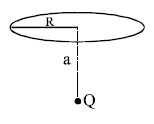
A point charge Q is located on the axis of a disc of radius R at a distance a from the plane of the disc. If one fourth (1/4th) of the flux from the charge passes through the disc, then find the relation between a & R.


1. a = R/2
2. \[ a =\frac{R}{\sqrt{3}}\]
3. a = R
4. \[ a =\frac{R}{\sqrt{2}}\]
View Answer

To solve the problem using the formula:

\[
\Phi = \frac{Q}{2\varepsilon_0} \left(1 - \cos\theta\right),
\]

where \(\theta\) is the half-angle subtended by the disc at the charge, follow these steps:

1. The flux through the disc is given to be one-fourth of the total flux:
\[
\Phi = \frac{1}{4} \cdot \frac{Q}{\varepsilon_0}.
\]

Substituting this into the formula:
\[
\frac{1}{4} \cdot \frac{Q}{\varepsilon_0} = \frac{Q}{2\varepsilon_0} \left(1 - \cos\theta\right).
\]

2. Simplify:
\[
\frac{1}{4} = \frac{1}{2} \left(1 - \cos\theta\right).
\]

3. Multiply through by 2:
\[
\frac{1}{2} = 1 - \cos\theta.
\]

4. Solve for \(\cos\theta\):
\[
\cos\theta = 1 - \frac{1}{2} = \frac{1}{2}.
\]

5. Using the geometry, \(\cos\theta = \frac{a}{\sqrt{a^2 + R^2}}\). Substituting:
\[
\frac{a}{\sqrt{a^2 + R^2}} = \frac{1}{2}.
\]

6. Square both sides:
\[
\frac{a^2}{a^2 + R^2} = \frac{1}{4}.
\]

7. Rearrange:
\[
4a^2 = a^2 + R^2.
\]

\[
3a^2 = R^2.
\]

8. Solve for \(a\):
\[
a = \frac{R}{\sqrt{3}}.
\]

Thus, the relation is:

\[
a = \frac{R}{\sqrt{3}}.
\]