A and B are two points on a uniform ring of resistance R. The ∠ACB = θ, where C is the centre of the ring. The equivalent resistance between A and B is
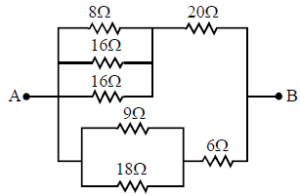
The equivalent resistance of the network shown in the figure between the points A and B is :-

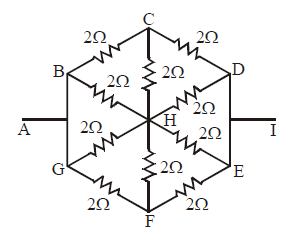
The effective resistance across the points A and I is :-

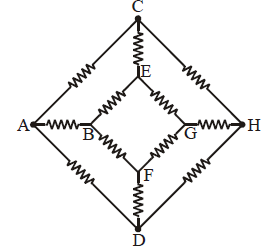
Twelve resistors each of resistance 1 Ω are connected in the circuit shown in the figure. Net resistance between points A and H would be :-

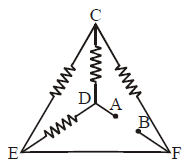
In the given network of resistors, each of resistance R ohm, the equivalent resistance between points A and B is :-

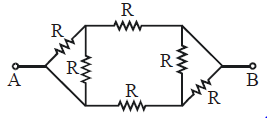
Equivalent resistance between A and B is:

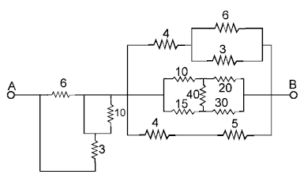
Find the equivalent resistance between point A and B. (all resistors are in ohms)

Which of the following is not possible by combination of four resistors each equal to \(8 \Omega \)?
With four \(8 \Omega \) resistors, the minimum possible equivalent resistance is when all four are in parallel: \(R_{min} = 8/4 = 2 \Omega\). Thus, \(1\Omega\) is impossible.
Five resistors, each of resistance \(R\) are connected in series to an ideal battery. When these resistors are connected in parallel to the same battery, the current through the battery is increased \(n\) times. The value of \(n\) is
The equivalent resistance in series is \(R_s = 5R\) and in parallel is \(R_p = \frac{R}{5}\). Since current \(I = \frac{V}{R_{eq}}\), we have \(\frac{I_p}{I_s} = \frac{R_s}{R_p} = \frac{5R}{R/5} = 25\). Thus, \(n = 25\).
The effective resistance of a parallel connection that consists of four wires of equal length, equal area of cross section and same material is 0.25 \(\Omega\). What will be the effective resistance if they are connected in series?
For four identical wires of resistance \(R\) connected in parallel, \(R_p = \frac{R}{4} = 0.25, \Omega ⇒ R = 1, \Omega\). In series, \(R_s = 4R = 4 \times 1, \Omega = 4, \Omega\).