Combination of Capacitors - NEET Physics Questions
← Back to Capacitors

Combination of Capacitors

Question 1: easy

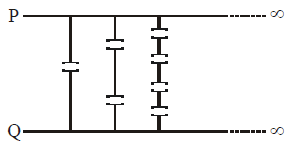
If each capacitor has C = I F, the capacitance across P and Q is:
 

1. 0.5 F
2. 1 F
3. 2 F
4. infinity
View Answer

First Branch has a capacitance of 1F , for second branch it is 1/2F , for third branch it is 1/4 F and so, on . As all these branches are in parallel

\[ C_{eq}=C_{1}+C_{2}+C_{3}+....\]

\[ C_{eq}= 1 + \frac{1}{2} + \frac{1}{4}+ \frac{1}{8}+....=\frac{1}{1-\frac{1}{2}}=2\mu F\]
Question 2: easy

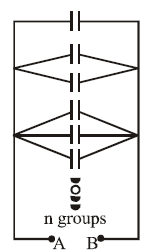
A number of capacitors, each of equal capacitance C, are arranged as shown in Fig. The equivalent capacitance between A and B is:

1. n²C
2. (2n + 1) C
3. \[\frac{\left( n-1 \right)n}{2}C\]
4. \[\frac{\left( n+1 \right)n}{2}C\]
View Answer

The figure shows

nn

groups of capacitors arranged in a specific pattern. Here's the reasoning for the given answer:

Solution:

  1. Each group consists of a series arrangement of capacitors with equal capacitance
    CC
     

    .

  2. The number of capacitors in each successive group increases by one, forming a triangular pattern:
    • 1st group: 1 capacitor,
    • 2nd group: 2 capacitors in series,
    • 3rd group: 3 capacitors in series, and so on, up to
      nn
       

      capacitors in the last group.

  3. Capacitance of a single group:
    • For
      kk
       

      capacitors in series, the equivalent capacitance is: Ck=CkC_k = \frac{C}{k} 

  4. Net capacitance:
    • These groups are connected in parallel. The total equivalent capacitance
      CeqC_{eq}
       

      is the sum of the capacitances of all groups: Ceq=āˆ‘k=1nCk=āˆ‘k=1nCkC_{eq} = \sum_{k=1}^{n} C_k = \sum_{k=1}^{n} \frac{C}{k} 

  5. Simplify:
    • The sum of the reciprocals of integers up to
      nn
       

      is: Ceq=Cā‹…(1+12+13+⋯+1n)C_{eq} = C \cdot \left( 1 + \frac{1}{2} + \frac{1}{3} + \dots + \frac{1}{n} \right) 

    • After simplifications, the given result:
      Ceq=(n+1)n2CC_{eq} = \frac{(n+1)n}{2}C
       

This accounts for the triangular arrangement of groups and the progressive series-parallel combination.

Question 3: easy

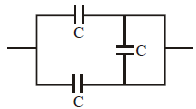
The equivalent capacitance of the combination shown in figure is :

1. C
2. 2C
3. 3/2
4. C/2
View Answer


Reason for the Short Circuit:

The middle capacitor is bypassed by a conducting wire (short circuit). Hence, no voltage difference exists across the middle capacitor, and it can be ignored in the calculation.


Simplified Circuit:

  1. The circuit reduces to two capacitors
    CC
     

    at the top and bottom in parallel.

  2. For capacitors in parallel, the equivalent capacitance is simply the sum of their capacitances:
    Ceq=C+C=2CC_{\text{eq}} = C + C = 2C
     

Final Answer:

The equivalent capacitance of the given combination is 2C.

Question 4: easy

Two capacitors \( C_1 \) and \( C_2 \) are charged to \( 120\text{V} \) and \( 200\text{V} \) respectively. It is found that by connecting them together the potential on each one can be made zero. Then :

1. \( 5C_1 = 3C_2 \)
2. \( 3C_1 = 5C_2 \)
3. \( 3C_1 + 5C_2 = 0 \)
4. \( 9C_1 = 4C_2 \)
View Answer

For the common potential to be zero, the initial charges on the capacitors must be equal in magnitude and connected with opposite polarities: \( q_1 = q_2 \Rightarrow 120 C_1 = 200 C_2 \Rightarrow 3 C_1 = 5 C_2 \).

Question 5: easy

A capacitor of capacitance \( 1\ \mu\text{F} \) can withstand a potential difference of \( 6\text{V} \) and another capacitor of \( 1\ \mu\text{F} \) can withstand a potential difference of \( 4\text{V} \). If they are connected in series, the combination can withstand a potential difference of

1. \( 3\text{V} \)
2. \( 4\text{V} \)
3. \( 6\text{V} \)
4. \( 8\text{V} \)
View Answer

Since both capacitors are in series and have equal capacitance, the total potential difference divides equally between them. The maximum potential is limited by the weaker capacitor: \( V_{\text{max}} = 2 \times 4\text{V} = 8\text{V} \).

Question 6: easy

Two conduction spheres of radii \(R_1\) and \(R_2\) are kept widely separated from each other. If the spheres are connected by a metal wire, what will be the capacitance of the combination? Think in terms of series-parallel connections.

1. \(4 \pi \epsilon_0 \frac{R_1 R_2}{R_1 + R_2}\)
2. \(4 \pi \epsilon_0 \frac{R_1 R_2}{R_1 - R_2}\)
3. \(4 \pi \epsilon_0 \sqrt{R_1 R_2}\)
4. \(4 \pi \epsilon_0 (R_1 + R_2)\)
View Answer

When widely separated conductors are connected, they are effectively in parallel as they share a common potential. The equivalent capacitance is the sum of individual capacitances: \(C_{eq} = C_1 + C_2 = 4 \pi \epsilon_0 R_1 + 4 \pi \epsilon_0 R_2 = 4 \pi \epsilon_0 (R_1 + R_2)\).