Newtons Law of Cooling - NEET Physics Questions
← Back to Thermal Physics

Newtons Law of Cooling

Question 1: easy

A liquid cools down from 70°C to 60°C in 5 minutes. The time taken to cool it from 60°C to 50°C will be

1. 5 minutes
2. Lesser than 5 minutes
3. Greater than 5 minutes
4. Lesser or greater than 5 minutes depending upon the density of the liquid
View Answer

According to Newton's law of cooling, the rate of cooling is proportional to the temperature difference between the object and its surroundings. As the liquid cools, the temperature difference between the liquid and the surroundings decreases, which slows down the rate of cooling.

Therefore, it will take greater than 5 minutes to cool from 60°C to 50°C, as the temperature difference is smaller, resulting in a slower cooling rate.

Question 2: easy

Newton’s law of cooling is used in laboratory for the determination of the

1. Specific heat of the gases
2. The latent heat of gases
3. Specific heat of liquids
4. Latent heat of liquids
View Answer

Newton’s law of cooling is used in the laboratory to determine the specific heat of gases by measuring the rate of temperature change of a heated gas as it cools in a controlled environment. By observing the cooling curve and applying the law, the specific heat can be calculated based on the energy lost over time, as it depends on the heat capacity of the gas.

Question 3: easy

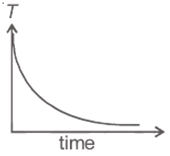
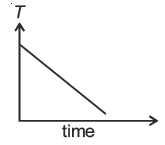
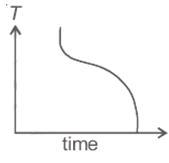
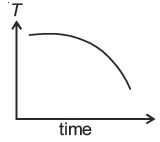
A block of metal is heated to a temperature much higher than the room temperature and allowed to cool in a room free from air currents. Which of the following curves correctly represents the cooling? (T : Temperature of block)

1.
2.
3.
4.
View Answer

To derive the exponential equation for Newton's law of cooling, we start with the differential form of Newton's law:

\[
\frac{dT}{dt} = -k (T - T_s)
\]

where:
- \( T \) is the temperature of the object at time \( t \),
- \( T_s \) is the temperature of the surroundings (constant),
- \( k \) is a positive constant of proportionality.

Step 1: Separate Variables
We can rewrite the equation as:
\[
\frac{dT}{T - T_s} = -k \, dt
\]

 Step 2: Integrate Both Sides
Integrate both sides with respect to \( T \) and \( t \):
\[
\int \frac{1}{T - T_s} \, dT = -\int k \, dt
\]

This gives:
\[
\ln |T - T_s| = -kt + C
\]

where \( C \) is the integration constant.

Step 3: Exponentiate Both Sides
Exponentiate both sides to remove the logarithm:
\[
T - T_s = e^{-kt + C} = Ce^{-kt}
\]

where \( C = e^C \) is a new constant.

Step 4: Apply Initial Condition
Let \( T(0) = T_0 \), where \( T_0 \) is the initial temperature of the object. Then:
\[
T_0 - T_s = Ce^0 = C
\]

Thus, \( C = T_0 - T_s \), and the solution becomes:
\[
T = T_s + (T_0 - T_s)e^{-kt}
\]

Final Equation
\[
T(t) = T_s + (T_0 - T_s)e^{-kt}
\]

This is the exponential cooling equation that describes the temperature \( T \) of the object over time according to Newton's law of cooling. So the graph is exponentially decreasing function

Question 4: easy

A cup of coffee cools from \(90^\circ\text{C}\) to \(80^\circ\text{C}\) in \(t\) minutes, when the room temperature is \(20^\circ\text{C}\). The time taken by a similar cup of coffee to cool from \(80^\circ\text{C}\) to \(60^\circ\text{C}\) at a room temperature same at \(20^\circ\text{C}\) is

1. \(\frac{5}{13}t\)
2. \(\frac{13}{10}t\)
3. \(\frac{13}{5}t\)
4. \(\frac{10}{13}t\)
View Answer

According to Newton's law of cooling, \(\frac{T_1 - T_2}{\Delta t} = K\left(\frac{T_1+T_2}{2} - T_0\right)\). For the first interval, \(\frac{10}{t} = 65K\). For the second interval, \(\frac{20}{t'} = 50K\). Dividing these equations yields \(t' = \frac{13}{5}t\).