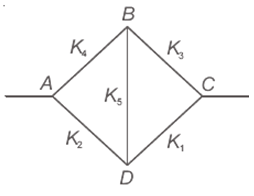
Five rods of same dimensions are arranged as shown in the figure. They have thermal conductivities K1, K2, K3, K4 and K5. When points A and C are maintained at different temperature, no heat flows through the central rod if
1. K1 = K4 and K2 = K3
2. K1K4 = K2K3
3. K1K2 = K3K4
4. \frac{K_{1}}{K_{4}}=\frac{K_{2}}{K_{3}}
View Answer
No heat flows through the central rod \(K_5\) if the system is balanced like a Wheatstone bridge. The condition for this is:
\[
\frac{K_1}{K_2} = \frac{K_3}{K_4}
\]
This ensures that the temperature difference between points B and D is zero, preventing any heat flow through \(K_5\).
The temperature gradient in a rod \(0.5\text{ m}\) long is \(80^\circ\text{C/m}\). If temperature of hotter end is \(30^\circ\text{C}\), then temperature of the colder end will be
1. \(0^\circ\text{C}\)
2. \(20^\circ\text{C}\)
3. \(10^\circ\text{C}\)
4. \(-10^\circ\text{C}\)
View Answer
Temperature gradient is defined as \(\frac{T_{\text{hot}} - T_{\text{cold}}}{L}\). Substituting the values, \(80 = \frac{30 - T_{\text{cold}}}{0.5}\). This simplifies to \(30 - T_{\text{cold}} = 40\), which gives \(T_{\text{cold}} = -10^\circ\text{C}\).
Consider the following statements:
(A) Convection involves flow of matter within a fluid due to unequal temperatures of its parts.
(B) The change of solid state to vapour state without passing through liquid state is called sublimation.
Based on above information, pick correct option.
1. Both statements are correct
2. Both statements are incorrect
3. Only statement A is correct
4. Only statement B is correct
View Answer
Statement A is correct as thermal convection is driven by density variations arising from unequal temperature distributions in fluids. Statement B is also correct as sublimation is the direct phase transition from solid to gas.
Assertion (A): A hot iron bar placed under a running tap loses heat by convection.
Reason (R): Convection involves flow of matter within a fluid due to unequal temperature of its parts.
1. Both (A) & (R) are true and the (R) is the correct explanation of the (A)
2. Both (A) & (R) are true but the (R) is not the correct explanation of the (A)
3. (A) is true but (R) is false
4. Both (A) and (R) are false
View Answer
Assertion (A) is true; heat loss from a hot bar to running water is a classic example of forced convection. Reason (R) correctly defines convection as heat transfer by bulk fluid movement due to temperature differences. Thus, both are true and (R) correctly explains (A).
Assertion (A): When you touch two bodies, the body which is felt warmer must be of higher temperature than the other one.
Reason (R): The heat flows from lower temperature to higher temperature.
1. Both (A) & (R) are true and the (R) is the correct explanation of the (A)
2. Both (A) & (R) are true but the (R) is not the correct explanation of the (A)
3. (A) is true but (R) is false
4. Both (A) and (R) are false
View Answer
Assertion (A) is true; sensation of warmth indicates heat flow to the body from the object. Reason (R) is false; heat always flows from higher to lower temperature. Thus, (A) is true but (R) is false.
Assertion (A): High thermal conductivity of metals is due to presence of free electrons.
Reason (R): Electrons at same temperature have very high average velocity than atoms.
1. Both (A) & (R) are true and the (R) is the correct explanation of the (A)
2. Both (A) & (R) are true but the (R) is not the correct explanation of the (A)
3. (A) is true but (R) is false
4. Both (A) and (R) are false
View Answer
Assertion (A) is true, free electrons are primary carriers of heat in metals. Reason (R) is true;
Electrons have higher velocity due to smaller mass at same kinetic energy. This high velocity enables efficient heat transfer, explaining (A). Both are true and (R) explains (A).
Assertion (A): Ice is placed at top of the bucket to cold the water.
Reason (R): Heat transfer by convection takes place in upward direction.
1. (1) Both (A) & (R) are true and the (R) is the correct explanation of the (A)
2. (2) Both (A) & (R) are true but the (R) is not the correct explanation of the (A)
3. (3) (A) is true but (R) is false
4. (4) Both (A) and (R) are false
View Answer
When ice is placed at the top, the water layer near the ice cools, becomes denser, and sinks. Warmer, less dense water from below rises to the top to be cooled by the ice. This sets up convection currents, efficiently cooling the entire volume. Thus, heat is transferred upwards to the ice by the rising warmer water. Both A and R are true, and R correctly explains A.
Assertion (A): Snow is better insulator than ice.
Reason (R): Snow contain air packet and air is bad conductor of heat.
1. (1) Both (A) & (R) are true and the (R) is the correct explanation of the (A)
2. (2) Both (A) & (R) are true but the (R) is not the correct explanation of the (A)
3. (3) (A) is true but (R) is false
4. (4) Both (A) and (R) are false
View Answer
Snow traps air, and air is a very poor conductor of heat. Therefore, snow acts as a better insulator than solid ice. Both assertion and reason are true, and the reason correctly explains the assertion.
Assertion (A): Snow is better insulator than ice.
Reason (R): Snow contain air packet and air is bad conductor of heat.
1. Both (A) & (R) are true and the (R) is the correct explanation of the (A)
2. Both (A) & (R) are true but the (R) is not the correct explanation of the (A)
3. (A) is true but (R) is false
4. Both (A) and (R) are false
View Answer
Snow traps air, making it a poor conductor of heat. Air is a bad conductor, hence snow acts as a better insulator than solid ice.
Assertion (A): Woolen clothes keep the body warm in winter.
Reason (R): Woolen fibres enclose a large amount of air in them & both air and wool are the bad conductors of heat.
1. Both (A) & (R) are true and the (R) is the correct explanation of the (A)
2. Both (A) & (R) are true but the (R) is not the correct explanation of the (A)
3. (A) is true but (R) is false
4. Both (A) and (R) are false
View Answer
Woolen clothes trap air, which is a poor conductor of heat, reducing heat loss from the body. Wool itself is also a poor conductor. Both A and R are true, and R explains A.