Two coaxial cylinders of radius r and 3r are made of material of thermal conductivity K1 and K2 respectively. The equivalent thermal conductivity of substance for axial heat flow may be
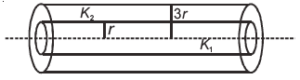
The system shows two coaxial cylinders made of materials with different thermal conductivities (\(K_1\) and \(K_2\)) and radii \(r\) and \(3r\). For axial heat flow, the conductivities act in parallel.
To find the equivalent thermal conductivity (\(K_{\text{eq}}\)) of the entire system, we use the formula for thermal conductivities in parallel, similar to how resistances in parallel are treated for electrical systems:
\[
K_{\text{eq}} = \frac{K_1 A_1 + K_2 A_2}{A_1 + A_2}
\]
Where:
- \(A_1 = \pi r^2\) is the area of the inner cylinder.
- \(A_2 = \pi (3r)^2 - \pi r^2\ = 8\pi r^2\) is the area of the outer cylinder.
Substituting into the equation:
\[
K_{\text{eq}} = \frac{K_1 (\pi r^2) + K_2 (8\pi r^2)}{\pi r^2 + 8\pi r^2}
\]
Simplifying:
\[
K_{\text{eq}} = \frac{K_1 + 8K_2}{1 + 8} = \frac{K_1 + 8K_2}{9}
\]
Thus, the equivalent thermal conductivity is:
\[
K_{\text{eq}} = \frac{K_1 + 8K_2}{9}
\]