Solid and Fluids - NEET Physics Questions
← All Chapters

Solid and Fluids

Question 31: moderate

The terminal velocity of a copper ball of radius 2.0 mm falling through a tank of oil at 20Β°C is 6.5 cms–1. Calculate the viscosity of the oil at 20Β°C. (Density of oil is \[1.7\times 10^{3}kgm^{-3}\] and density of copper is \[8.9\times 10^{3}kgm^{-3}\]) :
1. \[0.69 kg m^{-1} s^{-1}\]
2. \[0.79 kg m^{-1} s^{-1}\]
3. \[0.29 kg m^{-1} s^{-1}\]
4. \[0.99 kg m^{-1} s^{-1}\]
View Answer
Question 32: moderate

A lead sphere of mass m falls in viscous liquid with terminal velocity v0. Another lead sphere of mass M falls through the same viscous liquid with terminal velocity 4v0. the ratio M/m is :

1. 2
2. 4
3. 8
4. 16
View Answer
Question 33: easy

A cubical box of wood of side 30 cm weighing 21.6 kg floats on water with two faces horizontal. Calculate the depth of immersion of wood.

1. 30 cm
2. 24 cm
3. 20 cm
4. 15 cm
View Answer
Question 34: moderate

A sample of metal weights 210 gram in air, 180 gram in water and 120 gram in an unknown liquid. Then:

1. the density of metal is 3 g/cm3
2. the density of metal is 7 g/cm3
3. density of metal is 4 times the density of the unknown liquid
4. the metal will float in water
View Answer
Question 35: difficult

Two non-mixing liquids of densities \[\rho\] and \[n\rho(n>1)\] are put in a container. The height of each liquid is h. A solid cylinder of length L and density d is put in this container. The cylinder floats with its axis vertical and length pL(p < 1) in the denser liquid. The density d is equal to :

1. \[\left\{ {1+(n+1)p} \right\}\rho\]
2. \[\left\{ {2+(n+1)p} \right\}\rho\]
3. \[\left\{ {2+(n-1)p} \right\}\rho\]
4. \[\left\{ {1+(n-1)p} \right\}\rho\]
View Answer
Question 36: difficult

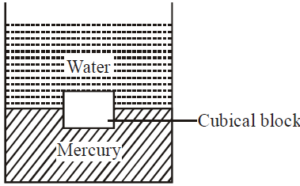
A tank contains water on top of mercury as shown in figure. A cubical block of side 10 cm is in equilibrium inside the tank. The depth of the block inside mercury is (RD of the material of block = 8.56, RD of mercury = 13.6)

1. 6 cm
2. 5 cm
3. 7 cm
4. 8 cm
View Answer
Question 37: moderate

The reading of spring balance when a block is suspended from it in air, is 60 N. This reading is changed to 40 N when the block is immersed in water. The specific gravity of the block is :

1. 3
2. 2
3. 6
4. 3/2
View Answer

Solution:

  • Loss of weight in water = $$\text{Weight in air} - \text{Weight in water} = 60\text{ N} - 40\text{ N} = 20\text{ N}$$

  • Specific gravity = $$\frac{\text{Weight in air}}{\text{Loss of weight in water}} = \frac{60}{20} = 3$$

Therefore, the specific gravity of the block is 3 (Option 1).

Question 38: moderate

An open U-tube contains mercury. When 11.2 cm of water is poured into one of the arms of the tube, how high does the mercury rise in the other arm from its initial level ?

1. 0.82 cm
2. 1.35 cm
3. 0.41 cm
4. 2.32 cm
View Answer

When 11.2 cm of water is poured into one arm, it balances a mercury column of height 2x, where x is the height the mercury rises in the other arm.

Using the pressure balance equation (density of water * height of water = density of mercury * 2x), we get 1 * 11.2 = 13.6 * 2x. Solving for x yields 0.41 cm, making Option 3 the correct answer.

Question 39: difficult

A wind with speed 40 m/s blows parallel to the roof of a house. The area of the roof is 250 m2. Assuming that the pressure inside the house is atmospheric pressure, the force exerted by the wind on the roof and the direction of the force will be: \[(\rho_{air}=1.2 kg/m^{3})\]

1. \[4.8\times 10^{5} N, upwards\]
2. \[2.4\times 10^{5} N, upwards\]
3. \[2.4\times 10^{5} N, downwards\]
4. \[4.8\times 10^{5} N, downwards\]
View Answer

Here is the short, step-by-step solution for your WordPress post:

Solution:

According to Bernoulli's principle, the high-speed wind blowing outside creates a low-pressure region ($P_{out}$) above the roof compared to the atmospheric pressure ($P_{in}$) inside.

$$\Delta P = P_{in} - P_{out} = \frac{1}{2}\rho v^2$$

Substituting the given values, the upward lifting force exerted on the roof is:

$$F = \Delta P \times A = \left(\frac{1}{2} \times 1.2 \times 40^2\right) \times 250 = 2.4 \times 10^5\text{ N (upwards)}$$

Correct Option: Option 2 ($2.4\times 10^{5}\text{ N, upwards}$)

Question 40: moderate

A large open tank has two holes in the wall. One is a square hole of side L at a depth y from the top and the other is a circular hole of radius R at a depth 4y from the top. When the tank is completely filled with water, the quantities of
water flowing out per second from the holes are both same. Then, R is equal to:

1. \[\frac{L}{\sqrt{2\pi}}\]
2. \[2\pi L\]
3. L
4. \[\frac{L}{2\pi}\]
View Answer

According to Torricelli's Law, the velocity of efflux from a hole at a depth hΒ is given by $$v = \sqrt{2gh}$$.

Since the volume flow rate per second

\( Q = \text{Area}\times\text{Velocity} \) is the same for both holes:

$$A_{\text{square}} \cdot v_1 = A_{\text{circle}} \cdot v_2$$
$$L^2 \sqrt{2gy} = (\pi R^2) \sqrt{2g(4y)}$$
$$L^2 = \pi R^2 \cdot 2$$
$$R = \frac{L}{\sqrt{2\pi}}$$

Thus, the correct option is Option 1.