Solid and Fluids - NEET Physics Questions
← All Chapters

Solid and Fluids

Question 11: moderate

Two wires are made of the same material and have the same volume. However wire 1 has cross-sectional area A and wire 2 has cross-sectional area 3A. If the length of wire 1 increases by \[\Delta x\] on applying force F, how much force is needed to stretch wire 2 by the same amount ?
1. 6F
2. 9F
3. F
4. 4F
View Answer
Question 12: moderate

Two wires are made of same material and have same volume. However wire -1 has cross-sectional area A and wire-2 has cross-sectional area 3A. If length of wire -1 increases by \[\Delta x\] on applying force F, how much force is needed to stretch wire-2 by same amount ?

1. F
2. 4F
3. 6F
4. 9F
View Answer
Question 13: easy

A wire suspended vertically from one of its ends is stretched by attaching a weight of 200 N to the lower end. The weight stretches the wire by 1mm, then elastic energy stored in wire is :

1. 0.1 J
2. 0.2 J
3. 10 J
4. 20 J
View Answer
Question 14: easy

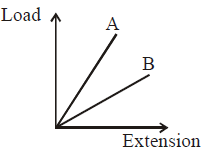
The dimensions of two wires A and B are same but their materials are different. Their load extension graphs are shown if \[y_{A} and y_{B}\] are the values of young’s modulus of elasticity of ‘A and ‘B’ respectively then :

1. \[y_{A} > y_{B}\]
2. \[y_{A} < y_{B}\]
3. \[y_{A} = y_{B}\]
4. \[y_{B} = 2y_{A}\]
View Answer
Question 15: moderate

If \[\rho\] is density of the material of a wire and \[\sigma\] is the breaking stress, the greatest length of the wire that can hang freely without breaking is :

1. \[\frac{2\sigma}{\rho g}\]
2. \[\frac{\rho}{\sigma g}\]
3. \[\frac{\rho g}{2\sigma}\]
4. \[\frac{\sigma}{\rho g}\]
View Answer
Question 16: moderate

Two wires of the same material & length but diameters in the ratio 1 : 2 are stretched by the same force. The potential energy per unit volume for the two wires when stretched will be in the ratio :

1. 16 : 1
2. 4 : 1
3. 2 : 1
4. 1 : 1
View Answer
Question 17: moderate

A tank is filled with water to a height H. A hole is made in one of the wall at a depth D below the water surface. The distance x from the foot of the wall at which the stream of water strikes the ground is given by :

1. \[ x=2[D(H+D)]^{1/2}\]
2. \[ x=2[DH]^{1/2}\]
3. \[ x=2[D(H-D)]^{1/2}\]
4. \[ x=2[gD]^{1/2}\]
View Answer
Question 18: moderate

A cylindrical tank has a hole of area 0.5 cm2 in its bottom. If the water is allowed to flow into the tank from a tube above it at the rate of 70 cm3/sec then the maximum height upto which water can rise in the tank is :

1. 2.5 cm
2. 5 cm
3. 10 cm
4. 0.25 cm
View Answer
Question 19: easy

Two unequal soap bubbles are formed one on each side of a tube closed in the middle by a tap. What happens when the tap is opened to put the two bubbles in communication ?

1. No air passes in any direction as the pressure are same on two sides of the tap  
2. Large bubble shrinks and smaller bubble increases in size till they become equal in size
3. Smaller bubble gradually collapses and the bigger one increase in size
4. None of the above
View Answer
Question 20: easy

The radii of the two columns in U tube are r1 and r2 (r1 > r2). When a liquid of density \[\rho\] (angle of contact is 0ΒΊ) is filled in it, the level difference of liquid in two arms is h. The surface tension of liquid is (g = acceleration due to gravity):

1. \[\frac{\rho ghr_{1}r_{2}}{2(r_{1}-r_{2})}\]
2. \[\frac{\rho gh(r_{1}-r_{2})}{2r_{1}r_{2}}\]
3. \[\frac{2 (r_{2}-r_{1})}{\rho ghr_{1}r_{2}}\]
4. \[\frac{\rho gh}{2(r_{2}-r_{1})}\]
View Answer