The density of the atmosphere at sea level is 1.3 kg/m3. Assume it does not change with altitude and g = 10 ms–2, how high would the atmosphere extend ?
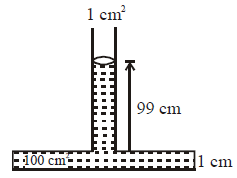
A tube 1 cm2 in cross-section is attached to the top of a vessel 1 cm high and of cross-section 100 cm2. Water is poured into the system filling it to a depth of 100 cm above the bottom of the vessel as shown in figure. Take g = 10 ms–2. Now,

A ball floats on the surface of water in a container exposed to the atmosphere. When the container is covered and the air is partially removed, then the ball : [Consider buoyancy effect of air also]
A body with a volume V neither sinks nor floats in a liquid. If the vessel containing the liquid falls with an acceleration g/3 , then the volume of the solid inside the liquid in the falling condition is:
A cylindrical piece of cork of density \[\rho\] of base area A and height h floats in a liquid of density \[\rho\acute{}\]. The cork is slightly depressed and then released. The time period of oscillation of the cork is :
A cubical box of wood of side 30 cm weighing 21.6 kg floats on water with two faces horizontal. Calculate the depth of immersion of wood.
A sample of metal weights 210 gram in air, 180 gram in water and 120 gram in an unknown liquid. Then:
Two non-mixing liquids of densities \[\rho\] and \[n\rho(n>1)\] are put in a container. The height of each liquid is h. A solid cylinder of length L and density d is put in this container. The cylinder floats with its axis vertical and length pL(p < 1) in the denser liquid. The density d is equal to :
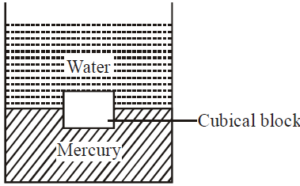
A tank contains water on top of mercury as shown in figure. A cubical block of side 10 cm is in equilibrium inside the tank. The depth of the block inside mercury is (RD of the material of block = 8.56, RD of mercury = 13.6)

The reading of spring balance when a block is suspended from it in air, is 60 N. This reading is changed to 40 N when the block is immersed in water. The specific gravity of the block is :
Solution:
-
Loss of weight in water = $$\text{Weight in air} - \text{Weight in water} = 60\text{ N} - 40\text{ N} = 20\text{ N}$$
-
Specific gravity = $$\frac{\text{Weight in air}}{\text{Loss of weight in water}} = \frac{60}{20} = 3$$
Therefore, the specific gravity of the block is 3 (Option 1).