A tank is filled with water to a height H. A hole is made in one of the wall at a depth D below the water surface. The distance x from the foot of the wall at which the stream of water strikes the ground is given by :
A cylindrical tank has a hole of area 0.5 cm2 in its bottom. If the water is allowed to flow into the tank from a tube above it at the rate of 70 cm3/sec then the maximum height upto which water can rise in the tank is :
A fully loaded Boeing aircraft has a mass of \[3.3\times 10^{5} kg\]. Its total wing area is 500 m2. It is in level flight with speed of 960 kmph. Estimate the pressure difference between the lower and upper surfaces of the wings :
A capillary tube of length L and radius R is joined to another tube of length L/3 and radius R/2 . A fluid is flowing through this tube. If the pressure difference across the first tube is P, then the pressure difference across the second tube is :
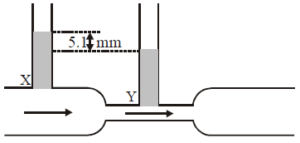
Figure shows a venturi meter, through which water is flowing. The speed of water at X is 2 cm/s. The speed of water at Y is :- (Take g = 1000 cm /s.s)

A water tank of height 10 m, completely filled with water is placed on a level ground. It has two holes one at 3 m and the other at 7 m from its base. The water ejecting from :
A wind with speed 40 m/s blows parallel to the roof of a house. The area of the roof is 250 m2. Assuming that the pressure inside the house is atmospheric pressure, the force exerted by the wind on the roof and the direction of the force will be: \[(\rho_{air}=1.2 kg/m^{3})\]
Here is the short, step-by-step solution for your WordPress post:
Solution:
According to Bernoulli's principle, the high-speed wind blowing outside creates a low-pressure region ($P_{out}$) above the roof compared to the atmospheric pressure ($P_{in}$) inside.
Substituting the given values, the upward lifting force exerted on the roof is:
Correct Option: Option 2 ($2.4\times 10^{5}\text{ N, upwards}$)
A large open tank has two holes in the wall. One is a square hole of side L at a depth y from the top and the other is a circular hole of radius R at a depth 4y from the top. When the tank is completely filled with water, the quantities of
water flowing out per second from the holes are both same. Then, R is equal to:
According to Torricelli's Law, the velocity of efflux from a hole at a depth hΒ is given by $$v = \sqrt{2gh}$$.
Since the volume flow rate per second
\( Q = \text{Area}\times\text{Velocity} \) is the same for both holes:
Thus, the correct option is Option 1.
A tank is filled to a height H. The range of water coming out of a hole which is a depth H/4 from the surface of water level is :
The horizontal range of water emerging from a hole is given by the formula
$$R = 2\sqrt{h(H - h)} $$