If force of cohesion of liquid is three times the force of adhesion between liquid and glass tube molecules, then the shape of meniscus of liquid in this glass tube is:
The density of the atmosphere at sea level is 1.3 kg/m3. Assume it does not change with altitude and g = 10 ms–2, how high would the atmosphere extend ?
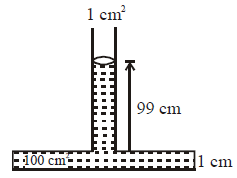
A tube 1 cm2 in cross-section is attached to the top of a vessel 1 cm high and of cross-section 100 cm2. Water is poured into the system filling it to a depth of 100 cm above the bottom of the vessel as shown in figure. Take g = 10 ms–2. Now,

A ball floats on the surface of water in a container exposed to the atmosphere. When the container is covered and the air is partially removed, then the ball : [Consider buoyancy effect of air also]
A body with a volume V neither sinks nor floats in a liquid. If the vessel containing the liquid falls with an acceleration g/3 , then the volume of the solid inside the liquid in the falling condition is:
A cylindrical piece of cork of density \[\rho\] of base area A and height h floats in a liquid of density \[\rho\acute{}\]. The cork is slightly depressed and then released. The time period of oscillation of the cork is :
A fully loaded Boeing aircraft has a mass of \[3.3\times 10^{5} kg\]. Its total wing area is 500 m2. It is in level flight with speed of 960 kmph. Estimate the pressure difference between the lower and upper surfaces of the wings :
A capillary tube of length L and radius R is joined to another tube of length L/3 and radius R/2 . A fluid is flowing through this tube. If the pressure difference across the first tube is P, then the pressure difference across the second tube is :
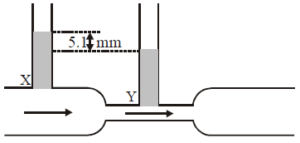
Figure shows a venturi meter, through which water is flowing. The speed of water at X is 2 cm/s. The speed of water at Y is :- (Take g = 1000 cm /s.s)

A water tank of height 10 m, completely filled with water is placed on a level ground. It has two holes one at 3 m and the other at 7 m from its base. The water ejecting from :