Solid and Fluids - NEET Physics Questions
← All Chapters

Solid and Fluids

Question 11: moderate

A tank is filled with water to a height H. A hole is made in one of the wall at a depth D below the water surface. The distance x from the foot of the wall at which the stream of water strikes the ground is given by :
1. \[ x=2[D(H+D)]^{1/2}\]
2. \[ x=2[DH]^{1/2}\]
3. \[ x=2[D(H-D)]^{1/2}\]
4. \[ x=2[gD]^{1/2}\]
View Answer
Question 12: moderate

A cylindrical tank has a hole of area 0.5 cm2 in its bottom. If the water is allowed to flow into the tank from a tube above it at the rate of 70 cm3/sec then the maximum height upto which water can rise in the tank is :

1. 2.5 cm
2. 5 cm
3. 10 cm
4. 0.25 cm
View Answer
Question 13: moderate

The density of the atmosphere at sea level is 1.3 kg/m3. Assume it does not change with altitude and g = 10 ms–2, how high would the atmosphere extend ?

1. 8 km
2. 10 km
3. 12 km
4. 16 km
View Answer
Question 14: moderate

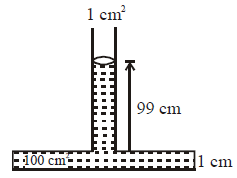
A tube 1 cm2 in cross-section is attached to the top of a vessel 1 cm high and of cross-section 100 cm2. Water is poured into the system filling it to a depth of 100 cm above the bottom of the vessel as shown in figure. Take g = 10 ms–2. Now,

1. Force exerted by the water against the bottom of the vessel is 100 N.
2. Weight of water in the system is 1.99 N.
3. Both (1) and (2) are correct.
4. Neither (1) nor (2) is correct.
View Answer
Question 15: moderate

A body with a volume V neither sinks nor floats in a liquid. If the vessel containing the liquid falls with an acceleration g/3 , then the volume of the solid inside the liquid in the falling condition is:

1. V
2. V/2
3. V/3
4. V/6
View Answer
Question 16: moderate

A fully loaded Boeing aircraft has a mass of \[3.3\times 10^{5} kg\]. Its total wing area is 500 m2. It is in level flight with speed of 960 kmph. Estimate the pressure difference between the lower and upper surfaces of the wings :

1. \[4.5\times 10^{3} N/m^{-2}\]
2. \[5.5\times 10^{3} N/m^{-2}\]
3. \[6.6\times 10^{3} N/m^{-2}\]
4. \[7.5\times 10^{3} N/m^{-2}\]
View Answer
Question 17: moderate

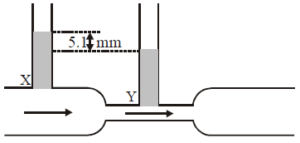
Figure shows a venturi meter, through which water is flowing. The speed of water at X is 2 cm/s. The speed of water at Y is :- (Take g = 1000 cm /s.s)

1. \[23 cm s^{-1}\]
2. \[32 cm s^{-1}\]
3. \[101 cm s^{-1}\]
4. \[1024 cm s^{-1}\]
View Answer
Question 18: moderate

The terminal velocity of a copper ball of radius 2.0 mm falling through a tank of oil at 20°C is 6.5 cms–1. Calculate the viscosity of the oil at 20°C. (Density of oil is \[1.7\times 10^{3}kgm^{-3}\] and density of copper is \[8.9\times 10^{3}kgm^{-3}\]) :

1. \[0.69 kg m^{-1} s^{-1}\]
2. \[0.79 kg m^{-1} s^{-1}\]
3. \[0.29 kg m^{-1} s^{-1}\]
4. \[0.99 kg m^{-1} s^{-1}\]
View Answer
Question 19: moderate

A lead sphere of mass m falls in viscous liquid with terminal velocity v0. Another lead sphere of mass M falls through the same viscous liquid with terminal velocity 4v0. the ratio M/m is :

1. 2
2. 4
3. 8
4. 16
View Answer
Question 20: moderate

A sample of metal weights 210 gram in air, 180 gram in water and 120 gram in an unknown liquid. Then:

1. the density of metal is 3 g/cm3
2. the density of metal is 7 g/cm3
3. density of metal is 4 times the density of the unknown liquid
4. the metal will float in water
View Answer