Fluid Dynamics - NEET Physics Questions
Question 1: moderate

A tank is filled with water to a height H. A hole is made in one of the wall at a depth D below the water surface. The distance x from the foot of the wall at which the stream of water strikes the ground is given by :
1. \[ x=2[D(H+D)]^{1/2}\]
2. \[ x=2[DH]^{1/2}\]
3. \[ x=2[D(H-D)]^{1/2}\]
4. \[ x=2[gD]^{1/2}\]
View Answer
Question 2: moderate

A cylindrical tank has a hole of area 0.5 cm2 in its bottom. If the water is allowed to flow into the tank from a tube above it at the rate of 70 cm3/sec then the maximum height upto which water can rise in the tank is :

1. 2.5 cm
2. 5 cm
3. 10 cm
4. 0.25 cm
View Answer
Question 3: moderate

A fully loaded Boeing aircraft has a mass of \[3.3\times 10^{5} kg\]. Its total wing area is 500 m2. It is in level flight with speed of 960 kmph. Estimate the pressure difference between the lower and upper surfaces of the wings :

1. \[4.5\times 10^{3} N/m^{-2}\]
2. \[5.5\times 10^{3} N/m^{-2}\]
3. \[6.6\times 10^{3} N/m^{-2}\]
4. \[7.5\times 10^{3} N/m^{-2}\]
View Answer
Question 4: moderate

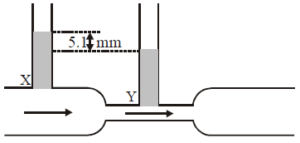
Figure shows a venturi meter, through which water is flowing. The speed of water at X is 2 cm/s. The speed of water at Y is :- (Take g = 1000 cm /s.s)

1. \[23 cm s^{-1}\]
2. \[32 cm s^{-1}\]
3. \[101 cm s^{-1}\]
4. \[1024 cm s^{-1}\]
View Answer
Question 5: moderate

A large open tank has two holes in the wall. One is a square hole of side L at a depth y from the top and the other is a circular hole of radius R at a depth 4y from the top. When the tank is completely filled with water, the quantities of
water flowing out per second from the holes are both same. Then, R is equal to:

1. \[\frac{L}{\sqrt{2\pi}}\]
2. \[2\pi L\]
3. L
4. \[\frac{L}{2\pi}\]
View Answer

According to Torricelli's Law, the velocity of efflux from a hole at a depth hΒ is given by $$v = \sqrt{2gh}$$.

Since the volume flow rate per second

\( Q = \text{Area}\times\text{Velocity} \) is the same for both holes:

$$A_{\text{square}} \cdot v_1 = A_{\text{circle}} \cdot v_2$$
$$L^2 \sqrt{2gy} = (\pi R^2) \sqrt{2g(4y)}$$
$$L^2 = \pi R^2 \cdot 2$$
$$R = \frac{L}{\sqrt{2\pi}}$$

Thus, the correct option is Option 1.

Question 6: moderate

A tank is filled to a height H. The range of water coming out of a hole which is a depth H/4 from the surface of water level is :

1. \[\frac{2H}{\sqrt{3}}\]
2. \[\frac{\sqrt{3}H}{2}\]
3. \[\sqrt{3}H\]
4. \[\frac{3H}{4}\]
View Answer

The horizontal range of water emerging from a hole is given by the formula

$$R = 2\sqrt{h(H - h)} $$

$$R = 2\sqrt{\left(\frac{H}{4}\right)\left(\frac{3H}{4}\right)} = 2\left(\frac{\sqrt{3}H}{4}\right) = \frac{\sqrt{3}H}{2}$$