Modern Physics - NEET Physics Questions
← All Chapters

Modern Physics

Question 41: moderate

If the kinetic energy of the particle is increased to 16 times its previous value, the percentage
change in the de-Broglie wavelength of the particle is :
1. 25
2. 75
3. 60
4. 50
View Answer
Question 42: easy

Fusion reaction takes place at high temperature because :

1. Molecules break up at high temperature
2. Nuclei break up at high temperature
3. Atoms get ionised at high temperature
4. Kinetic energy is high enough to overcome the coulomb repulsion between nuclei
View Answer
Question 43: moderate

A radio isotope ‘X’ with a half life \[1.4\times 10^{9} years\] decays to ‘Y’ which is stable. A sample of the rock from a cave was found to contain ‘X’ and ‘Y’ in the ratio 1 : 7. The age of the rock is :

1. \[1.96\times 10^{9} years\]
2. \[3.92\times 10^{9} years\]
3. \[4.20\times 10^{9} years\]
4. \[8.40\times 10^{9} years\]
View Answer
Question 44: moderate

A common example of β-decay is

\[_{15}P^{32}\longrightarrow _{16}P^{32} + x + y\]

Then x and y stand for :

1. Electron and neutrino
2. Positron and neutrino
3. Electron and antineutrino
4. Positron and antineutrino
View Answer
Question 45: easy

In radioactive decay process, the negatively charged emitted β – particles are :

1. the electrons orbiting around the nucleus
2. the electrons present inside the nucleus
3. the electrons produced as a result of the decay of neutrons inside the nucleus
4. the electrons produced as a result of collisions between atoms
View Answer
Question 46: difficult

Half life of a radio-active substance is 20 minutes. The time between 20% and 80% decay will be :

1. 20 minutes
2. 40 minutes
3. 30 minutes
4. 25 minutes
View Answer
Question 47: moderate

Initial number of nuclei of a radioactive substance is \[5\times 10^{16}\] and half life is 10 yrs. Find number of nuclei decayed in 5 yrs.

1. \[2\times 10^{16}\]
2. \[1.5\times 10^{16}\]
3. \[3.5\times 10^{16}\]
4. \[2.5\times 10^{16}\]
View Answer
Question 48: difficult

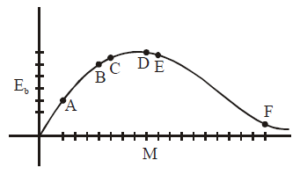
The above is a plot of binding energy per nucleon Eb, against the nuclear mass M; A, B, C, D, E, F correspond to different nuclei. Consider four reactions :

(i) A + B → C + ε

(ii) C → A + B + ε

(iii) D + E → F + ε

(iv) F → D + E + ε

where ε is the energy released ? In which reactions in ε positive :

1. (i) and (iv)
2. (i) and (iii)
3. (ii) and (iv)
4. (ii) and (iii)
View Answer
Question 49: easy

If the binding energy per nucleon of deuteron is 1.115 MeV, its mass defect in atomic mass unit is :

1. 0.0048
2. 0.0024
3. 0.0012
4. 0.0006
View Answer
Question 50: moderate

200 MeV of energy can be obtained by per fission. In a reactor generating 1000 kW find the number of nuclei under going the fission per second :

1. 1000
2. \[2\times 10^{8}\]
3. \[3.125\times 10^{16}\]
4. 931
View Answer