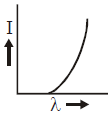
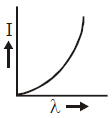
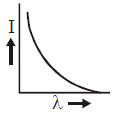
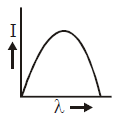
The anode voltage of a photocell is kept fixed. The wavelength λ of the light falling on the cathode is gradually changed. The plate current I of the photocell varies as given below :
A beam of fast moving α-particles was directed towards a thin film of gold. The part A’, B’ and C’ of the transmitted and reflected beams corresponding to the incident parts A, B and C of the beam are shown in the adjoining diagram. The number of α-particle in :

Binding energy per nucleon verses mass number curve for nuclei is shown in the figure. W, X, Y and Z are four nuclei indicated on the curve. The process that would release energy is :

The binding energies per nucleon of deuteron \[\left( _{1}H^{2} \right)\] and helium atom \[\left( _{2}He^{4} \right)\] are 1.1 MeV and 7 MeV. If two deuteron atoms react to form a single helium atom, then the energy released is:
If the momentum of an electron is changed by P, then de-Broglie wavelength associated with it
changes by 0.2%. The initial momentum of electron will be about :
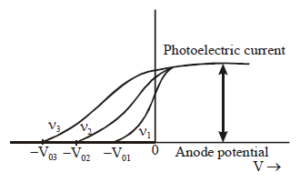
In photoelectric effect, the curve between photoelectric current and anode potential V (for
different frequencies) is shown in figure, then :

When the energy of the incident radiation is increased by 20%, the kinetic energy of the
photoelectrons emitted from a metal surface increased from 0.5eV to 0.8eV. The work
function of the metal is :
The de Broglie wavelength of an electron moving with a velocity
\[1.5\times 10^{8}m/s\] is equal to that of a photon. The ratio of the kinetic energy of the electron to the energy of the photon is :
A 200 W sodium street lamp emits yellow light of wavelength 0.6μm. Assuming it to be 25%
efficent converting electrical energy to light, the number of photons of yellow light it emits per
second is :
The ratio of wavelength of deutron and proton accelerated through the same potential difference will be :