Question 51:
moderate
Binding energy per nucleon plot against the mass number for stable nuclei is shown in the figure. Which curve is correct :
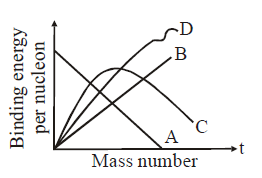
Binding energy per nucleon plot against the mass number for stable nuclei is shown in the figure. Which curve is correct :
Nuclear forces are :
The binding energy of deuteron \[_{1}^{2}H\] is 1.112 MeV per nucleon and an α-particle
\[_{2}He^{4}\] has a binding energy of 7.047 MeV per nucleon. Then in the fusion reaction
\[_{1}^{2}H+_{1}^{2}H\longrightarrow _{2}^{4}He+Q\] , the energy Q released is :
Which reaction is not the part of proton-proton cycle ?
In the stellar proton-proton chain reaction, deuterium fuses with a proton to form Helium-3, but deuterium does not fuse directly with another deuterium nucleus. Thus, reaction (2) is not part of this cycle.
The ground state energy of hydrogen atom is \(-13.6\text{ eV}\). The energy needed to ionize hydrogen atom from its second excited state will be
Second excited state corresponds to \(n = 3\). The energy is \(E_3 = -\frac{13.6}{3^2} = -1.51\text{ eV}\). The ionization energy required is \(E_{\text{ion}} = 0 - E_3 = 1.51\text{ eV}\).
The maximum kinetic energy of the emitted photoelectrons in photoelectric effects is independent of:
According to Einstein's photoelectric equation, \(K_{\text{max}} = h\nu - \phi\). The maximum kinetic energy depends on the frequency/wavelength of the incident light and the work function, but is independent of the intensity of the light.
The wavelength of Lyman series of hydrogen atom appears in
The Lyman series transitions terminate at the ground state (\(n = 1\)). The photon energies emitted in these transitions correspond to the ultraviolet region of the electromagnetic spectrum.
The de Broglie wavelength associated with an electron, accelerated by a potential difference of 81 V is given by:
The de Broglie wavelength for an electron accelerated through a potential \(V\) is given by \(\lambda = \frac{1.227}{\sqrt{V}}\text{ nm}\). Substituting \(V = 81\text{ V}\), we get \(\lambda = \frac{1.227}{9}\text{ nm} \approx 0.136\text{ nm}\).
Ratio of shortest wavelengths corresponding to Lyman and Balmer series in hydrogen spectrum is
The shortest wavelength in a series corresponds to transition from \(n_2 = \infty\) to \(n_1\). For Lyman series, \(\lambda_L = \frac{1}{R}\). For Balmer series, \(\lambda_B = \frac{4}{R}\). Therefore, the ratio \(\frac{\lambda_L}{\lambda_B} = \frac{1}{4}\).
Photocell is illuminated by a point source of light, which is placed at a distance \(d\) from the cell. If the distance becomes \(2d\), then number of electrons emitted per second will be
Intensity of light from a point source is inversely proportional to the square of the distance, \(I \propto \frac{1}{d^2}\). Since the number of photoelectrons emitted per second is proportional to intensity, doubling the distance reduces the emission to one-fourth.