Binding energy per nucleon verses mass number curve for nuclei is shown in the figure. W, X, Y and Z are four nuclei indicated on the curve. The process that would release energy is :
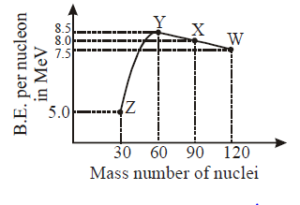
Binding energy per nucleon verses mass number curve for nuclei is shown in the figure. W, X, Y and Z are four nuclei indicated on the curve. The process that would release energy is :

Half life of a radio-active substance is 20 minutes. The time between 20% and 80% decay will be :

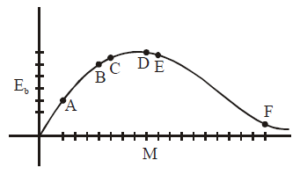
The above is a plot of binding energy per nucleon Eb, against the nuclear mass M; A, B, C, D, E, F correspond to different nuclei. Consider four reactions :
(i) A + B → C + ε
(ii) C → A + B + ε
(iii) D + E → F + ε
(iv) F → D + E + ε
where ε is the energy released ? In which reactions in ε positive :
The binding energy of deuteron \[_{1}^{2}H\] is 1.112 MeV per nucleon and an α-particle
\[_{2}He^{4}\] has a binding energy of 7.047 MeV per nucleon. Then in the fusion reaction
\[_{1}^{2}H+_{1}^{2}H\longrightarrow _{2}^{4}He+Q\] , the energy Q released is :