Question 81:
moderate
The radius of curvature of the path of the charged particle in a uniform magnetic field is directly proportional to
The radius of curvature of the path of the charged particle in a uniform magnetic field is directly proportional to
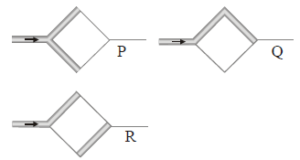
Two thick wires and two thin wires, all of the same materials and same length form a square in
the three different ways P, Q and R as shown in fig with current connection shown, the magnetic field at the centre of the square is zero in cases:
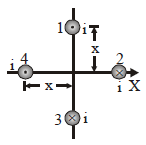
What will be the resultant magnetic field at origin due to four infinite length wires. If each wire produces magnetic field ‘B’ at origin:
A current I flows in a thin wire, shaped as regular polygon of n sides which can be
inscribed in a circle of radius R. The magnetic field induction at the centre of polygon due to
one side of the polygon is :
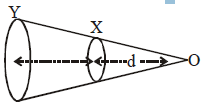
Two circular coils X and Y have equal number of turns and carry equal currents in the same sense and subtend same solid angle at point O. If the smaller coil X is midway between O and Y, then if we represent the magnetic induction due to bigger coil Y at O as BY and that due to smaller coil X at O as Bx :
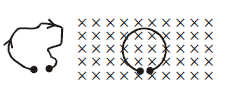
A thin flexible wire of length L is connected to two adjacent fixed points carries a current I in the clockwise direction, as shown in the figure. When system is put in a uniform magnetic field of strength B going into the plane of paper, the wire takes the shape of a circle. The tension in the wire is :
A bar magnet is placed inside a non-uniform magnetic field. It may experience :
Two particles, each of mass m and charge q, are attached to the two ends of a massless rigid rod of length 2R. The rod is rotated at constant angular speed about a perpendicular axis passing through its centre. The ratio of the magnitudes of the magnetic moment of the system and its angular momentum about the centre of the rod is :
The materials suitable for making electromagnets should have :
The universal property among all substances is: