Question 91:
moderate
A magnetic substance has susceptibility –0.05 at 300 K. The magnetic susceptibility of the substance at 600 K will be :
A magnetic substance has susceptibility –0.05 at 300 K. The magnetic susceptibility of the substance at 600 K will be :
Two very long straight parallel wires carry steady currents i and 2i in opposite directions. The
distance between the wires is d. At a certain instant of time a point charge q is at a point
equidistant from the two wires in the plane of the wires. Its instantaneous velocity \(\overrightarrow{v}\)
is perpendicular to this plane. The magnitude of the force due to the magnetic field acting on the charge at this instant is :
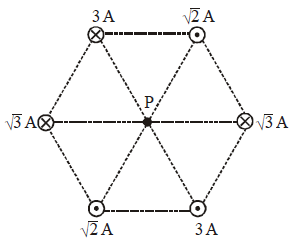
Consider a set of six infinite long straight parallel wires arranged perpendicular to the plane of paper in a hexagon as shown. The length of the each side of the hexagon is 3 cm. What is the magnitude and direction of the magnetic field at point P ?
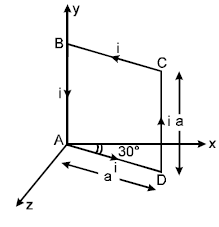
A square coil of side ‘a’ carrying current ‘ i ’ and is having one of its side AB parallel to
y-axis and its plane is at angle θ = 30° with x-axis. If a uniform magnetic field B exist in
the region along \[\hat{k}\] direction, then torque due to magnetic force on the coil is:
A long solenoid carrying a current produces a magnetic field B along its axis. If the current is
doubled and the number of turns per unit length is halved, the new value of the magnetic field
is :
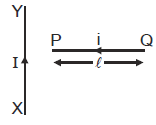
A wire PQ carries a current ‘i’ is placed perpendicular to a long wire XY carrying a current
I. The direction of force on PQ will be:
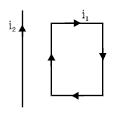
A rectangular loop carrying a current i1, is situated near a long straight wire carrying a steady current i2. The wire is parallel to one of the sides of the loop and is in the plane of the loop as shown in the figure. Then the current loop will :
A current carrying wire AC is placed in uniform transverse magnetic field then the force on wire AC :

Magnetic susceptibility of the following is :
Diamagnetic substances characterise by :