A proton, deutron and α-particle are accelerated by same potential, enters in uniform
magnetic field perpendicularly. Ratio of radii of circular path respectively :
Two particles X and Y having equal charges, after being accelerated through the same potential
difference, enter a region of uniform magnetic field and describe circular paths of radii R1 and
R2 respectively. The ratio of masses of X and Y is :
A beam of electrons is projected horizontally to the right. A straight conductor carrying a current is supported parallel to the electron beam and above it. If the current in the conductor is from left to right, what will be the effect on the electron beam ?
A uniform electric field and a uniform magnetic field are produced, pointed in the same direction. An electron is projected with its velocity pointed in the same direction :
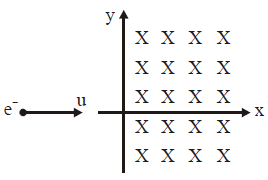
An electron moving with a speed u along the positive x-axis at y = 0 enters in a region of
uniform magnetic field \[\overrightarrow{B}=-B_{0}\hat{k}\] which exists to
the right of y-axis. The electron exits from the region after some time with speed v at coordinate
y, then :

When a charged particle moving with velocity \(\overrightarrow{v}\)is subjected to a magnetic field of induction \(\overrightarrow{B}\) , the force on it is non-zero. This implies the :
An eΘ is moving in North direction & magnetic field at this place is along upward direction then
eΘ will be deviate towards :
A uniform electric field and a uniform magnetic field are acting along the same direction in a certain region. If an electron is projected in the region such that its velocity is pointed along the direction of fields, then the electron
Since the velocity \(vec{v}\) is parallel to the magnetic field \(vec{B}\), the magnetic force is zero. The electric field exerts a force opposite to the direction of velocity on the negatively charged electron, decreasing its speed.
Which of the following charges has the maximum frequency of revolution in a uniform transverse magnetic field?
Frequency of revolution in a magnetic field is given by \(f = \frac{qB}{2\pi m}\). Since the electron has the highest charge-to-mass ratio \(q/m\) among the charged particles, it has the maximum frequency.
A particle of mass \(M\) and charge \(Q\) moving with velocity \(\vec{v}\) describes a circular path of radius \(R\) when subjected to a uniform transverse magnetic field of induction \(B\). The work done by the field when the particle completes one full circle is:
The magnetic force \(\vec{F} = Q(\vec{v} \times \vec{B})\) is always perpendicular to the velocity \(\vec{v}\). Therefore, power \(P = \vec{F} \cdot \vec{v} = 0\), meaning the work done is always zero.