Graphs of Motion - NEET Physics Questions
← Back to Kinematics

Graphs of Motion

Question 1: moderate

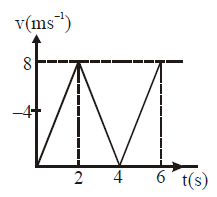
The v-t graph for a particle is as shown. The distance travelled in the first four second is
1. 12 m
2. 16 m
3. 20 m
4. 24 m
View Answer

Area bounded by v-t graph represents displacement. Here.

Area = (1/2)×4×8= 16

So, Distance travelled is 16 m.
Question 2: moderate

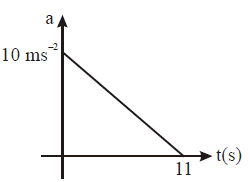
A particle starts form rest. Its acceleration (a) versus time (t) is as shown in the figure. The maximum speed of the particle will be

1. 110 ms–¹
2. 55 ms–¹
3. 550 ms–¹
4. 660 ms–¹
View Answer

Area of acceleration time graph represents change in velocity. As acceleration is always positive speed is always increasing.

Area = (1/2)× 10× 11 = 55

So, max. speed of 55 m/s

Question 3: moderate

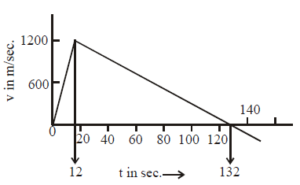
A rocket is fired upwards. Its velocity versus time graph is shown in figure. The maximum height reached by the rocket is :

1. 7.1 km
2. 79.2 km
3. 72 km
4. Infinite
View Answer
Question 4: moderate

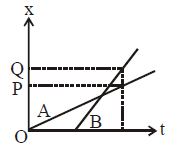
The position-time (x-t) graphs for two children A and B returning from their school O to their homes P and Q respectively are as shown in the figure. Choose the incorrect statement regarding these graphs :

1. A lives closer to the school than B
2. A starts from the school earlier than B
3. A walks faster than B
4. A and B reach home at the same time
View Answer

Slope of x-t graph represents velocity. slope is more for B so it will have higher velocity

Question 5: moderate

A car accelerates from rest at a constant rate \(\alpha\) for some time after which it decelerates at a constant rate \(\beta\) and comes to rest. If total time elapsed is t, then maximum velocity acquired by car will be:

(1994)

1. \(\frac{(\alpha^2 - \beta^2)t}{\alpha\beta}\)
2. \(\frac{(\alpha^2 + \beta^2)t}{\alpha\beta}\)
3. \(\frac{(\alpha + \beta)t}{\alpha\beta}\)
4. \(\frac{\alpha\beta t}{\alpha + \beta}\)
View Answer

Let (v_{max}) be the maximum velocity. Time to accelerate: \(t_1 = \frac{v_{max}}{\alpha}). Time to decelerate: (t_2 = \frac{v_{max}}{\beta}). Total time (t = t_1 + t_2 = \frac{v_{max}}{alpha} + \frac{v_{max}}{beta} = v_{max}\left(\frac{1}{alpha} + \frac{1}{\beta}\right) = v_{max}\left(\frac{\beta + \alpha}{\alpha\beta}\right)). Solving for \(v_{max}): (v_{max} = \frac{\alpha\beta t}{\alpha + \beta}).