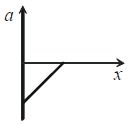
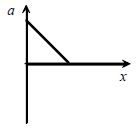
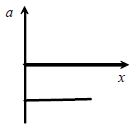
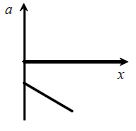
The given graph shows the variation of velocity with which one of the graph given below correctly represents the variation of acceleration with displacement :
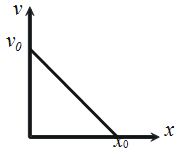
\[ a= v \frac{dv}{ds} \]
The given graph shows the variation of velocity with which one of the graph given below correctly represents the variation of acceleration with displacement :

\[ a= v \frac{dv}{ds} \]
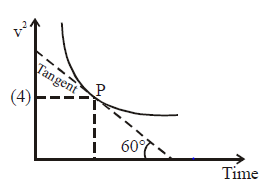
Particle moving along x-axis with variable velocity its (v²) vs. time graph is as shown in the following figure, then the acceleration of particle at point P is :

Between two stations a train first accelerates uniformly, then moves with uniform speed and finally retards uniformly. If the ratios of the time taken for acceleration, uniform speed and retarded motions are \(1 : 8 : 1\) and the maximum speed of the train is \(60\text{ km/hr}\), the average speed of the train over the whole journey is:
Let the time intervals be \(t\), \(8t\), and \(t\). Total time is \(10t\). Total distance is the area under the v-t graph: \(S = \frac{1}{2} (8t + 10t) v_{\text{max}} = 9t v_{\text{max}}\). Average speed is \(v_{\text{avg}} = \frac{9t v_{\text{max}}}{10t} = 0.9 v_{\text{max}} = 0.9 \times 60 = 54\text{ km/hr}\).