Properties of Charges - NEET Physics Questions
← Back to Electrostatics

Properties of Charges

Question 1: moderate

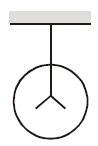
An electroscope is given a positive charge, causing its foil leaves to separate. When an object is brought near the top plate of the electrosope, the foils
separate even further. We conclude :
 

1. that the object is positively charged
2. that the object is electrically neutral
3. that the object is negatively charged
4. none of these
View Answer

The behavior of the electroscope can be explained as follows:

  • The electroscope is already positively charged, causing its foil leaves to separate due to the like charges repelling each other.
  • When the object is brought near the top plate and the foils separate even further, it indicates that more positive charge is being induced on the leaves. This happens when the object is also positively charged, as it repels positive charges towards the leaves, increasing the repulsion.

Thus, we conclude that the object is positively charged.

Question 2: moderate

Mark correct option :

1. Like charged bodies always repel each other
2. Like charged bodies always attract each other
3. Like charged bodies may attract each other
4. None of the above
View Answer

The statement "Like charged bodies may attract each other" is correct in certain situations due to charge redistribution. Here's the explanation:

  • When two like-charged bodies are brought close to each other, the distribution of charges on their surfaces may become non-uniform. This happens due to polarization effects caused by the electric fields of each body.
  • If the bodies are not perfectly conducting or have uneven shapes, the induced charge distributions may result in regions of opposite charge between the bodies, leading to localized attraction despite the overall like charges.

Thus, under specific conditions, like-charged bodies can exhibit attraction.

Question 3: moderate

Two metallic spheres of same mass are given equal and opposite charges; then :

1. the mass of positively charged sphere increases
2. the mass of both remains the same
3. the mass of negatively charged sphere increased
4. the mass of both spheres increases
View Answer

The mass of the negatively charged sphere increases because:

  • When a sphere becomes negatively charged, it gains extra electrons. Since electrons have mass (
    9.1Γ—10βˆ’31 kg9.1 \times 10^{-31} \, \text{kg}
     

    ), the addition of electrons increases the mass of the negatively charged sphere.

  • Conversely, the positively charged sphere loses electrons, resulting in a slight decrease in its mass.

Thus, the mass of the negatively charged sphere increases due to the addition of electrons.

Question 4: easy

Two metallic spheres carry equal charges. The distance between the spheres cannot be considered large in comparison with the diameters of the spheres. In which case, will the force of interaction between the spheres be greater ?

1. Like charges
2. Unlike charges
3. One is neutral and other is charged
4. None of the above
View Answer

When the two metallic spheres are close to each other, their charges induce redistribution of charges on their surfaces due to proximity. This redistribution impacts the force of interaction:

  • For like charges (both positive or both negative): The redistribution of charge reduces the repulsive force because the induced charges create opposing electric fields, weakening the overall repulsion.
  • For unlike charges (one positive, one negative): The redistribution enhances the attractive force because the induced charges increase the local electric field, strengthening the attraction.

Thus, the force of interaction is greater for unlike charges due to this enhancement caused by charge redistribution.

Question 5: moderate

Choose incorrect statement/s :

(A) In friction (method of charging), body having high work function will aquire positive charge.

(B) In conduction charge transfer takes place till potential of both bodies becomes equal.

(C) Inducing body will get opposite nature of charge.

(D) Induction is a body phenomena.

1. Only A
2. Only B
3. Both A and C
4. Both C and D
View Answer

Here’s the reasoning behind the incorrect statements A and C:

(A) Incorrect:

  • In frictional charging, the body with a lower work function (which requires less energy to remove electrons) will lose electrons and acquire a positive charge, while the one with a higher work function will gain electrons and acquire a negative charge. Thus, the statement is reversed.

(C) Incorrect:

  • In induction, the inducing body does not get an opposite charge. Instead, the induced charge on the other body is opposite in nature to the inducing charge, while the inducing body retains its original charge. Therefore, this statement is wrong.

Additional Notes:

  • (B) Correct: In conduction, charge transfer continues until both bodies achieve the same potential.
  • (D) Correct: Induction involves the rearrangement of charges within a body due to the presence of a nearby charged object. It is a property of the body itself.