Electric Potential - NEET Physics Questions
← Back to Electrostatics

Electric Potential

Question 1: difficult

Electric field at a distance x from origin is given as E = 100/x², then potential difference between points situated at x = 10 m and x = 20 m.

1. 5 V
2. 10 V
3. 15 V
4. 4 V
View Answer

The electric field \( E \) is related to the potential difference \( \Delta V \) by:

\[
\Delta V = -\int_{x_1}^{x_2} E \, dx
\]

Given \( E = \frac{100}{x^2} \), the potential difference between \( x = 10 \) m and \( x = 20 \) m is:

\[
\Delta V = -\int_{10}^{20} \frac{100}{x^2} \, dx
\]

\[
\Delta V = -\left[ \frac{100}{x} \right]_{10}^{20}
\]

\[
\Delta V = -\left( \frac{100}{20} - \frac{100}{10} \right)
\]

\[
\Delta V = -\left( 5 - 10 \right) = 5 \, \text{V}
\]

Thus, the potential difference is \( 5 \, \text{V} \).
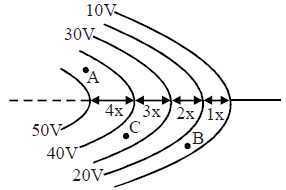
Question 2: difficult

The figure shows lines of constant potential in a region in which electric field is present. The values of the potential are written in brackets. Of the points A, B and C, the magnitude of the electric field is greatest at the point :

1. A
2. B
3. C
4. unpredictable
View Answer

Electric potential decreases in the direction of Electric Field. So Field will be maximum at A

Question 3: difficult

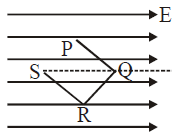
Point charge (q) moves from point (P) to point (S) along the path PQRS as shown in fig. in a uniform electric field E pointing co parallel to the positive direction of the x-axis. The co-ordinates of the points P,Q,R and S are (a, b, 0), (2a, 0, 0), (a, –b, 0) and (0, 0, 0) respectively. The work done by the field in the above process is given by the expression

1. Q E a
2. –Q E a
3. Q E a√2
4. \[ QE\sqrt{\left[ \left( 2a \right)^{2}+b^{2} \right]}\]
View Answer

Work done in a conservative field is not dependent on path taken by the object so,

\[ dV= - \overrightarrow{E}.\overrightarrow{dr}\]

\[ V= - E\widehat{i}.(-a\widehat{i}-b\widehat{j})\]

so, Potential difference = -E.a

Work Done= -Q. E.a

Question 4: difficult

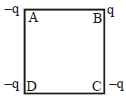
Charges are placed on the vertices of a square as shown. Let \overrightarrow{E} be the electric field and V the potential at the centre. If the charges on A and B are interchanged with those on D and C respectively, then

1. \( \overrightarrow{E}\) remains unchanged, V changes
2. Both \(\overrightarrow{E}\) and V change
3. \(\overrightarrow{E} \) and V remain unchanged
4. \(\overrightarrow{E} \)changes, V remains unchanged
View Answer

On interchanging A and B with C and D direction of electric field will get reversed. But potential being scaler quantity remains unchanged.

Question 5: difficult

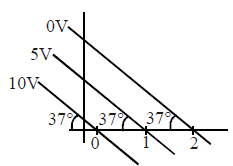
In a particular region, equipotential surfaces are spaced as shown. The electric field is :

1. \[ 5\hat{i}+5\hat{j}\]
2. \[ 5\hat{i}+\frac{20}{3}\hat{j}\]
3. \[ \frac{15}{4}\hat{i}+5\hat{j}\]
4. \[ \frac{-15}{4}\hat{i}+\frac{20}{3}\hat{j}\]
View Answer


To determine the electric field \(\vec{E}\) from the equipotential surfaces:

1. Electric Field Magnitude: The electric field is the negative gradient of the potential:
\[
|\vec{E}| = -\frac{\Delta V}{\Delta s}
\]
where \(\Delta V\) is the potential difference and \(\Delta s\) is the perpendicular spacing between equipotential surfaces.

2. Horizontal Component (\(E_x\)):
- The horizontal spacing between 0V and 10V surfaces is \(2 \, \text{units}\).
- \(E_x = -\frac{\Delta V_x}{\Delta x} = -\frac{10}{2} = -5 \, \text{V/unit}\).

3. Vertical Component (\(E_y\)):
- The vertical spacing between equipotential surfaces (tilted at \(37^\circ\)) corresponds to \(\tan 37^\circ = \frac{3}{4}\). Hence, the vertical spacing between 0V and 10V is \(2 \cdot \frac{3}{4} = 1.5 \, \text{units}\).
- \(E_y = -\frac{\Delta V_y}{\Delta y} = -\frac{10}{1.5} = -\frac{20}{3} \, \text{V/unit}\).

4. Resultant Electric Field:
\[
\vec{E} = -E_x \hat{i} - E_y \hat{j} = 5\hat{i} + \frac{20}{3}\hat{j}.
\]

Question 6: difficult

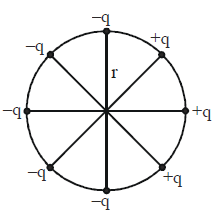
Three positive charges and five negative charges of same magnitude are arrangement as shown in the figure. The magnitude of the electric field and the electric potential at the centre of the circuit (radius r) are given by


1. \[ E=\frac{2kq}{r^{2}}(1+2\sqrt{2}),V=0\]
2. \[ E=\frac{2kq}{r^{2}}(1+\sqrt{2}),V=\frac{-2qk}{r}\]
3. \[ E=\frac{2kq}{r^{2}}(1+2\sqrt{2}),V=\frac{-2qk}{r}\]
4. None of these
View Answer

Electric Potential (\( V \)):

1. Potential at the center due to a charge \( q \) at a distance \( r \) is:
\[
V = \frac{kq}{r}.
\]

2. Total potential is the algebraic sum since potential is scalar. For 3 positive charges and 5 negative charges:
\[
V_{\text{total}} = 3 \cdot \frac{kq}{r} - 5 \cdot \frac{kq}{r} = \frac{-2kq}{r}.
\]

---

Electric Field (\( E \)):

1. Symmetry of arrangement: The charges along the diagonals cancel their horizontal components, leaving only vertical components.

2. Field due to charges along diagonals (\( -q, -q, +q, +q \)):
- Each diagonal pair creates a net field of magnitude:
\[
E_{\text{pair}} = \frac{\sqrt{2}kq}{r^2}.
\]
- Two such pairs contribute:
\[
E_{\text{diagonals}} = 2 \cdot \frac{\sqrt{2}kq}{r^2} = \frac{2\sqrt{2}kq}{r^2}.
\]

3. Field due to the remaining vertical pair (\( -q, -q \)):
- Net field:
\[
E_{\text{vertical}} = \frac{2kq}{r^2}.
\]

4. Total electric field:
\[
E_{\text{total}} = E_{\text{diagonals}} + E_{\text{vertical}} = \frac{2kq}{r^2}(1 + \sqrt{2}).
\]

---

Final Answer:
\[
E = \frac{2kq}{r^2}(1 + \sqrt{2}), \quad V = \frac{-2kq}{r}.
\]

Question 7: difficult

In a certain region of space, the potential is given by : V = k[2x² + y² – 2z]. The electric field at the point (1, 0, 1) has magnitude equal to 

1. k√5
2. 2k√5
3. 2k√3
4. 4k√3
View Answer

The electric field \(\vec{E}\) is related to the potential \(V\) by:
\[
\vec{E} = -\nabla V = -\left(\frac{\partial V}{\partial x} \hat{i} + \frac{\partial V}{\partial y} \hat{j} + \frac{\partial V}{\partial z} \hat{k}\right).
\]

Given \(V = k[2x^2 + y^2 - 2z]\):

1. Partial derivatives:
- \(\frac{\partial V}{\partial x} = 4kx\),
- \(\frac{\partial V}{\partial y} = 2ky\),
- \(\frac{\partial V}{\partial z} = -2k\).

2. Electric field components at \((1, 0, 1)\):
- \(E_x = -\frac{\partial V}{\partial x} = -4k(1) = -4k\),
- \(E_y = -\frac{\partial V}{\partial y} = -2k(0) = 0\),
- \(E_z = -\frac{\partial V}{\partial z} = -(-2k) = 2k\).

3. Magnitude of \(\vec{E}\):
\[
|\vec{E}| = \sqrt{E_x^2 + E_y^2 + E_z^2} = \sqrt{(-4k)^2 + (0)^2 + (2k)^2} = \sqrt{16k^2 + 4k^2} = \sqrt{20k^2} = 2k\sqrt{5}.
\]

Thus, the magnitude of the electric field is \(2k\sqrt{5}\).

Question 8: difficult

An electric charge 10–³ μC is placed at the origin (0, 0) of X–Y co-ordinate system. Two points A and B are situated at ( √2, √2) and (2, 0) respectively. Find the potential difference between the points A and B.

1. \[V_{A} - V_{B}=\frac{kq}{2}\]
2. \[V_{A} - V_{B}=\frac{kq}{\sqrt{2}}\]
3. \[V_{A} - V_{B}=0\]
4. \[V_{A} - V_{B}=9\times 10^{6}\]
View Answer

The potential \( V \) due to a point charge \( q \) at a distance \( r \) is given by:

\[
V = \frac{kq}{r}
\]

1. Distance from the charge at the origin:
- Point \( A(\sqrt{2}, \sqrt{2}) \): Distance \( r_A = \sqrt{(\sqrt{2})^2 + (\sqrt{2})^2} = \sqrt{4} = 2 \).
- Point \( B(2, 0) \): Distance \( r_B = \sqrt{(2)^2 + 0^2} = 2 \).

2. Potentials at \( A \) and \( B \):
\[
V_A = \frac{kq}{r_A} = \frac{kq}{2}, \quad V_B = \frac{kq}{r_B} = \frac{kq}{2}.
\]

3. Potential difference:
\[
V_A - V_B = \frac{kq}{2} - \frac{kq}{2} = 0.
\]

Thus, \( V_A - V_B = 0 \).