Electric Flux - NEET Physics Questions
Question 11: moderate

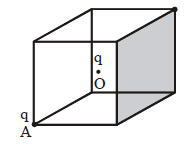
The length of each side of a cubical closed surface is l. If charge q is situated on one of the vertices of the cube, then find the flux passing through shaded face of the cube.

1. \[ \frac{q}{6\varepsilon_{0}}\]
2. \[ \frac{q}{8\varepsilon_{0}}\]
3. \[ \frac{q}{24\varepsilon_{0}}\]
4. \[ \frac{q}{\varepsilon_{0}}\]
View Answer

To find the flux through the shaded face of the cube, we use symmetry:

1. The total flux through a closed surface is given by Gauss's law:
\[
\Phi_{\text{total}} = \frac{q}{\varepsilon_0}.
\]

2. The charge \(q\) is at one vertex of the cube. It is shared equally among 8 cubes because the vertex belongs to 8 adjacent cubes. Hence, the charge effectively enclosed in one cube is:
\[
q_{\text{enclosed}} = \frac{q}{8}.
\]

3. The flux through the entire surface of one cube is:
\[
\Phi_{\text{cube}} = \frac{q_{\text{enclosed}}}{\varepsilon_0} = \frac{q}{8\varepsilon_0}.
\]

4. A cube has 6 faces, and due to symmetry, the flux through each face is the same. Therefore, the flux through one face is:
\[
\Phi_{\text{one face}} = \frac{\Phi_{\text{cube}}}{6} = \frac{q}{48\varepsilon_0}.
\]

5. The shaded face is shared by 2 adjacent cubes, so it will receive twice the flux compared to one face:
\[
\Phi_{\text{shaded face}} = 2 \times \frac{q}{48\varepsilon_0} = \frac{q}{24\varepsilon_0}.
\]

Thus, the flux through the shaded face is:

\[
\Phi = \frac{q}{24\varepsilon_0}.
\]
Question 12: difficult

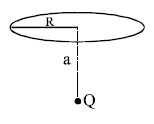
A point charge Q is located on the axis of a disc of radius R at a distance a from the plane of the disc. If one fourth (1/4th) of the flux from the charge passes through the disc, then find the relation between a & R.


1. a = R/2
2. \[ a =\frac{R}{\sqrt{3}}\]
3. a = R
4. \[ a =\frac{R}{\sqrt{2}}\]
View Answer

To solve the problem using the formula:

\[
\Phi = \frac{Q}{2\varepsilon_0} \left(1 - \cos\theta\right),
\]

where \(\theta\) is the half-angle subtended by the disc at the charge, follow these steps:

1. The flux through the disc is given to be one-fourth of the total flux:
\[
\Phi = \frac{1}{4} \cdot \frac{Q}{\varepsilon_0}.
\]

Substituting this into the formula:
\[
\frac{1}{4} \cdot \frac{Q}{\varepsilon_0} = \frac{Q}{2\varepsilon_0} \left(1 - \cos\theta\right).
\]

2. Simplify:
\[
\frac{1}{4} = \frac{1}{2} \left(1 - \cos\theta\right).
\]

3. Multiply through by 2:
\[
\frac{1}{2} = 1 - \cos\theta.
\]

4. Solve for \(\cos\theta\):
\[
\cos\theta = 1 - \frac{1}{2} = \frac{1}{2}.
\]

5. Using the geometry, \(\cos\theta = \frac{a}{\sqrt{a^2 + R^2}}\). Substituting:
\[
\frac{a}{\sqrt{a^2 + R^2}} = \frac{1}{2}.
\]

6. Square both sides:
\[
\frac{a^2}{a^2 + R^2} = \frac{1}{4}.
\]

7. Rearrange:
\[
4a^2 = a^2 + R^2.
\]

\[
3a^2 = R^2.
\]

8. Solve for \(a\):
\[
a = \frac{R}{\sqrt{3}}.
\]

Thus, the relation is:

\[
a = \frac{R}{\sqrt{3}}.
\]

Question 13: moderate

Two point charge, each of q, are kept at centre of cube O and vertex A. Find \[\phi_{e}\] from shaded face.

1. \[\frac{5q}{8\epsilon_{0}}\]
2. \[\frac{7}{24}\frac{q}{\epsilon_{0}}\]
3. \[\frac{2q}{\epsilon_{0}}\]
4. \[\frac{5}{24}\frac{q}{\epsilon_{0}}\]
View Answer

\phi= \frac{q}{6\varepsilon_{0}} + \frac{q}{24\varepsilon_{0}}= \frac{5q}{24\varepsilon_{0}}

Question 14: moderate

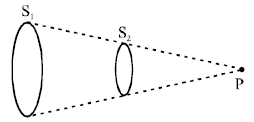
Two surfaces S1 & S2 are shown in figure. when a pt charge is placed at pt P Flux associated with S1 is Ξ¦1 & S2 is Ξ¦2. Which is correct.

1. \[\phi_{1}>\phi_{2}\]
2. \[\phi_{1}<\phi_{2}\]
3. \[\phi_{1}=\phi_{2}\]
4. can't say any thing
View Answer

As number of electric field lines passing through both the surfaces is equal electric flux associated through both of them is equal.

Question 15: moderate

If the electric field is given by \[\left( 5\hat{i}+4\hat{j}+9\hat{k} \right)\] , the electric flux through a surface of area 20 unit lying in the Y-Z plane will be :

1. 100 unit
2. 80 unit
3. 180 unit
4. 20 unit
View Answer

The area vector \( \vec{A} \) for a surface in the \( YZ \)-plane points along the \( \hat{i} \)-direction, with magnitude \( A = 20 \). Thus,
\[
\vec{A} = 20\hat{i}.
\]

The electric field is given by:
\[
\vec{E} = 5\hat{i} + 4\hat{j} + 9\hat{k}.
\]

Flux \( \Phi \) is:
\[
\Phi = \vec{E} \cdot \vec{A} = (5\hat{i} + 4\hat{j} + 9\hat{k}) \cdot 20\hat{i}.
\]

Only the \( \hat{i} \)-component contributes:
\[
\Phi = 5 \times 20 = 100 \, \text{units}.
\]

Question 16: moderate

Which of the following is sufficient condition for finding the electric flux Ξ¦ through a closed surface?

1. If the magnitude of \( \overrightarrow{E}\) is known everywhere on the surface
2. If the total charge inside the surface is specified
3. If the total charge outside the surface is specified
4. Only if the location of each point charge inside the surface is specified
View Answer

Specifying the total charge inside the surfaceΒ is a sufficient condition for finding the electric flux \( \Phi \) through a closed surface.

According to Gauss's law:
\[
\Phi = \frac{q_{\text{enclosed}}}{\varepsilon_0}
\]

The flux depends only on the enclosed charge \( q_{\text{enclosed}} \), regardless of the surface's shape or the charge distribution.

Question 17: easy

A cylinder of radius R and length L is placed in a uniform electric field E parallel to the cylinder axis. The total flux from the surface of the cylinder is:

1. \[2\pi R^{2}E\]
2. \[\pi R^{2}E\]
3. \[\left( \pi R^{2}+\pi R^{2} \right)/E\]
4. zero
View Answer

Since the electric field \( E \) is parallel to the cylinder's axis, the field lines enter and exit symmetrically through the two flat circular ends. The curved surface has no perpendicular component of the field, so no flux passes through it.

By Gauss's law, the net flux through the entire surface is:
\[
\Phi = \text{Charge enclosed} / \varepsilon_0
\]

As no charge is enclosed, \( \Phi = 0 \).

Question 18: easy

The electric flux Ξ¦ through a hemisphere surface of radius R, placed in a uniform electric field of intensity E parallel to the axis of its circular plane is:

1. \[2\pi RE\]
2. \[2\pi R^{2}E\]
3. \[\pi R^{2}E\]
4. \[\left( 4/3 \right)\pi R^{3}E\]
View Answer

The electric flux through the hemisphere is due to the uniform electric field passing perpendicularly through the circular plane of radius \( R \).

Flux through the circular plane:
\[
\Phi = E \cdot \text{Area of circular plane} = E \cdot \pi R^2
\]

Since no flux passes through the curved surface (field is parallel to it), the total flux is:
\[
\Phi = \pi R^2 E
\]

Question 19: easy

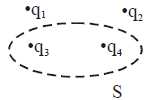
Figure shows four charges q1, q2, q3 and q4 fixed in space. Then the total flux of electric field through a closed surface S, due to all charges q1, q2, q3, and q4 is :

1. not equal to the total flux through S due to charges q3 and q4.
2. equal to the total flux through S due to charges q3 and q4.
3. zero if q1 + q2 = q3 + q4
4. twice the total flux through S due to charges q3 and q4 if q1 + q2 = q3 + q4
View Answer

Gauss's law states that the total electric flux passing through a closed surface is equal to the charge enclosed within the surface divided by the permittivity of the medium.

In short: The net electric field around a closed surface depends on the charge inside it.

Question 20: moderate

A charge \(Q\) \(mu\text{C}\) is placed at the centre of a cube. The flux coming out from any one of its faces will be (in SI unit)

1. \(\frac{Q}{6Ξ΅_0} times 10^{-3}\)
2. \( \frac{Q}{6Ξ΅_0} times 10^{-6}\)
3. \( \frac{Q}{Ξ΅_0} times 10^{-6}\)
4. \( \frac{2Q}{3Ξ΅_0} times 10^{-3}\)
View Answer

By Gauss's law, the total flux through the cube is \(\Phi = \frac{q_{\text{enclosed}}}{Ξ΅_0}\). Since the charge is at the center, the flux through one of the six faces is \(\Phi_1 = \frac{\Phi}{6} = \frac{Q \times 10^{-6}}{6Ξ΅_0}\).