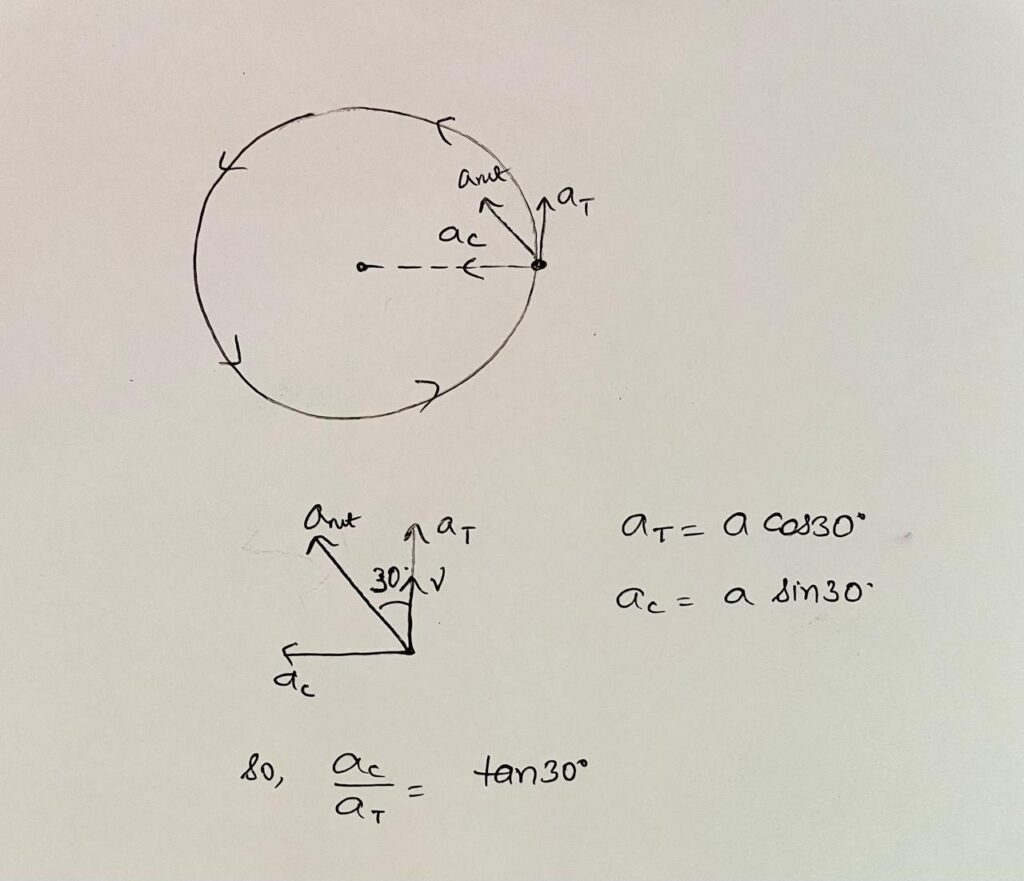
A point on the periphery of rotating disc has its acceleration vector making on angle 30° with velocity vector then the ratio of magnitude of centripetal acceleration to tangential acceleration is :
A block on a stationary horizontal table with increasing speed in a circle is seen from an inertial frame of reference. The angle between net force on the block and velocity vector is :
When net acceleration makes acute angle with velocity, speed of the particle will increase. As tangential accleration is positive, speed will increase.
A wheel is subjected to uniform angular acceleration about its axis. Initially its angular velocity is zero. In the first 2 sec, it rotates through an angle θ1; in the next 4 sec, it rotates through an additional angle θ2. The ratio of θ2/θ1 is :
For Circular motion angle traversed is θ = ω t + ½ α t²
so, θ1 =½α(2)² = 2α
and θ1 + θ2 = ½α(6)² = 18 α ⇒ θ2= 16 α
so θ2 /θ1= 8
At t = 0 a wheel is rotating at 50 rad/sec. A motor gives it a constant angular acceleration of 5 rad/sec2 until it reaches 100 rad/sec the motor is disconnected how many revolutions are completed at t = 20 sec
ω = ω 0 + α.t
⇒ 100 =50 + 5 × t
⇒ 50 = 5.t
⇒ t = 10 sec.
Angle traversed during acceleration= ½.α.t²= ½×5×(10)²= 250 rad
Angle traversed with constant angular speed = ω.t= 100 × 10 = 1000 rad
Total angle traversed = 1250 rad
Number of Revolutions = 1250 /2π= 625 /π
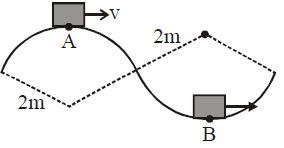
Find ratio of Normal reaction of blocks. At point A & point B respectively if their masses are same and velocities are 2 m/s & 4 m/s respectively :

Centrifugal Force act radially outwards,
So, N A = mg - mv²/R = m(10) - m(2)²/2= 8m
So, N B = mg + mv²/R = m(10) +m(4)²/2= 18m
N A : N B = 4 : 9
Two stones of masses m and 2 m are whirled in horizontal circles, the heavier one in a radius r/2 and the lighter one in radius r. The tangential speed of lighter stone is n times that of the value of heavier stone when they experience same centripetal forces. The value of n is :