Circular Motion - NEET Physics Questions
← All Chapters

Circular Motion

Question 1: moderate

A point on the periphery of rotating disc has its acceleration vector making on angle 30° with velocity vector then the ratio of magnitude of centripetal acceleration to tangential acceleration is :
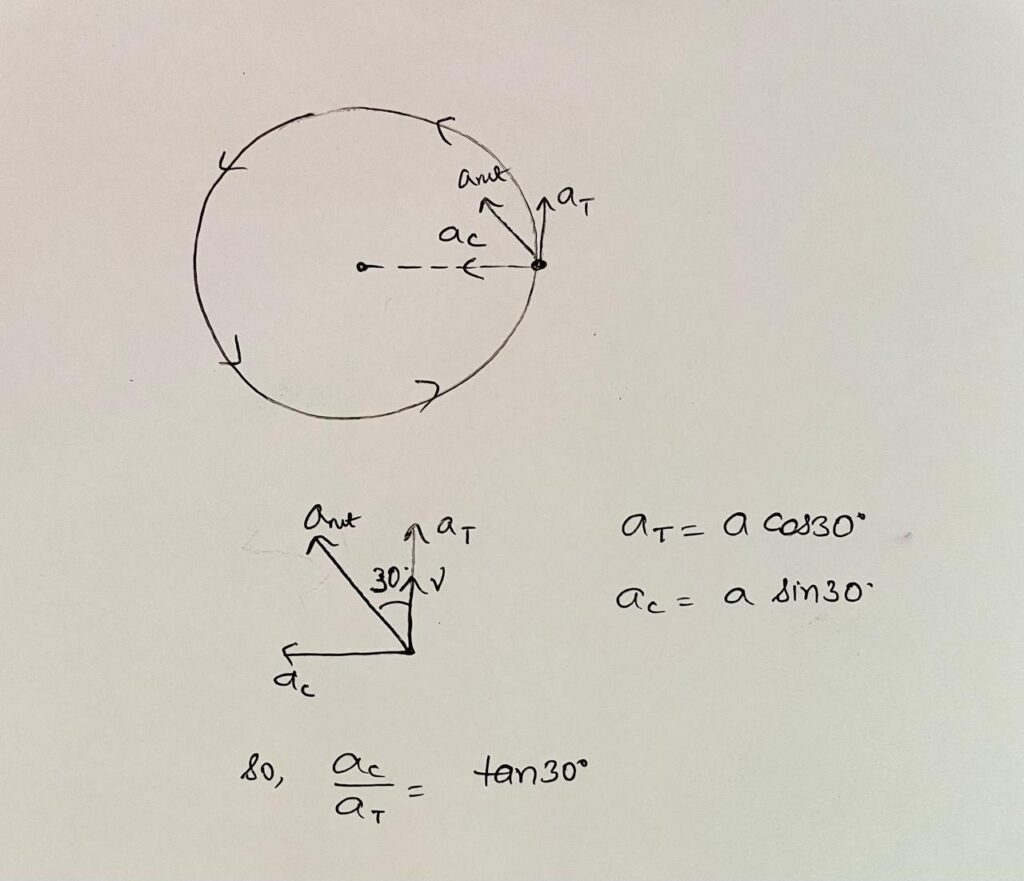
1. sin 30°
2. cos 30°
3. tan 30°
4. None of these
View Answer
Question 2: easy

A stone is moved round a horizontal circle with a 20 cm long string tied to If centripetal acceleration is 9.8 m/s2, then its angular velocity will be :

1. 7 rad/s
2. 22/7 rad/s
3. 49 rad/s
4. 14 rad/s
View Answer

Centripetal Acceleration is given by a= ω²R

⇒ 9.8 = ω²× 1/5

⇒ ω² =49

⇒ ω = 7 rad/sec

Question 3: moderate

A block on a stationary horizontal table with increasing speed in a circle is seen from an inertial frame of reference. The angle between net force on the block and velocity vector is :

1. Greater than 90°
2. Less than 90°
3. Equal to 90°
4. Data is insufficient
View Answer

When net acceleration makes acute angle with velocity, speed of the particle will increase. As tangential accleration is positive, speed will increase.

Question 4: moderate

A wheel is subjected to uniform angular acceleration about its axis. Initially its angular velocity is zero.  In the first 2 sec, it rotates through an angle θ1; in the next 4 sec, it rotates through an additional angle θ2. The ratio of θ21 is :

1. 9
2. 2
3. 3
4. 8
View Answer

For Circular motion angle traversed is θ = ω t + ½ α t²

so, θ1   =½α(2)² = 2α

and θ1 + θ2 = ½α(6)² = 18 α ⇒ θ2= 16 α

so θ21= 8

Question 5: easy

A wheel having diameter of 3 m starts from rest and accelerates uniformly to an angular velocity of 210 rpm in 5 seconds. Angular acceleration of the wheel is :

1. 1.4π rad/s²
2. 3.3π rad/s²
3. 2.2π rad/s²
4. 1.1π rad/s²
View Answer

ω = ω + α . t 

⇒(210 × 2π)/60 = 0 + α × 5 

⇒ α = 1.4 π rad/sec ²

Question 6: easy

The angular velocity of earth about its axis of rotation is :

1. 2π/(60×60×24) rad/sec
2. 2π/(60×60) rad/sec
3. 2π/60 rad/sec
4. 2π/(365×24×60×60) rad/sec
View Answer

Angular speed ω = 2π / T = 2π / (60×60×24) rad /sec 

Question 7: easy

Two bodies of masses 10 kg and 5 kg moving on concentric orbits of radii R and r such that their period of revolution are same. The ratio of their centripetal acceleration is :

1. R/r
2. r/R
3. R²/r²
4. r²/R²
View Answer

As time period of revolution is same for both the particles angular speed will be equal for both.

Centripetal Acceleration is given by ω²r.

so a 1 / a 2 = R/r

Question 8: easy

A stone of mass m is tied to a string of length l and rotated in a circle with a constant speed v. If the string is released, the stone flies :

1. radially outward
2. radially inward
3. tangentially
4. with an acceleration mv2/l
View Answer

In Circular motion velocity of the particle is always directed along tangent. So when string is released object moves tangentially.

Question 9: easy

A car has to move on a level turn of radius (R = 50m). If the coefficient of static friction between tyre and road is µ = 0.2. Find the maximum speed the car can take without skidding is given by :

1. 20 m/s
2. 10 m/s
3. 9.39 m/s
4. 25 m/s
View Answer

For safe turning on a horizontal road.

μ = v²/ rg ⇒ v= (μ rg ) 1/2

v = (0.2 × 50 × 10 ) 1/2 = 10 m/s

Question 10: easy

A coin placed on a rotating turntable just slips if it is placed at a distance of 4 cm from the If the angular velocity of the turntable is doubled, it will just slip at a distance of :

1. 1 cm
2. 2 cm
3. 4 cm
4. 8 cm
View Answer

F= mω²r

As the distance will increase centrifugal force acting on the object will also increase. As slipping starts at 4 cm object will not slip at radius smaller than 4cm.