Dynamics of Circular Motion - NEET Physics Questions
← Back to Circular Motion

Dynamics of Circular Motion

Question 1: easy

Two bodies of masses 10 kg and 5 kg moving on concentric orbits of radii R and r such that their period of revolution are same. The ratio of their centripetal acceleration is :

1. R/r
2. r/R
3. R²/r²
4. r²/R²
View Answer

As time period of revolution is same for both the particles angular speed will be equal for both.

Centripetal Acceleration is given by ω²r.

so a 1 / a 2 = R/r
Question 2: easy

A car has to move on a level turn of radius (R = 50m). If the coefficient of static friction between tyre and road is µ = 0.2. Find the maximum speed the car can take without skidding is given by :

1. 20 m/s
2. 10 m/s
3. 9.39 m/s
4. 25 m/s
View Answer

For safe turning on a horizontal road.

μ = v²/ rg ⇒ v= (μ rg ) 1/2

v = (0.2 × 50 × 10 ) 1/2 = 10 m/s

Question 3: easy

A coin placed on a rotating turntable just slips if it is placed at a distance of 4 cm from the If the angular velocity of the turntable is doubled, it will just slip at a distance of :

1. 1 cm
2. 2 cm
3. 4 cm
4. 8 cm
View Answer

F= mω²r

As the distance will increase centrifugal force acting on the object will also increase. As slipping starts at 4 cm object will not slip at radius smaller than 4cm.

Question 4: easy

A stone of mass 1 kg tied to one end of a string 1.0 m long is revolved in a horizontal circle at the rate of 10/π revolution per second. Calculate the tension of the string ?

1. 300 N
2. 400 N
3. 500 N
4. 600 N
View Answer

Tension force in the string will provide required centripetal force

T = mω²r= 1× (10/π ×2π)²×1= 400 N

Question 5: easy

A store of mass 5 kg is tied to a string of length 10 m is whirled round in a horizontal circle. What is the maximum speed with which the stone can be whirled around if the string can withstand a maximum tension of 200 N :

1. 10 m/s
2. 15 m/s
3. 20 m/s
4. 25 m/s
View Answer

Tension force will provide required centripetal force so,

T = mv²/r

⇒ 200 = 5 v²/10 ⇒ v² = 400 ⇒ v =20 m/s

Question 6: easy

A cyclist is moving with speeding up itself in a circular track then work done by net force on cyclist will be :

1. Greater than zero
2. Less than zero
3. Zero (0)
4. Data insufficient
View Answer

As the speed of cyclist is increasing positive tangential acceleration is acting on the object. so net acceleration makes an acute angle with velocity.

As, net acceleration and net force will have same direction, angle between velocity and net force is acute. Work done will be positive.

Question 7: moderate

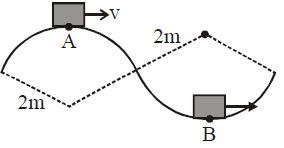
Find ratio of Normal reaction of blocks. At point A & point B respectively if their masses are same and velocities are 2 m/s & 4 m/s respectively :

1. 4/9
2. 9/4
3. 2/9
4. 2/7
View Answer

Centrifugal Force act radially outwards,

So, N A = mg - mv²/R = m(10) - m(2)²/2= 8m

So, N B = mg + mv²/R = m(10) +m(4)²/2= 18m

N A : N B = 4 : 9

Question 8: moderate

Two stones of masses m and 2 m are whirled in horizontal circles, the heavier one in a radius r/2 and the lighter one in radius r. The tangential speed of lighter stone is n times that of the value of heavier stone when they experience same centripetal forces. The value of n is :

1. 1
2. 2
3. 3
4. 4
View Answer

m(nω)²×r = 2m(ω)² ×(r/2)

so, n =1

Question 9: easy

A particle moves in a circle of radius 5 m with constant speed and time period 2π s. The acceleration of the particle is :

1. 15 m/s²
2. 25 m/s²
3. 36 m/s²
4. 5 m/s²
View Answer

As speed of the particle is constant only centripetal acceleration will act on the object.

Centripetal Acceleration = ω²R

a c = (2π/2π)× 5= 5 m/s² 

Question 10: difficult

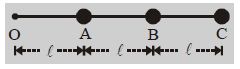
Three identical particles are joined together by a thread as shown in figure. All the three particles are moving in a horizontal plane. If the velocity of the outermost particle is v0, then the ratio of tensions in the three sections of the string is :

1. 3 : 5 : 7
2. 3 : 4 : 5
3. 7 : 11 : 6
4. 3 : 5 : 6
View Answer

T c = mω²(3l)= 3mω²

T B = mω²(2l) + T c = 5mω²l
T A = mω²(l) + T B = 6mω²l
So,
T C : T B : T A = 3:5:6