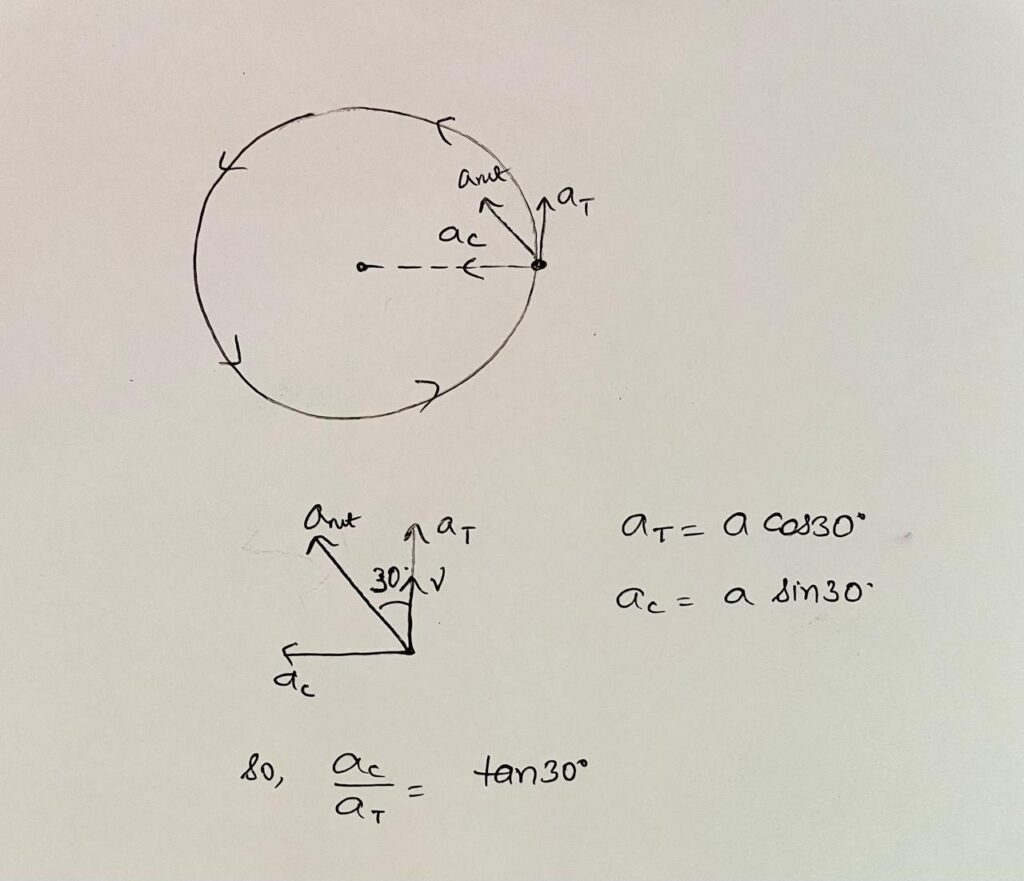
A point on the periphery of rotating disc has its acceleration vector making on angle 30° with velocity vector then the ratio of magnitude of centripetal acceleration to tangential acceleration is :
A stone is moved round a horizontal circle with a 20 cm long string tied to If centripetal acceleration is 9.8 m/s2, then its angular velocity will be :
Centripetal Acceleration is given by a= ω²R
⇒ 9.8 = ω²× 1/5
⇒ ω² =49
⇒ ω = 7 rad/sec
A block on a stationary horizontal table with increasing speed in a circle is seen from an inertial frame of reference. The angle between net force on the block and velocity vector is :
When net acceleration makes acute angle with velocity, speed of the particle will increase. As tangential accleration is positive, speed will increase.
A wheel is subjected to uniform angular acceleration about its axis. Initially its angular velocity is zero. In the first 2 sec, it rotates through an angle θ1; in the next 4 sec, it rotates through an additional angle θ2. The ratio of θ2/θ1 is :
For Circular motion angle traversed is θ = ω t + ½ α t²
so, θ1 =½α(2)² = 2α
and θ1 + θ2 = ½α(6)² = 18 α ⇒ θ2= 16 α
so θ2 /θ1= 8
A wheel having diameter of 3 m starts from rest and accelerates uniformly to an angular velocity of 210 rpm in 5 seconds. Angular acceleration of the wheel is :
The angular velocity of earth about its axis of rotation is :
Angular speed ω = 2π / T = 2π / (60×60×24) rad /sec
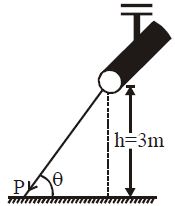
A spot light S rotates in a horizontal plane with a constant angular velocity of 0.1 rad/s. The spot of light P moves along the wall at a distance of 3 m. The velocity of spot P when θ = 45° is :-
At t = 0 a wheel is rotating at 50 rad/sec. A motor gives it a constant angular acceleration of 5 rad/sec2 until it reaches 100 rad/sec the motor is disconnected how many revolutions are completed at t = 20 sec
ω = ω 0 + α.t
⇒ 100 =50 + 5 × t
⇒ 50 = 5.t
⇒ t = 10 sec.
Angle traversed during acceleration= ½.α.t²= ½×5×(10)²= 250 rad
Angle traversed with constant angular speed = ω.t= 100 × 10 = 1000 rad
Total angle traversed = 1250 rad
Number of Revolutions = 1250 /2π= 625 /π
A particle is executing uniform circular motion with velocity \(\vec{v}\) and acceleration \(\vec{a}\). Which of the following is true?
In uniform circular motion, the magnitudes of velocity and centripetal acceleration are constant, but their directions continuously change as the particle moves along the circle. Thus, both vector quantities are non-constant.
A particle moves in a circular path so that its distance travel varies with time \(t\) as \(s = 3t^2 + 6t\). Then its acceleration at \(t = 1\text{ sec.}\) is (radius of path is \(12\text{ m}\)) –
Speed is \(v = \frac{ds}{dt} = 6t + 6\). At \(t = 1\text{ s}\), \(v = 12\text{ m/s}\). Tangential acceleration is \(a_t = \frac{dv}{dt} = 6\text{ m/s}^2\). Centripetal acceleration is \(a_c = \frac{v^2}{R} = \frac{12^2}{12} = 12\text{ m/s}^2\). Total acceleration is \(a = \sqrt{a_t^2 + a_c^2} = \sqrt{6^2 + 12^2} = 6\sqrt{5}\text{ m/s}^2\).