Circular Motion - NEET Physics Questions
← All Chapters

Circular Motion

Question 11: easy

A stone of mass 1 kg tied to one end of a string 1.0 m long is revolved in a horizontal circle at the rate of 10/π revolution per second. Calculate the tension of the string ?

1. 300 N
2. 400 N
3. 500 N
4. 600 N
View Answer

Tension force in the string will provide required centripetal force

T = mω²r= 1× (10/π ×2π)²×1= 400 N
Question 12: difficult

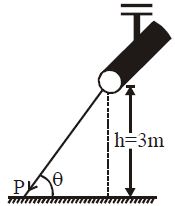
A spot light S rotates in a horizontal plane with a constant angular velocity of 0.1 rad/s. The spot of light P moves along the wall at a distance of 3 m. The velocity of spot P when θ = 45° is :-

1. 0.2 m/s
2. 0.3 m/s
3. 0.6 m/s
4. 0.8 m/s
View Answer
Question 13: easy

A store of mass 5 kg is tied to a string of length 10 m is whirled round in a horizontal circle. What is the maximum speed with which the stone can be whirled around if the string can withstand a maximum tension of 200 N :

1. 10 m/s
2. 15 m/s
3. 20 m/s
4. 25 m/s
View Answer

Tension force will provide required centripetal force so,

T = mv²/r

⇒ 200 = 5 v²/10 ⇒ v² = 400 ⇒ v =20 m/s

Question 14: moderate

At t = 0 a wheel is rotating at 50 rad/sec. A motor gives it a constant angular acceleration of 5 rad/sec2 until it reaches 100 rad/sec the motor is disconnected how many revolutions are completed at t = 20 sec 

1. 1250
2. 625
3. 625/π
4. 875/π
View Answer

ω = ω 0 + α.t

⇒ 100 =50 + 5 × t

⇒ 50 = 5.t

⇒ t = 10 sec.

Angle traversed during acceleration= ½.α.t²= ½×5×(10)²= 250 rad

Angle traversed with constant angular speed = ω.t= 100 × 10 = 1000 rad

Total angle traversed = 1250 rad 

Number of Revolutions = 1250 /2π= 625 /π 

Question 15: easy

A cyclist is moving with speeding up itself in a circular track then work done by net force on cyclist will be :

1. Greater than zero
2. Less than zero
3. Zero (0)
4. Data insufficient
View Answer

As the speed of cyclist is increasing positive tangential acceleration is acting on the object. so net acceleration makes an acute angle with velocity.

As, net acceleration and net force will have same direction, angle between velocity and net force is acute. Work done will be positive.

Question 16: moderate

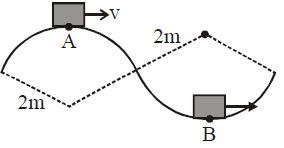
Find ratio of Normal reaction of blocks. At point A & point B respectively if their masses are same and velocities are 2 m/s & 4 m/s respectively :

1. 4/9
2. 9/4
3. 2/9
4. 2/7
View Answer

Centrifugal Force act radially outwards,

So, N A = mg - mv²/R = m(10) - m(2)²/2= 8m

So, N B = mg + mv²/R = m(10) +m(4)²/2= 18m

N A : N B = 4 : 9

Question 17: moderate

Two stones of masses m and 2 m are whirled in horizontal circles, the heavier one in a radius r/2 and the lighter one in radius r. The tangential speed of lighter stone is n times that of the value of heavier stone when they experience same centripetal forces. The value of n is :

1. 1
2. 2
3. 3
4. 4
View Answer

m(nω)²×r = 2m(ω)² ×(r/2)

so, n =1

Question 18: easy

A particle moves in a circle of radius 5 m with constant speed and time period 2π s. The acceleration of the particle is :

1. 15 m/s²
2. 25 m/s²
3. 36 m/s²
4. 5 m/s²
View Answer

As speed of the particle is constant only centripetal acceleration will act on the object.

Centripetal Acceleration = ω²R

a c = (2π/2π)× 5= 5 m/s² 

Question 19: difficult

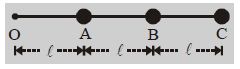
Three identical particles are joined together by a thread as shown in figure. All the three particles are moving in a horizontal plane. If the velocity of the outermost particle is v0, then the ratio of tensions in the three sections of the string is :

1. 3 : 5 : 7
2. 3 : 4 : 5
3. 7 : 11 : 6
4. 3 : 5 : 6
View Answer

T c = mω²(3l)= 3mω²

T B = mω²(2l) + T c = 5mω²l
T A = mω²(l) + T B = 6mω²l
So,
T C : T B : T A = 3:5:6

Question 20: easy

The maximum speed of car with which it can go around a level road of radius 10 m is (coefficient of friction between the road and tyre is 0.5)
(g = 9.8 m/s²)

1. √19 m/s
2. √29 m/s
3. √39 m/s
4. √49 m/s
View Answer

The maximum speed on a level road is limited by static friction: u=v²/rg

Given μs​=0.5, g=9.8m/s², and r=10m.

Substituting these values: V²max​=(0.5)(9.8)(10)​= 49 ​= 7m/s.

Therefore, the maximum speed is 7 m/s.