Question 1:
moderate
Match the following and choose the correct option from given codes :
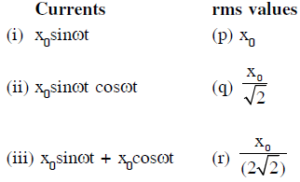
Match the following and choose the correct option from given codes :
The current in a circuit varies with time as I = 2 √t . Then the rms value of the current for the interval t = 2 to t = 4 sec is
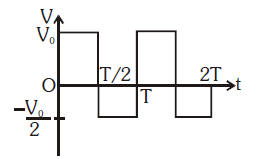
The r.m.s. value of potential difference V shown in the figure is :-
A square wave current switching rapidly between \(+0.5\) ampere and \(-0.5\) ampere is passed through an A.C ammeter. Then the reading shown by it, is
An AC ammeter measures the RMS value of the current. For a symmetric square wave of amplitude \(I_0\), the RMS value is equal to its peak value, \(I_{rms} = I_0 = 0.5\text{ A}\).
The peak value of the alternating current given by \(I = 4 \sin\omega t + 4 \sin(\omega t + 2\pi/3)\) is:
The two currents can be vectorially added with phase difference \(\phi = 2\pi/3 = 120^\circ\). Resultant amplitude is \(I_0 = \sqrt{4^2 + 4^2 + 2 \times 4 \times 4 \cos 120^\circ} = 4\).
The peak voltage of the AC source is equal to
For a sinusoidal AC voltage source, the relation between peak voltage \(V_0\) and root-mean-square voltage \(V_{\text{rms}}\) is \(V_0 = \sqrt{2}V_{\text{rms}}\).
Assertion (A): The moving coil ammeters or voltmeters can’t be employed to measure alternating current or voltage respectively.
Reason (R): If an alternating current is passed through a moving coil ammeter or voltmeter, then the average value of torque experienced by the coil is zero.
Moving coil instruments measure the average value of current. For AC, the average value over a full cycle is zero, resulting in zero average torque. Hence, moving coil ammeters/voltmeters cannot measure AC. Both assertion and reason are true, and the reason correctly explains the assertion.
Assertion (A): \(220V\), \(50 \text{ Hz}\) appliance implies that potential difference in bulb is always \(220V\).
Reason (R): Every appliance is specified with its peak tolerable voltage.
\(220V\) AC represents the RMS voltage, not the instantaneous or peak voltage. The instantaneous voltage varies sinusoidally, reaching a peak of \(V_{\text{peak}} = V_{\text{RMS}} \sqrt{2} = 220 \sqrt{2} \approx 311 \text{V}\). So, Assertion (A) is false. Appliances are usually specified by their RMS operating voltage, not peak tolerable voltage. So, Reason (R) is false. Both assertion and reason are false.
Assertion (A): Transformer does not work on \( \text{dc} \).
Reason (R): \( \text{dc} \) neither changes in magnitude nor in direction.
Transformers operate on the principle of mutual induction, requiring a changing magnetic flux. \( text{dc} \) current produces a constant magnetic field, thus no change in flux and no induced EMF. Hence, (A) is true. \( text{dc} \) current indeed has constant magnitude and direction, so (R) is also true and correctly explains (A).
Assertion (A): The divisions are equally marked on the scale of \( \text{ac} \) ammeter.
Reason (R): Heat produced is directly proportional to the current.
\( \text{ac} \) ammeters (hot wire type) measure current based on the heating effect, where heat produced is \( H \propto I^2 \). This quadratic relationship results in a non-linear scale, not equally marked. Thus (A) is false. Heat produced is proportional to the square of the current, not directly, so (R) is also false.