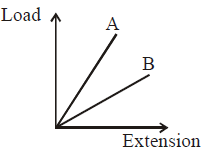
Given below are two statements:
Assertion (A): Young’s modulus for a perfectly plastic body is zero.
Reason (R): For a perfectly plastic body, restoring force is zero.
1. Both (A) and (R) are true and (R) is the correct explanation of (A).
2. Both (A) and (R) are true but (R) is not the correct explanation of (A).
3. (A) is true but (R) is false.
4. Both (A) and (R) are false.
View Answer
For a perfectly plastic body, there is no tendency to regain its shape, meaning the restoring force (and thus stress) is zero. Since Young's modulus \(Y = \frac{\text{stress}}{\text{strain}}\), it is also zero. Both statements are true and Reason is the correct explanation.
Young’s modulus of rubber is \(10^4\text{ N/m}^2\) and area of cross-section is \(2\text{ cm}^2\). If force of \(2 \times 10^5\text{ dynes}\) is applied along its length, then length of wire becomes how much times of its initial length \(L\):- (Assume stress \(\propto\) strain)
1. three times
2. four times
3. two times
4. No change in length
View Answer
Converting Young's modulus to CGS units gives \(Y = 10^5\text{ dyne/cm}^2\). Stress is \(F/A = 2 \times 10^5 / 2 = 10^5\text{ dyne/cm}^2\). Since \(\text{Strain} = \text{Stress}/Y = 1\), we have \(\Delta L = L\). Thus, the final length becomes \(L + \Delta L = 2L\).
A metal block is experiencing an atmospheric pressure of \(1 \times 10^5\text{ N/m}^2\). When the same block is placed in a vacuum chamber, the fractional change in its volume is (the bulk modulus of metal is \(1.25 \times 10^{11}\text{ N/m}^2\))
1. \(4 \times 10^{-7}\)
2. \(2 \times 10^{-7}\)
3. \(8 \times 10^{-7}\)
4. \(1 \times 10^{-7}\)
View Answer
The bulk modulus is defined as \(B = \frac{\Delta P}{\Delta V/V}\). Moving to vacuum causes a pressure change of \(\Delta P = 10^5\text{ N/m}^2\). Thus, the fractional volume change is \(\frac{\Delta V}{V} = \frac{\Delta P}{B} = \frac{10^5}{1.25 \times 10^{11}} = 8 \times 10^{-7}\).
When the load on a wire is increased from \(3\text{ kg wt}\) to \(5\text{ kg wt}\) the elongation increases from \(0.61\text{ mm}\) to \(1.02\text{ mm}\). The required work done during the extension of the wire is :
1. \(16 \times 10^{-3}\text{ J}\)
2. \(8 \times 10^{-2}\text{ J}\)
3. \(20 \times 10^{-2}\text{ J}\)
4. \(11 \times 10^{-3}\text{ J}\)
View Answer
The work done during the extension is \(W = \frac{1}{2} (F_2 x_2 - F_1 x_1)\). Converting values: \(F_1 = 3 \times 9.8\text{ N}\), \(F_2 = 5 \times 9.8\text{ N}\), \(x_1 = 0.61 \times 10^{-3}\text{ m}\), and \(x_2 = 1.02 \times 10^{-3}\text{ m}\) yields \(W \approx 16 \times 10^{-3}\text{ J}\).