Young’s modulus of the material of a wire of length ‘L’ and radius ‘r’ in ‘Y’ \[N/m^{2}\]. If the length in reduced to L/2 and radius to r/2, the Young modulus will be :
The load versus elongation graph for four wires of the same material is shown in the figure. The thickest wire is represented by the line :

The stress versus strain graphs for wires of two materials A and B are as shown in the figure. If \[Y_{A}andY_{B}\] are the Young’s modulus of the materials then :

A wire suspended vertically from one of its ends is stretched by attaching a weight of 200 N to the lower end. The weight stretches the wire by 1mm, then elastic energy stored in wire is :
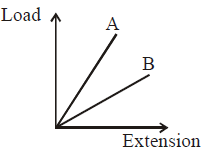
The dimensions of two wires A and B are same but their materials are different. Their load extension graphs are shown if \[y_{A} and y_{B}\] are the values of young’s modulus of elasticity of ‘A and ‘B’ respectively then :

Two unequal soap bubbles are formed one on each side of a tube closed in the middle by a tap. What happens when the tap is opened to put the two bubbles in communication ?
The radii of the two columns in U tube are r1 and r2 (r1 > r2). When a liquid of density \[\rho\] (angle of contact is 0ΒΊ) is filled in it, the level difference of liquid in two arms is h. The surface tension of liquid is (g = acceleration due to gravity):
If force of cohesion of liquid is three times the force of adhesion between liquid and glass tube molecules, then the shape of meniscus of liquid in this glass tube is:
A water tank of height 10 m, completely filled with water is placed on a level ground. It has two holes one at 3 m and the other at 7 m from its base. The water ejecting from :
A cubical box of wood of side 30 cm weighing 21.6 kg floats on water with two faces horizontal. Calculate the depth of immersion of wood.