Solid and Fluids - NEET Physics Questions
← All Chapters

Solid and Fluids

Question 1: difficult

The interatomic distance for a metal is

\[3.6\times 10^{-10}m\].

If the interatomic force constant is

\[3.6\times 10^{-9}\]

N/Å then the young’s modulus in

\[N/m^{2}\]

will be :

1. \[1.2\times 10^{11}\]
2. \[4.2\times 10^{11}\]
3. \[10.8\times 10^{8}\]
4. \[2.4\times 10^{10}\]
View Answer
Question 2: difficult

A cylindrical piece of cork of density \[\rho\] of base area A and height h floats in a liquid of density \[\rho\acute{}\]. The cork is slightly depressed and then released. The time period of oscillation of the cork is :

1. \[\pi\sqrt{\frac{g\rho\acute{}}{g\rho}}\]
2. \[\pi\sqrt{\frac{h\rho}{g\rho\acute{}}}\]
3. \[2\pi\sqrt{\frac{h\rho\acute{}}{g\rho}}\]
4. \[2\pi\sqrt{\frac{h\rho}{g\rho\acute{}}}\]
View Answer
Question 3: difficult

A capillary tube of length L and radius R is joined to another tube of length L/3 and radius R/2 . A fluid is flowing through this tube. If the pressure difference across the first tube is P, then the pressure difference across the second tube is :

1. 16P/3
2. 4P/3
3. P
4. 3P/16
View Answer
Question 4: difficult

Two non-mixing liquids of densities \[\rho\] and \[n\rho(n>1)\] are put in a container. The height of each liquid is h. A solid cylinder of length L and density d is put in this container. The cylinder floats with its axis vertical and length pL(p < 1) in the denser liquid. The density d is equal to :

1. \[\left\{ {1+(n+1)p} \right\}\rho\]
2. \[\left\{ {2+(n+1)p} \right\}\rho\]
3. \[\left\{ {2+(n-1)p} \right\}\rho\]
4. \[\left\{ {1+(n-1)p} \right\}\rho\]
View Answer
Question 5: difficult

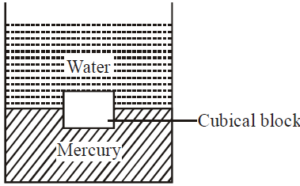
A tank contains water on top of mercury as shown in figure. A cubical block of side 10 cm is in equilibrium inside the tank. The depth of the block inside mercury is (RD of the material of block = 8.56, RD of mercury = 13.6)

1. 6 cm
2. 5 cm
3. 7 cm
4. 8 cm
View Answer
Question 6: difficult

A wind with speed 40 m/s blows parallel to the roof of a house. The area of the roof is 250 m2. Assuming that the pressure inside the house is atmospheric pressure, the force exerted by the wind on the roof and the direction of the force will be: \[(\rho_{air}=1.2 kg/m^{3})\]

1. \[4.8\times 10^{5} N, upwards\]
2. \[2.4\times 10^{5} N, upwards\]
3. \[2.4\times 10^{5} N, downwards\]
4. \[4.8\times 10^{5} N, downwards\]
View Answer

Here is the short, step-by-step solution for your WordPress post:

Solution:

According to Bernoulli's principle, the high-speed wind blowing outside creates a low-pressure region ($P_{out}$) above the roof compared to the atmospheric pressure ($P_{in}$) inside.

$$\Delta P = P_{in} - P_{out} = \frac{1}{2}\rho v^2$$

Substituting the given values, the upward lifting force exerted on the roof is:

$$F = \Delta P \times A = \left(\frac{1}{2} \times 1.2 \times 40^2\right) \times 250 = 2.4 \times 10^5\text{ N (upwards)}$$

Correct Option: Option 2 ($2.4\times 10^{5}\text{ N, upwards}$)